

Editor’s note: This story was written before a ceasefire took effect in the Gaza Strip.
During the war, Gazans have taken refuge in the most unlikely places: on the streets, on cliffs, on the beach, in mosques, gyms, hospitals, and schools — but the Allouh family never imagined they would be living among the dead.
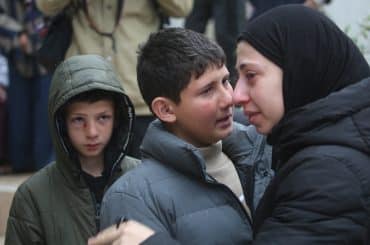
And yet, for the past year, 14 family members have been staying in tents in Ansar cemetery in western Deir al-Balah surrounded by hundreds of graves, a small, rank-smelling, and frightening space.
The Allouhs evacuated eastern Deir al-Balah on October 7, 2023, fleeing to escape certain death. Israeli forces bombed their house that same month. For the entirety of the war, this area closer to Israel remained off-limits for Palestinians.
Suffering through multiple displacements as the war raged on, Ahmad, 32, his wife Nada, 33, their children and extended family found themselves in limbo. With no place to call their own or acquaintances to ask for help, the family scattered — the women and children managed to find some space in crowded schools that had turned into refuges for the displaced, while the men were left to wander the streets of western Deir al-Balah.
“I was walking and searching for any empty spot to sleep,” said Ahmad, who, like everyone in the family who spoke to Mondoweiss for this article, requested to use a pseudonym. “I went into the cemetery to rest, and I don’t know how I found myself the next morning sleeping there on the cold marble of a grave!”
After spending a night sleeping alone in Ansar cemetery without encountering anything scary, Ahmad felt encouraged to spend more time there. Finally, he had found somewhere to take shelter in.

‘We are as dead as the ones beneath the graves’
Ansar cemetery is one of the major cemeteries in Deir al-Balah, home to some 50,000 graves across 3.5 hectares (8.6 acres). The cemetery has been in use until recently, when it ran out of space to bury the dead amid the relentless bloodshed of the war, forcing Palestinians to bury martyrs on top of one another.
Ahmad wished to be reunited with his family, including his parents Ali and Amna, his wife Nada, children, sisters, and brothers. But it was no easy feat to convince them to move to Ansar cemetery. They all refused out of fear, but Ahmad didn’t give up.
He began bringing his children to the graveyard during the daytime, letting them play and get used to this unusual environment.
“This life doesn’t deserve to be called life for us, it’s unfair. We are as dead as the ones beneath the graves, but they are only bones; there is nothing to be afraid of.” This is what Nada remembered her husband telling her to persuade her to come along.
Eventually, the family decided that anything was preferable to remaining torn apart. They spoke with several sheikhs, or religious leaders, who confirmed that, despite the general prohibition in Islam against living in a cemetery, it was permissible due to the exceptional circumstances and the family’s hardships.
When the family moved in, they set up their tents in the narrow spaces between gravestones. However, the crowded cemetery made it impossible for them to avoid the tombs altogether, although they avoided more recent burial spaces.
“I sleep on a baby’s grave; it’s under my pillow because there is no other space for me in the tent!”, Ahmad said. His and his brother’s tents are each set up above two graves, while the Allouhs’ other tents only cover one grave each.
The first weeks were difficult. Both women and children couldn’t sleep at night, screaming and having panic attacks whenever they heard the sound of stray dogs roaming through the graveyard.
Ahmad had to dig a hole for the family to set up a septic tank — an unforgettable and unsettling experience.
“Every time I dug deep into the ground, I found either bones or corpses of dead people; it seemed that there were old graves that had lost their gravestones. I had to do it several times to finally find an empty hole for my bathroom,” Ahmad recalled.
A moldy smell permeates their plastic tents, forcing them to spend most of their time outside, exposed to visitors’ gaze as if they were in a zoo. The lack of privacy is further compounded by people coming to visit the tombs of their relatives buried where the Allouh family’s tents are set up. Mourning relatives come frequently, asking to be left alone in the tent to grieve.
The family squeezes all their daily tasks — cooking on the fire, washing the dishes, and doing the laundry by hand — in the narrow alleys between tombs.
“Imagine yourself washing the dishes when men suddenly bring a dead body and start digging to bury it just next to you while you are working and watching calmly,” said Aya, Ahmad’s sister-in-law, describing a situation she witnessed herself.
A controversial refuge
The family’s decision to relocate to the cemetery has caused controversy among many fellow displaced Palestinians.
“A word can either warm your heart or shed your tears,” said Amna, Ahmad’s mother. The family faces two kinds of visitors to the cemetery. The sympathetic ones support them with warm words, looks, and prayers, wishing them a better life and expressing understanding for their decision to live in such a place.
However, most people are shocked by their living situation and react aggressively, the family said. Some relatives of those buried in the graves near or close to the tents have ordered the Allouhs to keep the graves and their surroundings clean at all times, even if they didn’t cause the mess there, and have forbidden them from coming any closer to them, not even to sit. They also sometimes shout and threaten to throw the family out of the cemetery if they don’t obey their orders.
Whenever the Allouh family thinks about their life and the ancestors beneath them, it hurts them too.
“We feel dead just like our ancestors because our lives lack the necessities to live decently,” Ahmad said. “The only difference is that our forebears are under the ground, and we are above it.”
The Allouh family had been waiting on tenterhooks for the announcement of the ceasefire on January 19, with the hope that they could soon return to their bombed-out house.
Until then, they decided to stay at Ansar cemetery until they could either return home or find a new place to live. The only relief they have found during the ceasefire is simply the respite from airstrikes and the sound of bombs.
The ancestors resting in their tombs, meanwhile, have nothing to fear.
The question of genocide hangs over all of this, and in regards to that issue it is Israeli historians and political scientists who lead the way.
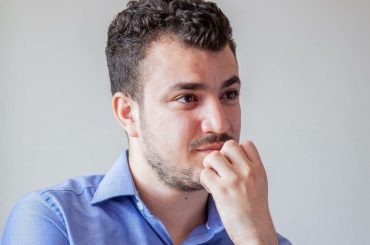
Lee Mordechai is a history professor at the Hebrew University of Jerusalem; he has put together a website called “Bearing Witness to the Israel-Gaza War” which classifies various aspects of the war under categories like ‘dehumanization’, ‘ethnic cleansing’, ‘causing deaths of civilian populations’, etc. Here is a summary:
https://witnessing-the-gaza-war.com/1169-2/
I, Lee Mordechai, a historian by profession and an Israeli citizen, bear witness in this document to the situation in Gaza as events are unfolding. The enormous amount of evidence I have seen, much of it referenced later in this document, has been enough for me to believe that Israel is committing genocide against the Palestinian population in Gaza. I explain why I chose to use the term below. Israel’s campaign is ostensibly its reaction to the Hamas massacre of Oct. 7, 2023, in which war crimes and crimes against humanity were committed within the context of the longstanding conflict between Israelis and Palestinians that can be dated back to 1917 or 1948 (or other dates). In all cases, historical grievances and atrocities do not justify additional atrocities in the present. Therefore, I consider Israel’s response to Hamas’ actions on Oct. 7 utterly disproportionate and criminal….Over the past year, Israel has repeatedly massacred Palestinians in Gaza, killing over 44,000 Palestinians – at least 60% of whom are women, children and elderly – as of writing. …Israel has actively attempted to cause the death of the civilian population of Gaza….Israeli discourse has de-humanized Palestinians to such an extent that the vast majority of Israeli Jews supports the aforementioned measures….The evidence I have seen and discuss indicates that one of Israel’s very likely objectives is to ethnically cleanse the Gaza Strip, whether in part or in total, by removing as many Palestinians as feasibly possible….
https://witnessing-the-gaza-war.com/
**
https://en.history.huji.ac.il/people/lee-mordechai
It is entirely believable zealots for a greater Israel jumped at the opportunity 10-7 provided to take territory by force and cleanse as many Palestinians as they could get away with. Hamas’ emphasis on freeing captured fighters and civilians, discredits the frequent charge of indifference to civilian lives. The tunnels are a much safer place to fight from and guns haven’t shown up in the rubble. Greater Israel came to cleanse. Apparent except to those with an interest in not seeing or blinded by victimhood.
Palestinians come out ahead by accessing the existing situation, seeking consensus on the best way forward, while bridging to Israelis who seek security, not land. It is fortunate that Hamas has called for a permanent ceasefire, elections, and a new unity governance. Their call for Marwan Barghouti’s freedom should be emphasized and supported.