Progressive International (PI) is an international organization established in 2020 to “to unite, organize and mobilize the world’s progressive forces.” The movement now includes over a hundred organizations across the world, representing millions of members.
“Unlike past internationals, the PI is not restricted to any one kind of organization, or any one kind of struggle,” wrote PI’s Co-General Coordinator David Adler upon the group’s launch. “Political parties do not have a monopoly on political organization, and a 21st century international must reflect the diversity of associations in our lives. That is why the PI aims to bring together all progressive forces — from trade unions and tenant organizations to liberation movements and underground publications — to contribute to a common front.”
“Unlike past forums, the PI is founded on the premise that a social network is not enough,” he continued. “Just as past internationals advanced the demands for a shorter working week and an end to child labor, the PI aims to develop a pragmatic policy vision to transform our institutions.”
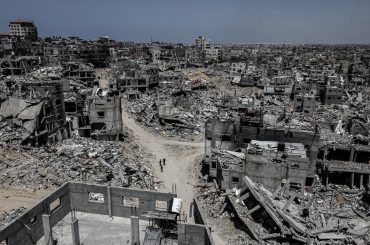
Since its founding, PI has helped develop multiple campaigns, which includes efforts to hold Israel and its international backers accountable for the crimes of genocide, apartheid, and occupation.
In January 2025 PI convened The Hague Group, which was founded by 8 member states (Bolivia, Colombia, Cuba, Honduras, Malaysia, Namibia, Senegal and South Africa) in an effort to uphold the recent rulings from the International Court of Justice (ICJ) and the International Criminal Court (ICC) on Gaza.
“We call on all nations to join us in The Hague Group in the solemn commitment to an international order based on the rule of law and international law, which, together with the principles of justice, is essential for peaceful coexistence and cooperation among States,” reads the group’s inaugural statement.
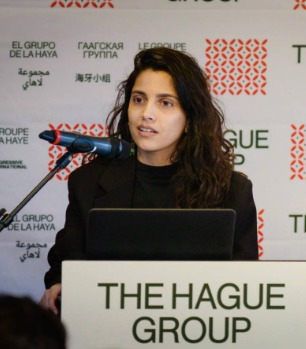
Varsha Gandikota-Nellutla is a Co-General Coordinator of Progressive International and acting chair of The Hague Group.
Mondoweiss U.S. correspondent Michael Arria spoke with Gandikota-Nellutla about PI, The Hague Group, and why political education is such an important part of fighting for a better world.
How did Progressive International come about and what are its goals?
Progressive International launched now five years ago in 2020. It’s an international group of parties, social movements, trade unions, intellectuals and research institutes from around the world, asking the very simple question of what internationalism looks like in the 21st century.
Why are we asking that question? We’re asking that question because we realize that we are living in a moment where internationalism and standing in solidarity has really been stripped of all of its a real meaning. Standing in solidarity for someone has been reduced as an idea to, for example, signing a petition or adding your name to something.
So, in many ways, it’s an experiment and that experiment was born again in a moment of a global war and the COVID pandemic of 2020. A lot of our work revolves around operating in those spaces between countries and between progressive forces doing incredible things within nations states.
On the labor side it looks like Make Amazon Pay, bringing together unions who are working in different Amazon factories around the world to strike together. On the state side, it looks like a vaccine internationalism, where we’re bringing nations that could put forth vaccine technology, factories, money to produce medicines at solidarity prices for the whole world. At a global level, at an anti-imperialist level, it looks like The Hague Group, where a block of nations and movements come together to say, we are going to materially break arteries of the genocidal machine by striking at ports, by blocking ships and by enforcing policies at an international level.
I follow PI across social media and I am struck by how often the group shares information and explainers about past political movements and campaigns. I am wondering if you could talk about why history seems like such a crucial component of this project.
Partly because we take all of our lessons from history. We take inspiration from history and we also learn from the mistakes of history.
Going back to what I began with, part of what has plagued the left has been a kind of defeatism. We aren’t operating in the internationalism of the 60s or the 70s or the moment of third world independent struggles, where you really had left governments and political parties seize power across the world in many different contexts.
I do think that defeatism has set in, as we look around the world now we see a lot right-wing movements gaining power whether that’s economically or militarily, and the left has been relegated to the fringes.
I do think that defeatism has set in, as we look around the world now we see a lot right-wing movements gaining power whether that’s economically or militarily, and the left has been relegated to the fringes. One thing we’re attempting with this kind of education is to show that these cycles have happened in the past. We fought against them and won.
So, I do think that defeatism has set in, as we look around the world now we see a lot right-wing movements gaining power whether that’s economically or militarily, and the left has been relegated to the fringes.
One thing we’re attempting with this kind of education is to show that these cycles have happened in the past. We fought against them and won. The second is to resurrect and renovate, not just repeat, some of these incredible projects, like the Non-Aligned Movement, which has great resonance now, as we see what’s happening with Ukraine and Palestine. The New International Economic Order Project, as we’re seeing what’s happening now with the new rush for critical metals and the new land and minerals grab in Africa, and the consolidation across Europe.
This is also for political projects and political parties. We have seen some of our old establishment left parties across many different countries, especially in the global South, have had to reinvent themselves. I suppose it’s a call for younger generations who are looking to be inspired and looking to work for a project that works for justice and dignity for all peoples.
PI has worked on a number of campaigns connected to Palestine, including No Harbour for Genocide, which aimed to block ships from transporting weapons to Israel. Can you talk about some of those efforts and how the organization has adapted its activism to the genocide in Gaza?
I do think that the solidarity with Palestine in rhetorical terms has always been incredibly strong, but what we saw once the genocide began, was just how impotent we all found ourselves as social movements, sometimes as unions, and even as political parties to stop it.
PI’s campaigns have looked for every leaf with which we can undermine the economy that underpins the might of this genocidal machine. So one part of that is corporate complicity. The Watermelon Index, carefully documents corporate complicity across big companies in the tech industry, retail industry, and the consumer industry and how they are profiting off the genocide in Palestine.
It’s not just about exposition. It’s about organizing, which, of course, is the central principle of all Progressive International’s work. How can we bring together blue collar and white collar workers, the workforces of these companies, to stand for Palestine?
But it doesn’t stop there. It’s not just about exposition. It’s about organizing, which, of course, is the central principle of all Progressive International’s work. How can we bring together blue collar and white collar workers, the workforces of these companies, to stand for Palestine? Whether that looks like striking or actually breaking the technology sometimes in some of these places so that it can no longer be used to say, for example, surveil Palestinians.
So, the Watermelon Index is one big project. The second is around ports, which are a hub of the genocide. It very quickly became clear to us all that the only way to stop arms from going to Israel was not actually through the law. We did see movements at the International Court of Justice and multiple cases being filed in domestic courts, but courts operate on a kind of different timeline. Here we were faced with a genocide where it was being cast on our phones every single day. That’s really when we realized there was a need for a coalition of both trade unions, but also researchers to come together to identify ships, identify shipping routes, a lot of which were secret, identify companies, a lot of which again were wearing disguises, so it wasn’t always easy to figure out which ships were carrying arms to Israel, because they’re very good at hiding these things.
So the No Harbor for Genocide campaign was developed. This was not with Progressive International alone. It’s in partnership with a range of different organizations and incredible activists, like those from the Palestinian Youth Movement and BDS movement who have meticulously tracked, whether you’re looking at Turkey, Spain, France, UK, India, or Columbia, to document ships who are carrying jet fuel and military supplies for Israel and expose them to the world.
Also, we also have to hold governments accountable. Like the case of Spain, for example, where they said one thing, but really are letting their ports still be used. In other parts of the world, we need to really use the strength of unions to cut off the ports altogether.
The third is, of course, legal. We do believe that international institutions and international law is something that we’ve all lost faith in because you look at this and think, “Surely, the international community should not allow this to happen.” The reason is because countries like France, multiple countries in Europe, are making up rules as they go. You have the president of France saying Netanyahu has immunity or Hungary and Poland saying they’ll defy the ICC warrants.
So both with South Africa’s ICJ case as well as the Hague Group, there has been a real attempt, not to actually bypass international institutions, but to truly use these institutions that have, let’s be honest, historically been used against Global South countries so far, to subvert them to hold Israel and inherently its backers, the United States and European nations to account.
How did The Hague Group coalition come about and what is it pushing for?
This goes back to your original question about why we do political education and why we look at history. When we found ourselves looking at this genocide and its unabated endorsement from the West, we looked at how the South African apartheid regime was made to fall.
You have examples there of collective action, with a diverse shape and form through the years. It begins with something like the Lusaka Manifesto of 1969, that essentially focused on African liberation movements because there was a very clear understanding that it was important for the many other colonized peoples across the continent to liberate themselves and win state power in order for the South African regime to fall and for them to fight against it.
That develops, of course, and it goes into the multilateral space and you get the arms embargo from the United Nations Security Council Resolution that gets issued against the apartheid regime, which then morphs into something even bigger, a comprehensive embargo demand, which then emerges as Global South countries coming together in a special conference against apartheid where multiple nations adopt trade sanctions against the apartheid regime.
What’s interesting, if you look at that story, is that what begins as essentially an African liberation demand then grows to become a multilateral demand and brings together countries that issue some of the strongest sanctions against the apartheid regime. Then it becomes a much more global level of enforcement measures when it moves out of the multilateral space to a national level space.
So when we looked at that, it was very clear that limiting ourselves to the international legal architecture of the ICJ/ICC or the existing multilateral architecture of the United Nations General Assembly or the Security Council, where of course we know, that the U.S. would continue to veto every single attempt to hold Israel and its backing of Israel accountable would simply be insufficient. Each of these states do have obligations under international law to stop Israel’s occupation as determined by the ICJ.
This goes back to some of your early questions about our campaign work. Why do we do this stuff? Why are we looking at ports and why we trying to connect activism at different ports? One, it’s a question of collective action. It’s only through collective action that we can stand up as states and say, actually we do believe in salvaging international law. We don’t think you can make up rubbish rules and destroy these institutions or target them with sanctions.
It’s also because collective action is the only antidote to unilateral punishment. We’ve seen those coming, when South Africa brought its ICJ case against Israel, immediately there was a motion introduced by the Republicans in the U.S. House of Representatives to put all South African bilateral trade relations under review.
This was a year and a half ago. Now, obviously, things have escalated massively and South Africa is completely under attack under Trump, but I’m talking about Biden when I talk about what happened a year and a half ago. Even when Spain announced an embargo, it was suddenly slapped with a foreign trade investigation that is still ongoing and could levy something close to, I think $2.3 million per voyage when it blocks a boat from heading towards Israel.
We know that the logic of punishment is extremely swift, extremely strong, and really permeates this entire space. The only antidote to this kind of punishment from powerful nations is for us to act collectively.
So we know that the logic of punishment is extremely swift, extremely strong, and really permeates this entire space. The only antidote to this kind of punishment from powerful nations is for us to act collectively. The Hague Group is currently nine but if it’s a lot more countries acting together, then if the United States chooses to punish every single country, it’ll end up it’d be isolating itself.
The other issue is simply quite practical. We do know that there is no existing infrastructure, as strange as it may sound because we tend to think of states as all powerful in the their control over jurisdictions, but there is actually no infrastructure to look at shipping routes across different continents.
Through conversations with Foreign Ministry we found out that it’s hard for a port authority in one particular country to have the complete information about what a ship has on board when it’s coming to its soil and where it’s headed to afterwards, two or three steps down the line.
We believe you need this information to cut off an artery for the ship. I’ll give you a very concrete example. A ship could be empty when it arrives at my port, but it could be picking up weapons at the next port need to have the information that it’s going to pick up pick up weapons at its next port.
So that’s the infrastructure that we’re trying to set up. That’s the due diligence protocol that we’re trying to standardize, so that the idea for international law doesn’t remain rhetorical and becomes a national level practice across all governments of conscience.
I read a recent quote from you in Middle East Eye. You said, “The Hague Group isn’t meant to be just a talk shop where states say they support Palestine.”
Can you talk about moving forward with that vision and expanding the group, in the face of an escalating situation in the Middle East? How do you envision the future of the group?
We wake up every morning making this calculation of whether the list of countries that were confident about joining us originally remains the same, or has something Trump said or done completely thrown that out the window. It’s the same kind of calculation for founding members. Are they newly under attack for yet another bogus reason?
However, I can say with confidence that we have received a great deal of interest from countries across different continents about joining the group. What’s unique about it is exactly what you said, it’s not a talk shop and the reason it’s not a talk shop is that at the moment of its founding, it ensured that there were inaugural measures that were about national level state policy.
So that kind of becomes the entry requirement and the entry bar for any new nation that’s interested in joining the group. You have to walk the walk. You will have to commit to both complying with the ICC warrants, accept that you will prevent vessels from docking at your ports should they contain jet fuel and or military supplies, and accept that you’ll prevent any export of arms or transfer of arms headed towards Israel to be used against the Palestinian people.
Those entry measures can make it difficult for us to rapidly multiply, but at the same time, that’s what makes the group incredibly substantive and really useful in the long run. Our hope is to make the entire world a kind of no-go map for Netanyahu. To hold him accountable, and connect every single port across continents so that a few bad actors find it increasingly difficult to use our lands and our air spaces to send arms to be used on Palestinians.