Since I was a child, Ramadan wasn’t just about fasting. It was about taraweeh prayers, long nights of making dua (prayers of supplication), and warm family gatherings. My father would take us to visit our relatives — our aunts, uncles, and to my grandfather’s house. Every year, we rode in his car, and I always sat by the window, not just for the view but to capture every moment in my mind, as if saving pictures that would never fade.
I loved watching the crowded streets, the vendors selling the classic Ramadan sweet, qatayef, kids playing in the alleys, and the palm trees swaying in the evening breeze. The lights and decorations made the city glow. We visited every corner of Gaza — our aunts in al-Bureij, Rafah, and Khan Younis, then in Deir al-Balah and al-Maghazi, before finally reaching my grandfather’s house in al-Nuseirat. There, under one roof, our family came together.
This year was different.
Gaza was not the same. Even though there was a ceasefire, the war had not fully ended, and many places were still too dangerous to visit. The streets, once full of life, were now covered in rubble. Towers that once stood tall had collapsed. The borders were shut — no fuel, no gas. Even my father’s car, our trusted companion on these trips, was not available. The little fuel left had to be saved for emergencies.
Then, one evening after iftar, my father shared unexpected news:
“A friend lent me his gas-powered car for a day…tomorrow, we will go on Ramadan visits!”
Excitement filled the home. Everyone wanted to go.
“Of course, I’m coming!” I said right away.
My sister Aya, who was busy studying for her final year of tawjihi high school exams, surprised us by saying she’ll take a break. “I’m coming too!”
My younger brothers cheered, “All of us are going!”
The next morning, I was the first to wake up. I got ready quickly, made sure my phone was charged, and waited eagerly. But I wasn’t prepared for what I saw.
The roads were unrecognizable. Every street we passed had destroyed buildings, cracked roads, and piles of debris. Inside the car, I could feel every bump as we drove over the broken asphalt. Familiar places looked like ruins. The names of the streets I had memorized no longer matched what I saw.
Yet, despite everything, I felt happy to see the sea again. It had been two years since I last looked at it, heard its waves, or smelled the salty air. The sea hadn’t changed, but it seemed sad as if mourning the destruction around it. I took dozens of photos, hoping they would bring me comfort later, even just a little.
On our way to Deir al-Balah, my father stopped next to a destroyed building. At first, I thought it was just another bombed building, but then I saw a single minaret — still standing — while the rest of the mosque was gone.
A sharp pain filled my chest. I turned to my sister, voice shaking. “Aya…isn’t this al-Salam Mosque?”
“Yes…it is.”
My throat tightened. This mosque held so many memories. Aya and I had spent days at our aunt’s house nearby, and we used to pray there. I could still hear the imam’s voice reciting and remember how peaceful it felt inside.
Now, it was gone. A place once filled with worshippers was now nothing but dust.
Memories came rushing back — walking out of the mosque after prayer, our aunt buying us ice cream, sitting outside and enjoying it before heading to my aunt’s house. Now only the minaret stood, refusing to fall, bearing witness to all that had happened.
As we continued, the destruction around us became harder to ignore. Entire houses had disappeared, leaving only blackened, broken walls. In some places, even the walls were gone — just piles of stone and twisted metal.
But people remained among the ruins. Some were trying to rebuild their homes. Others lived in tents in the middle of their destroyed home, choosing to stay on their land and refusing to leave. It was their way of saying: we are here to stay.
I saw children playing between the rubble. Some ran over the debris, while others had turned pieces of metal into makeshift wheels, rolling them on the ground as if to say, “You won’t take our childhood away, no matter how much you destroy.”
Every home—or tent—we visited had the same question:
“How was displacement for you?”
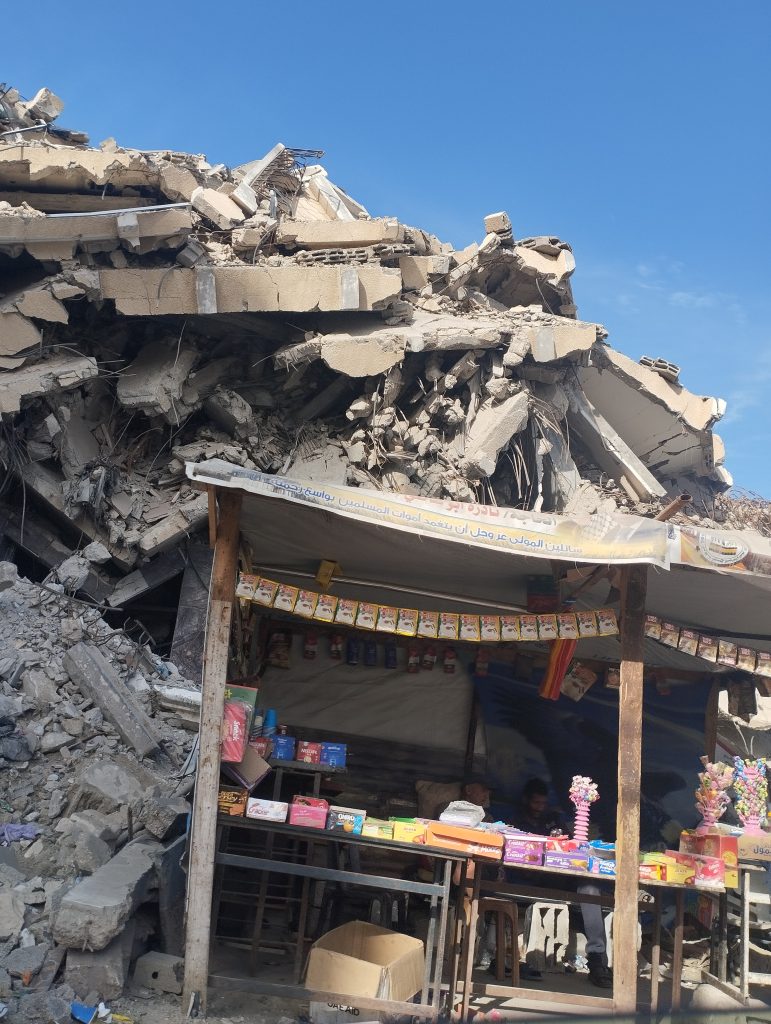
Displacement had become normal. Everyone had a story. But time was short — we couldn’t stay long if we wanted to see everyone. Yet, squeezing two years of suffering into a few sentences felt impossible. No words could fully capture what we had been through. Every person in Gaza carries a story of loss.
At night, Gaza changed. Darkness covered the ruins, and Ramadan lights shone in the streets. Small lanterns hung from shop doors, whispering, “I am still here, despite everything.” Even markets built over the rubble were open. People walked through them, refusing to give up. Vendors called out their prices, children laughed, and the call to prayer echoed in the air.
At that moment, I realized — Gaza is stronger than war. Stronger than destruction.
We returned home exhausted, but something inside me had shifted. I was grateful for the chance to go out, to see the sea, to be with family.
War returns
That Sunday night, March 16, 2025, we thought we would finally rest after a long day. I planned to sleep early, but I had university tasks to finish. Since I was taking summer classes online, I stayed up studying until 12:30 a.m., then went to bed, hoping to wake up before dawn to drink water, pray, and make dua before sleeping again.
But things didn’t go as planned.
Barely an hour after I closed my eyes, sudden, deafening explosions shook the city. There was no time to prepare or understand what was happening. We ran from our rooms to the living room, searching for safety, though we knew there was none.
No words can describe that moment — the sheer force of the blasts, how they shattered the night’s silence. The sound of airstrikes is something you never truly get used to, no matter how long you’ve lived through war.
We checked the news. The war had returned.
Shock froze me. I never imagined that Sunday would be a farewell to everyone I had seen without knowing it. Even in my worst nightmares, I never thought war would start again.
Yet, here we were, back in the nightmare.
Maybe the worst part of all this isn’t just the destruction. It’s the silence of the world. Governments say they support Gaza, but in reality, they do nothing to stop our suffering. The laws we were told would protect civilians in war, the rules we were taught to believe in, never applied to us.
We are left alone to pick up our broken pieces, to fight for our survival. Every day, we ask if we have to die to prove that we deserve to live.
But through it all, we hold onto one truth: Our faith in God is our only refuge. The world may remain silent. But we will remain steadfast.
Because we believe that faith can move mountains. Patience leads to victory, and one day, in God’s perfect timing, this darkness will pass.