

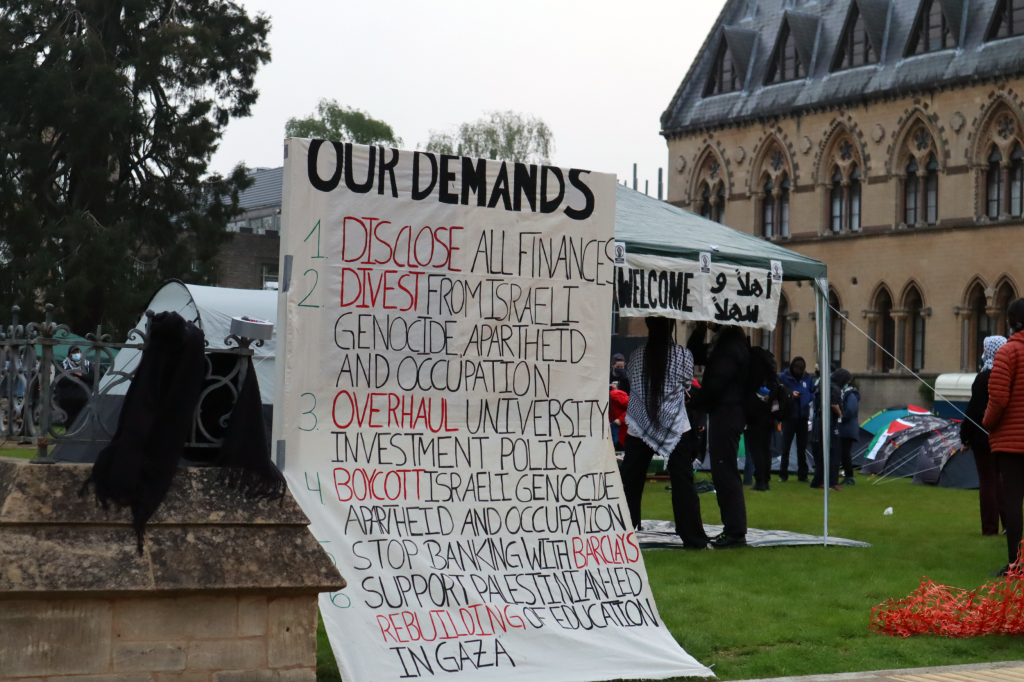
Five days after the ceasefire in Gaza took effect, Oxford Action for Palestine (OA4P) occupied a “landmark Oxford library,” renaming it “The Khalida Jarrar Library.” Occupiers reiterated the demands for an academic boycott of Israeli institutions and for divestment from all arms companies while also reinvesting in the urgent Palestinian-led rebuilding of higher education in Gaza. This action forced much-needed attention on Palestine after the ‘ceasefire’ in Gaza placated the efforts of many—as if Israeli machinations of genocide had ceased, even as manufactured starvation and the targeted destruction of the healthcare system continued unabated. Against the backdrop of almost 1000 violations of the ceasefire by Israel and the ramping up of invasions and settler pogroms in the West Bank, the urgency of keeping eyes on Palestine was paramount. Israel proved this by unilaterally shattering the ceasefire on March 18th with hundreds of simultaneous strikes on Gaza, killing 1,263 Palestinians in 17 days.
OA4P’s seven-hour occupation encapsulated the current state of pro-Palestine student organizing globally. Pockets of students are escalating their actions, such as protestors at Bowdoin and Columbia, though in many other cases, the efforts have dwindled. Amid increased repression of protest and free speech by police and state actors worldwide, and declining media coverage of Palestine, the acceleration and intensification of actions that disrupt the status quo and reject the normalization of Zionist violence are imperative.
Student organizers around the world face a crossroads. Behind punchy headlines and viral posts, the student movement grapples with strategic stagnation. As Israel’s genocide intensifies, we must reassess where our efforts are most necessary, strategic, and viable.
Student organizers around the world face a crossroads. Behind punchy headlines and viral posts, the student movement grapples with strategic stagnation. As Israel’s genocide intensifies, we must reassess where our efforts are most necessary, strategic, and viable.
The focus on visible mass mobilization has shifted seismically to quieter, more calculated steps: building alliances with supportive staff, pressuring decision-makers through legal and bureaucratic channels, and challenging universities in court. For example, organizers at Oxford leveraged the university’s increasing reputational damage—including a significant human rights legal complaint against All Souls College for investing millions in illegal settlements—while dedicating more time to the infrastructure and care work essential for the movement’s long-term survival. But without the sustained visibility and pressure of global encampments, sporadic militant actions like setting up occupations drain our capacity, fragment our efforts, and leave us vulnerable.
This is a pivotal moment to collectively raise the ceiling of the Palestine solidarity movement; we must strategically realign our efforts and deepen our networks to counter the urgent challenges facing movement sustainability. We revisit recent learnings and kindred struggles to resist manufactured urgency, build lasting structures, and sharpen our use of university battlegrounds as instruments for long-term change.

History unfolds unchanged
Universities have long weaponized time to stifle momentum, stalling through delays, intimidation, obscured inaction, and buried precedents set by previous cohorts of student protesters. The erasure of protest history forces us to reconstruct past efforts through chance discoveries and informal encounters. Universities today remain hell-bent on resetting the clock to zero with each new wave of mobilization. Resurfacing this history is important to understand how institutional repression operates cyclically.1 Historical moments of mass mobilization broke through and laid the groundwork for future victories—shifting public consciousness and, at times, forcing institutions to reckon, not by choice, but by the weight of collective refusal.
In an alarming intensification of repression disguised as order under the Trump administration, a growing number of pro-Palestine activists and academics have been arrested by Homeland Security. Mahmoud Khalil’s arrest drew widespread condemnation for criminalizing political organizing. After initially being rejected, the University of Cambridge secured a revised injunction banning all protests in three key campus areas until July 2025—setting a dangerous precedent in criminalizing pro-Palestine activism. Universities and their carceral partners are refining tactics to deter, exhaust, and outlast us.
As threats grow and burnout deepens, we must break from a cycle of reactivity, chasing every crackdown and policy shift—this loop makes us predictable and ineffective. Now is the time to strategize and regroup so that we are not undermined or fragmented by burnout and disorganization as the next wave of momentum builds.
As threats grow and burnout deepens, we must break from a cycle of reactivity, chasing every crackdown and policy shift—this loop makes us predictable and ineffective. Now is the time to strategize and regroup so that we are not undermined or fragmented by burnout and disorganization as the next wave of momentum builds.
Over the past year, universities have escalated repression—restricting protest, ramping up surveillance, and implementing disciplinary measures. Signal chats now buzz with legal updates and strategy meetings; students are being drawn into negotiations around divestment—often opaque, limited in scope, and intended only to defuse public pressure. This shift reflects both constraint and clarity: the encampments have disrupted the status quo, redefined the organizing landscape, and created openings amid unimaginable devastation. As the bombs continue to fall and the death toll in Gaza climbs, the need to act becomes all the more urgent—but urgency must not cloud strategy. This moment demands tactical clarity that matches the scale of carnage and prepares us for the long road ahead.
Proposals for the road ahead
As we speak with peers grappling with the question of longevity, we aim to create space for evolving tactics and strategy.2 The three proposals below are not blueprints for success but invitations to think, experiment, respond, and learn collectively in times which demand perpetual adaptation.
Direct action plays a crucial role in creating disruptions, generating further opportunities, and exposing vulnerabilities. However, in the post-post-ceasefire present, even minimal acts of association to pro-Palestine activism have triggered rights violations against students in the West. While militancy remains undoubtedly necessary, it is increasingly insufficient on its own. The fight for divestment demands durable structures that outlast institutional amnesia and high student turnover—which have consistently won the war of attrition. True power lies not only in BDS wins but in dismantling academia’s deeper entanglement with imperial structures. This requires sustained recruitment, political education, organizational restructuring, and coalition-building within and across universities.
I. From spontaneity to structure: a scaffolding
With this in mind, we propose a primary focus on infrastructure—for organizing, legitimizing Palestinian narratives, documenting learnings, and onboarding new cohorts. Despite historical precedents, no sustained scaffolding exists; we rely on makeshift systems assembled in real time. Practically, this means creating alternative digital and physical spaces that integrate new members. Crucially, it means moving beyond dependence on a few key individuals who have sustained these movements in their force today. We must incrementally carve out more institutional spaces and build long-term alliances across the university and city to uphold the struggle.
The University of Oxford is not a neutral institution. Across disciplines and administrative operations, it actively reproduces the structures we seek to dismantle—structures we now strategically confront from multiple entry points. Coordination, knowledge-sharing, and capacity-lending are critical to sustaining an effective, collective strategy across departments and colleges.
II. Reclaiming the university from within
Education is equally essential—that we must still demand political education from institutions that present themselves as bastions of learning reveals the willful ignorance and deep failures concealed behind “academic excellence”. We need education that normalizes so-called ‘radical’ perspectives, exposes institutional complicity, connects campus struggles to broader communities, and clarifies how power operates through the banal machinery of bureaucracy. Western academia remains a powerful propaganda engine for legitimizing the global Zionist narrative. It is a central battleground where language, frameworks, and political ‘common sense’ are shaped—this directly affects how we advocate for BDS and understand our obligations to Palestinian liberation as residents of the imperial core.
Political education is especially key to disrupting institutional complicity. We have been consistently organizing teach-ins, reading groups, and public events that confront the ideological underpinnings of Zionism and its normalization in academic discourse and challenge the institutional partnerships that sustain colonial narratives.
Our divisional organizing targets specific departments, questioning research agendas and institutional affiliations that reproduce settler logic under the guise of neutrality. Engineering schools fuel weapons development; humanities and social sciences legitimize occupation through colonial narratives; business schools advance investment in apartheid infrastructure, and medical faculties collaborate with institutions complicit in denying Palestinians healthcare.
Education equips us with the tactics to target the granular mechanics of university capital—through actions like altering ethical investment policies, pursuing Charity Commission challenges, and pressuring trustees—transforming seemingly small BDS wins into material leverage. By embedding political education into the university, we wound the Zionist weaponization of academia at its source: its claim to objectivity, authority, moral legitimacy, and untouchable historical inevitability. This is about shaping the political common sense of a generation, and our task is clear: to ensure no one can say they didn’t know, and to translate that knowledge into reparative measures—scholarships, protest rights, and redirected resources.
III. Solidarity, not charity: politicizing fundraising
Our final suggestion is to make concerted efforts to directly support Palestinians through fundraising. Fundraising for mutual aid in Gaza within the student movement is not a logistical afterthought—it is an inherently political act. Student organizers must answer the call for direct material support with the same urgency as they mobilize against their institutions’ complicity. OA4P is one of the 90 signatories worldwide to endorse and actively fundraise for the recently launched student-led “Gaza Fundraiser.” Students must also help construct alternative support systems that bypass Israeli control and reject neoliberal charity models, saviorism, and institutional co-optation. We explicitly call for a focus on linking our solidarity—from the capitals of complicity—to Palestine (and beyond) through well-organized fundraising and sustained mutual aid.
The current wave of student mobilization has exposed universities as economic and ideological tools of war—from investments in weapons manufacturers to research partnerships with military contractors. If institutions fund occupation, then students must support resistance and enable Palestinian resilience. For students in the Global North—whose governments arm and fund Israel’s genocidal campaign—redistributing resources from within the epicenters of empire is not generosity; it is a necessary commitment to decolonial struggle and Palestinian steadfastness.
Student-led fundraising has to break from consumer-driven, transactional models that prioritize visibility over impact. We must cultivate collective resource-sharing and mutual aid through monthly contributions, local business pledges, and long-term financial infrastructures. This is reparative justice and a concrete expression of anti-Zionist, anti-imperialist solidarity.

The road ahead
Over the past eighteen months, we have witnessed an unprecedented, growing awareness of the Palestinian struggle for liberation—though it took live-streamed genocidal violence to catalyze this shift. Consequently, Israel’s image has suffered irreversible damage, alongside the credibility of liberal, rights-based frameworks of justice. This moment has made devastatingly clear: witnessing the violence, uncovering its scale, and attracting global attention is not enough to halt it. What it has produced, however, is invaluable institutional knowledge, extensive networks, a generation of committed organizers, and unparalleled global connectivity—all forged amid an escalating polycrisis. Moving forward, the focus must be on transmitting this knowledge, securing local BDS wins, and embedding resistance and self-determination into the political mainstream—fueling a resilient, long-term movement.
Moving forward, the focus must be on transmitting this knowledge, securing local BDS wins, and embedding resistance and self-determination into the political mainstream—fueling a resilient, long-term movement.
We face these challenges because of our movement’s strength—because we pose an unprecedented threat to a genocidal Zionist order. The lessons, precedents, and relationships of the past year and a half build on decades of organizing. We know things are getting worse, and rapidly so. But we also see the strength of the coalition, community, and movement—we organize in a time of the broadest support for Palestinian liberation ever seen. Militancy without direction dulls our force—let’s get our ranks in order and strike where it matters.
In keeping with our rallying cry, “Long Live the Student Intifada,” we will not rest until we witness our educational institutions tantafid3—becoming unmanageable, ungovernable, and utterly unable to maintain ‘business as usual.’
Engy Sarhan
Engy Sarhan is an AfOx-Clarendon scholar and current MSc candidate in Modern Middle Eastern Studies at the University of Oxford.
Vivian Ho
Vivian Ho is a science and technology studies scholar and current MPhil candidate in Medical Anthropology at the University of Oxford.
Notes
- The University of Oxford, like many others, delegitimizes student protests, labeling organizers as outcasts or external agitators. During the spring 2024 Gaza Solidarity Encampment, an Oxford community member recalled the 2009 occupation of the Clarendon Building by 100 students protesting the university’s pro-Israel stance during the First Gaza War. Parallels between then and now reveal a recurring pattern: students mobilize, universities demonize, and complicity persists. Sixteen years later, the University of Oxford has yet to act on the same core demands. It continues to make vacuous, placating promises. Even as the Oxford City Council unanimously passed a BDS motion citing the ICJ rulings on Palestine, the university isolates itself from the moral clarity of its surrounding community. ↩︎
- A complementary read by comrades from Students for Palestine in Finland was published in NO NIIN Magazine on April 9, 2024. Their article addresses similar questions and raises shared concerns while adopting a reflective tone to offer more granular, actionable insights. See also: Disrupting Complicity: Students Organising for Palestine in Finland. ↩︎
- Tantafid (verb, feminine): Derived from the Arabic noun Intifada (Uprising) meaning to tremble, shiver, and shake off the ground beneath the colonizer. The verb’s root signifies “to be undone” or “to unravel.” Commonly used in the context of Palestinian resistance and other uprisings in modern Arab history. ↩︎


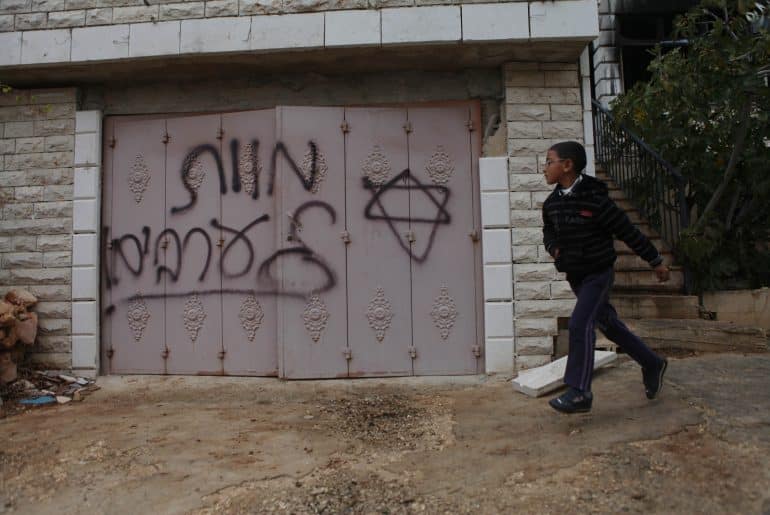
“This is a pivotal moment to collectively raise the ceiling of the Palestine solidarity movement; we must strategically realign our efforts and deepen our networks to counter the urgent challenges facing movement sustainability. “
__________________________________________________________________
I submit there are important alliances to expand. The Israeli and American peoples, whose hearts and minds are pivotal.
Both are inhibited by confusion over the movement’s intentions toward the future. Far too many hold the view it does not include peaceful co-existence.
Saeb Erekat proposed the key was equal citizenship in the State of Israel. That would build needed alliances and prompt Israelis to choose between one state or two. Would give student protests the demand for equality.