

Louis Theroux is perhaps the UK’s most renowned documentarian. His newest film, “The Settlers,” is a deep dive into the religious ultra-nationalist Zionist settler movement in the West Bank, and is primarily comprised of interviews with said settlers. The interviewees’ candidness is the film’s main hook, which has consequently stirred up quite the commotion. Reception has ranged from adoration of the interview techniques to tired accusations of bias.
Yet controversy alone is an ill-fitting indicator of the film’s quality, as even the most anodyne criticism of Zionist society produces an abundance of outrage. Can the film stand on its own legs, and is it worth a view?
The short answer is a reserved yes, but ample qualifications follow.
The ugly face of settler colonialism
The documentary’s greatest strength lies in simply allowing the settlers to speak for themselves. Theroux didn’t need to prod, provoke, or lay rhetorical traps for them; they were more than happy to share their repugnant views. There is a twisted — yet somehow refreshing — honesty about right-wing Zionists; they don’t try to obfuscate their goals or actions with false remorse or pity, otherwise known as shooting and crying. Palestinians are subhuman and should be conquered, expelled, or disappeared in one way or another, they say openly. The entirety of the area from the Sinai to Lebanon is Jewish land and should be forcibly seized from the “camel riders,” one settler Rabbi said in the film.
Indeed, had we ascribed to these settlers the positions that they proudly broadcast in the documentary, we’d be accused of antisemitism and blood libel. Yet the ease and comfort with which they so brazenly shared their views reveal how normal this is to them. There was no hesitation or fear; they knew they were allowed, even encouraged, to spew and act upon their hatred and genocidal ethnonationalism. This is the product of decades of impunity, governmental support, and protection.
One particularly detestable character Theroux interacts with is Daniella Weiss. Often called the godmother of the settler movement, Weiss has spent her entire life establishing new settlements in Palestine and supporting their expansion. She bragged about her connections in government and how, contrary to mainstream narratives, she was not in conflict with them but was rather doing “for governments what they cannot do for themselves.”
Weiss’s statements align historically with the way the settlement movement has functioned as a mechanism for the colonization of Palestine. It provided plausible deniability to Israeli land grabs by seizing territory in an initially “unsanctioned” manner, where outposts are constructed with the protection of the army, and are then retroactively legalized and become an established fact on the ground. Today, there is little need for these charades, and settlers are free to occupy whatever they want with the government’s open support. One of the first scenes of the documentary shows Itamar Ben-Gvir, Israeli Minister of National Security, attending a settler celebration and calling for the recolonization of the Gaza Strip.
Theroux’s travels across the West Bank highlight how the supposedly dreaded specter of annexation is already here. Settlers hailing from Brooklyn and Texas, speaking in perfect American accents, all argue that Theroux is on Jewish and Israeli land. This follows a long Israeli tradition of altering the de facto status quo before de jure formalizing the new arrangements. The annexation of Jerusalem and the land seizure accompanying the construction of the Separation Wall are just two examples. The film demonstrates that without a shadow of a doubt, there is truly one authority from the river to the sea.
Missing the bigger picture
Although the documentary excels at showing the settlement movement’s ugly face, it could have done better to situate it in its proper historical context. Viewers are left with the impression that this is a fringe movement with some radical supporters in the current Israeli government, rather than a mainstream position among Israelis. Over 10% of the Jewish Israeli population are West Bank settlers, and a full 62% of Jewish Israelis don’t even consider the West Bank as occupied territory. Just because many won’t join in packing caravans to seize a hilltop does not mean that they wouldn’t support others doing so in their stead. Even so-called “centrist” politicians, who posed as an alternative to Netanyahu, built their electoral campaigns around promises to annex more land in the West Bank than him.
This is the danger of coupling the settlement project with religious ultra-nationalists. It is a thoroughly Zionist project regardless of stream or ideology. The original architect of settlements in the West Bank, Yigal Allon, was a secular labor Zionist. So-called “economic settlers,” who Theroux mentions in passing, also populate the West Bank settlements, attracted by generous government subsidies and other advantages. When outposts or settlements are erected, this means the construction of army bases, roads, and infrastructure. It means cordoning off Palestinians from their lands and farms and locking down their communities. All settlers benefit from this, regardless of their motivations for living in these colonies or their political leanings.
Like most documentaries about Palestine, especially those helmed by non-Palestinians, it does suffer from “1967 war blinders” — that is, a hyper-fixation on the occupation following the 1967 War, rather than viewing it as a logical continuation of turn-of-the-century Zionist settler colonialism. The Nakba is not mentioned at all; thus, there is a failure to connect the colonization of the 1967 territories to that of the 1948 territories. What’s frustrating is that Weiss even says this in passing — that the settlement project is essentially the face of Zionism and the mechanism through which the Zionist state was established. It is a shame that this was not unpacked or addressed in any way.
Indeed, the efficiency with which the 1967 occupation commenced was chiefly due to the same systems of domination existing inside the Green Line and had been used against the surviving Palestinian population there. There is no reason why Sderot inside the Green Line should be treated morally or materially differently from Barkan in the West Bank. They were both created through military conquest, land seizure, and depopulation, and the same infrastructure of violence and domination sustains them both to this day. To Palestinians, there is little functional difference between a village that was demolished based on bureaucratically approved army orders and a village whose residents were expelled by marauding settlers. This context would be lost on people hoping to learn about the settlement movement for the first time from this documentary.
This becomes more egregious when you realize that the omission was not an oversight, but a deliberate choice made by the documentary team. Muhammad Hureini, one of the few Palestinians given any time in the documentary, details how he elucidated this history and critical context to Theroux and his crew. Being a son of refugees ethnically cleansed in the Nakba, and facing threats of expulsion again today, reporting on the latter while omitting the former leaves Hureini’s story incomplete and decontextualized. It reduces it to a modern rights-based squabble over property rather than the continuing legacy of the establishment of the Zionist state and the erasure of Palestine. One can only speculate why this information was not deemed necessary enough to convey to the viewers.
Perhaps the thing that most stuck with me after viewing the film is how frustratingly late it felt. It could have been made anytime in the last 50 years, and nothing would have fundamentally changed; even Daniella Weiss would have been able to reprise her infamous role. Nothing the settlers bragged about, not even the most wicked or dehumanizing of statements, deviates from what Palestinians have been documenting for a century.
The counterargument, of course, is that there is a utility in broadcasting such nakedly genocidal rhetoric to an uninitiated and broad audience. Theroux is well-known and carries a certain level of credibility, which can help raise awareness. The angry backlash from Israel apologists underscores this point, as they cannot explain away the reprehensible colonial rhetoric and violence depicted in the film. Instead, they try to minimize the scale of the problem, an argument that the documentary could have preemptively negated by establishing a broader context. Too many Palestinians have been killed and dispossessed — far too recently and far too publicly — to continue with the charade that there is only a troublesome minority of extremist settlers to contend with.
But the film’s outright refusal to scratch anywhere beneath the surface points to deeper problems with how the world still discusses Palestine. There are clear limits to Palestinian aspirations or rights that cannot exceed the threshold of Israeli table scraps. Under this ceiling, we are permitted to abstractly discuss violations and appeal to international law. The world is even happy to point out some problems; occasionally, it musters the courage to condemn them. Still, it rejects naming their origins or taking tangible action towards them.
This film will undoubtedly expose new people to the settlement enterprise in the West Bank and Palestine in general. It could be argued that this is a net gain. Yet it remains dispiriting that after nearly a century of colonialism and occupation, and over 580 days into a genocide, we are still having these same conversations, trying to set the record straight in a futile one-way conversation.
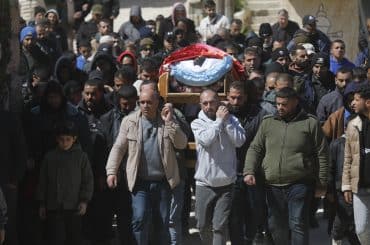
Just another normal day in Judea and Samaria….
Israeli settlers torch 15 Palestinian vehicles in occupied West Bank….Illegal Israeli settlers set fire to at least 15 Palestinian vehicles in villages near the cities of Nablus and Salfit in the occupied West Bank, local sources told Anadolu today….According to the sources, a group of illegal settlers also attacked a well belonging to the city of Nablus….They warned that illegal settlers may be attempting to seize control of the well, which supplies water to surrounding villages, amid repeated assaults on the area….Eyewitnesses reported that hundreds of illegal settlers gathered near Bruqin village near Nablus and stayed overnight yelling insults and threats at Palestinians….
https://www.middleeastmonitor.com/20250516-israeli-settlers-torch-15-palestinian-vehicles-in-occupied-west-bank/
We have to credit Theroux for making a compelling documentary that focuses on a specific part of the dense multilayered criminality and depravity of Zionism. Francesca Albanese has admitted that she only began to understand the nature of the Zionist process of genocide within the last two years.
I analogize Daniella Weiss and her fellow racial supremacist colonial settlers to state actors in US law. See Amdt14.2 State Action Doctrine. When a state wants to deprive some group of Americans of rights and the state cannot legally or constitutionally undertake the necessary action or does not want to perpetrate the necessary action publicly, the state may become entwined or develop a symbiotic relationship with a private actor that then becomes a state actor or proxy for the state. The private state actor then undertakes the action that the state wants to take place.
In the USA, state action usually relates to violations of the 1st or 14th Amendment. The State of Israel licenses private state actors for the purpose of genocide.
It is also telling that the documentary is made by Louis Theroux, a man known for making documentaries about people who (strongly) deviate from the mainstream. This is part of the framing of these settlers by the BBC.
Settlers: The Mythology Of The White Proletariat from Mayflower to Modern
A uniquely important book in the canon of the North American revolutionary left and anticolonial movements, Settlers was first published in the 1980s. Written by activists with decades of experience organizing in grassroots anticapitalist struggles against white supremacy, the book established itself as an essential reference point for revolutionary nationalists and dissident currents within the Marxist-Leninist and anarchist movements. Always controversial within the establishment left, Settlers uncovers centuries of collaboration between capitalism and white workers and their organizations, as well as their neocolonial allies, showing how the United States was designed from the ground up as a parasitic and genocidal entity. As recounted in painful detail by J. Sakai, the United States has been built on the theft of Indigenous lands and of Afrikan labor, on the robbery of the northern third of Mexico, the colonization of Puerto Rico, and the expropriation of the Asian working class, with each of these crimes being accompanied by violence. This new edition includes a new essay and an interview with author J. Sakai by Ernesto Aguilar.
https://archive.org/details/Settlers_201801
Fascism, imperialism, and the law w/ Nina Farnia
The Red Nation Podcast host Nick Estes is joined by legal scholar Nina Farnia (@NinaFarnia) to discuss America’s supposed slide into oligarchic fascism, what remains of the Western “rules-based order,” and how the war in Ukraine and the Gaza holocaust have enriched the US ruling class.
Check out her article, “Imperialism in the Making of U.S. Law” https://scholarship.law.stjohns.edu/l…
Check out Nick’s Subtstack, Red Scare
https://nickestes.substack.com/
https://youtu.be/Gy8kAbS3vIs?si=nyTLcP66WkD86Yjw