“I usually do not like to sleep outside my home in Shatila, but these days I feel even more attached to the camp and my home in it,” says Umm Mahmoud, a Palestinian originally from Tabaria living in Shatila refugee camp in south Beirut. “I have lived in this home for fifty years after I married and moved from Wavell Refugee camp in Baalbek. I am now haunted by the possibility of not having a base here, not having a home.”
“This is making me nostalgic for the camp and everything in it,” she continues. “Even during the war days I lived through in Shatila, the siege — I cherish all of it.”
I also speak to Umm Ahmad, another resident of the camp who feels the same way. “I feel so attached to the camp these days, it is like my paradise,” she says. “I want to walk around and smell it, feel it, touch the walls, and embrace everyone….It’s when you are aware that you’re about to lose something, at which point you say to yourself it is beautiful.”
These are conversations I had through several visits to Shatila refugee camp between March and April in Beirut. They took place in the wake of Israel’s escalating wave of airstrikes against several targets that it claimed belonged to Hezbollah and, most notably, Hamas, which maintains a presence in Lebanon. These attacks have been the latest in Israel’s systematic violations of the ceasefire with Hezbollah, which began in November 2024. Israel claims to be targeting military sites belonging to the organizations that have allegedly been used to launch rockets into Israel in recent weeks.
As Umm Mahmoud and I are talking, the breaking news on the TV repeats the Israeli claims. Never mind that Hamas has denied any responsibility — the TV station continues to host commentators speculating as to the “consequences” of such acts. Most commentators spoke of disarming the Palestinian factions, all of which are based in the Palestinian refugee camps.
Those “consequences” were not long in coming. Just yesterday, May 2, Lebanese Prime Minister Nawaf Salam warned Hamas not to engage in any action on Lebanese soil that “harms Lebanese national security.” These statements have been released alongside as-yet unconfirmed reports that the Lebanese state has reportedly seized 800 rockets in Baddawi refugee camp in northern Lebanon. Palestinian factions have so far denied these claims.
Umm Mahmoud’s worries about leaving Shatila refugee camp are directly connected to these ongoing events. “There is a general feeling that the camps will be the next target,” she says. “They are building up a story. Every other day, they claim Hamas is launching rockets from the south towards Israel — Hamas this, Hamas that: ‘Hamas comes from the Palestinian camps! Hamas has weapons!’ God help us.”
For Umm Waleed, a resident of Shatila who is originally from Kuwaykat in the Galilee, it is the news of the destruction of camps in the West Bank that is giving her this same feeling of attachment to Shatila. Televised like the ongoing genocide, Israel’s bulldozing campaign in the northern West Bank’s Palestinian refugee camps over the past several months has displaced over 40,000 people. Umm Walid seems to think that there is a war on all Palestinian camps in their respective host countries.
“We moved from the War of the Camps to the war on the camps,” she says, referring to the military and political conflict that led to a protracted siege on Palestinian refugee camps in Lebanon between 1984 and 1990. The War of the Camps had been fought by various sides of the Lebanese Civil War, including loyalists of the PLO and Yasser Arafat’s Fatah, Syrian-backed Palestinian splinter organizations like Fatah al-Intifada, and the Lebanese Amal movement.
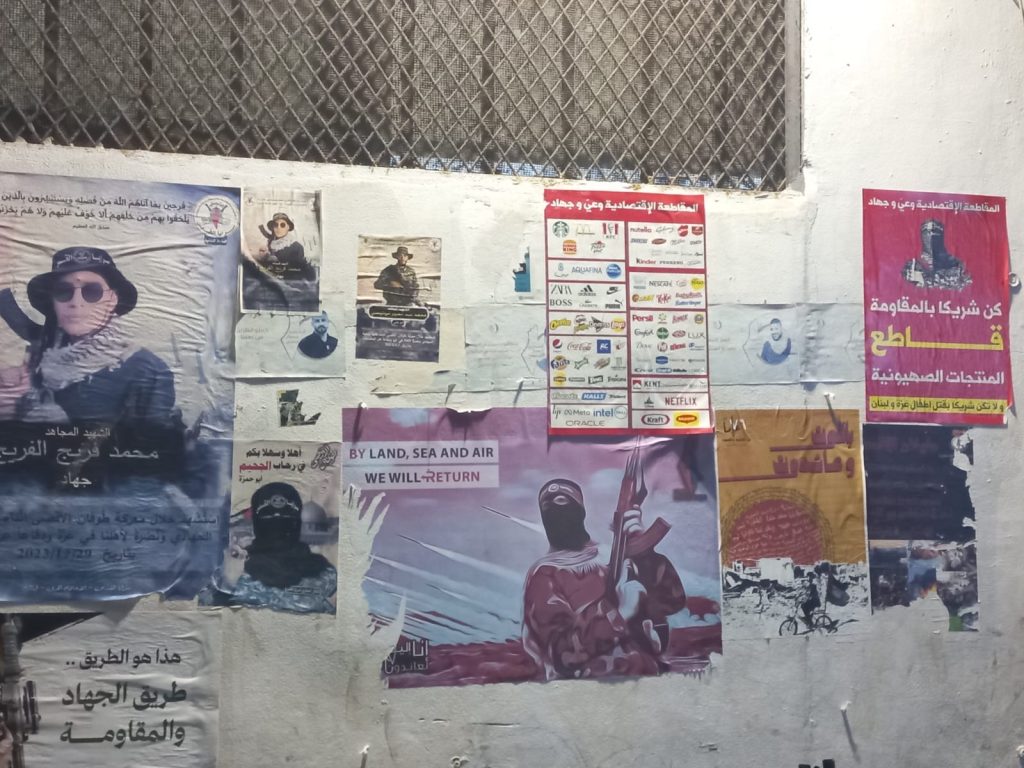
But the current worries of the Palestinian residents of Shatila are more broadly an outcome of the current state of affairs in Lebanon. This includes the defeat of Hezbollah as a resistance organization, the recent election of what is perceived as a Saudi and U.S.-friendly Lebanese president, the news of the possible disarmament of Hezbollah — and by extension, the Palestinian factions — and the general state of hopelessness and helplessness amid the resumption of the genocide in Gaza after the ceasefire.
The fear in Shatila and other Palestinian refugee camps in Lebanon is starting to gain traction. The Lebanese government’s accusation that Hamas is behind the rockets is seen as “a prelude to the introduction of disarming and attacking the Palestinian camps in Lebanon,” a Shatila resident named Waleed suggests.
All in all, the current situation is one in which friends of the Palestinian cause are absent. The shift in Lebanon is now toward a strong state, and UNRWA and the right of return are under assault by Israel. Amid this climate, Palestinians in Lebanon feel they have little leeway for negotiating with anyone.
The Lebanese state and Palestinians in Lebanon
Palestinians’ past experiences with the Lebanese state do not make them hopeful for their future if the camps are disarmed and put under the control of the Lebanese army.
While the first decade of Palestinians’ presence in Lebanon after 1948 went by largely without incident, in 1958, the Lebanese state put the camps under the control of the police and the Second Bureau — the intelligence unit of the Lebanese army — with the aim of controlling the camps. The people of Shatila, as well as other Palestinian refugee camps, remember this period as one of the worst, especially when it comes to surveillance, oppression, and the denial of dignity.
Shatila residents speak of how the Second Bureau and the Lebanese police restricted mobility and controlled every aspect of people’s lives. “My auntie told me that she needed permission to leave the camp to visit her sister in Burj al-Barajneh refugee camp, which is ten minutes away,” Umm Mahmoud says. “The Bureau banned all meetings except family gatherings. Some people could get access to news from the radio or from newspapers to follow issues related to Palestine before, but the Bureau banned these, too. They wanted to know what we read, what we ate, when we went to the bathroom, and who we talked to,” Umm Mahmoud says.
Others speak of how the Lebanese army denied Palestinians the right to build homes or put corrugated steel sheets as roofs over their shelters. They were not allowed to even build bathrooms, instead using designated bathrooms that men, women, and children had to walk a distance to reach, day or night. “The trip to the bathrooms was the most painful,” Umm Mahmoud explains. “The Lebanese Second Bureau members harassed us, mocked us for not having bathrooms, for living in tents, and sometimes they harassed women.”
Shatila residents spoke of similar humiliation from the police. “My mother told me how one time, the police dragged her from her scarf for pouring water on the streets. This was not allowed. They created rules for everything to suffocate the Palestinians,” Umm Mahmoud intimates.
While the period of the PLO’s presence in Lebanon restored some dignity for Palestinians, the withdrawal of the PLO from Lebanon in 1982 culminated in the War of the Camps a few years later. This led to the deprivation of Palestinians’ civil rights, with the excuse that the Lebanese state was safeguarding Palestinians’ right of return.

Palestinians in Lebanon are still banned from 32 professions and allowed only menial jobs. “This is a typical move: using the Palestinian cause in order to suppress the Palestinians,” Mahmoud, a resident of Shatila originally from Syria’s Yarmouk refugee camp, observes.
“As the late Shafiq al-Hout would say,” he notes, referring to the Palestinian writer and politician who was one of the founders of the PLO, “the Lebanese love Palestine, but hate the Palestinians.”
Mahmoud pauses for a moment before continuing his point. “It seems this is the case for many actors; Egyptians cry out against the dismantling of the Palestinian cause, but they are okay with the ongoing genocide against the Palestinians; Syrians were for Palestine, but destroyed the camps in Lebanon and in Syria.”
“What will happen now?” asks Samira, another resident. “Will the Lebanese state grant us civil rights as they are signing off on the dismantling of the Palestinian cause? Will we be displaced to other countries? Will we be besieged? It all seems bleak.”
‘The camps are the target’
When Shatila residents speak of how the Palestinian cause is being dismantled in Lebanon, they are not only referring to fears of interference from the Lebanese state; they are also worried that the ongoing Israeli attacks across Lebanon will soon come for Palestinian refugee camps. Some in Shatila wonder whether disarming the Palestinian camps will be the Lebanese army doing the Israelis’ work for them, will be done by Israel directly, or will take on the form of a war between different Palestinian factions within the camps, particularly Hamas and Fatah. Israel’s global attack on UNRWA is the first step, and its effects have started to be felt in the camps.
“Watching Jenin and Tulkarem being wiped off the map reignites memories of similar times when camps were destroyed in Lebanon.”
Waleed, a Palestinian resident of Shatila refugee camp.
Beyond these immediate fears of what disarming the factions might mean, Shatila residents are worried about the dismantlement of the camp as a commune for Palestinian refugees in Lebanon. These fears are based on the perception that everything connected to the Palestinian cause is now under attack in the region.
“The camps are the target,” says a Shatila resident named Ayman. “Palestinian camps everywhere are being destroyed, uprooted. They were ethnically cleansed in Lebanon during the Civil War, in Syria, now in the West Bank — and next, in Lebanon again.”

Waleed, another Palestinian in Shatila, believes that targeting the camps in Lebanon is only a matter of time, and the only question that remains is when and how. “Is it going to be total destruction of the camps? War? A call to leave? ” he wonders.
Mahmoud, who fled Syria’s Yarmouk refugee camp during the Syrian Civil War and resettled in Shatila, thinks these fears are well-founded when looking back at history. “You know, just think about the past decades, there has been a systematic war on the camps as a commune for the Palestinians,” he contemplates. “Look at Syria: total destruction, siege, starvation, and displacement. Before that, Iraq. Then Gaza. And now the West Bank.”
“Of course, the Lebanese are pioneers,” Mahmoud makes sure to add. “Two camps were wiped out during the [Lebanese] Civil War. And one, Nahr al-Bared, was almost wiped out [in 2007]. And let’s not forget the attempt to wipe them out during the War of the Camps.”
“They were different times,” Mahmoud muses. “We resisted, and there were compromises. But now, with Israel gaining the upper hand, and in light of the decision to end the Palestinian cause, of course, we’re next!”
“Watching Jenin and Tulkarem being wiped off the map reignites memories of similar times when camps were destroyed in Lebanon,” Waleed says. “We learned about some of them from stories our parents told us, such as the destruction of Tal al-Zaatar and Dbayyi camps at the beginning of the Lebanese Civil War. Others we witnessed ourselves, such as the War of the Camps, and the attack on Nahr al-Bared.”

The Palestinian refugee camp of Tal al-Za’tar was established in 1949 on the eastern side of Beirut in the Dekwaneh area. The camp was the first to be targeted at the beginning of the Lebanese Civil War in 1976, besieged and attacked by different right-wing Christian militias and aided by the Syrian army. Before its eradication, hundreds of its residents were massacred, and the rest were displaced to other camps in Lebanon.
More recently, in 2007, Nahr al-Bared refugee camp in northern Lebanon was completely destroyed and its residents displaced after a confrontation between the Lebanese army and an Islamist group known as Fatah al-Islam, who were said to have taken refuge in the camp. Most of its residents were displaced, and the camp is yet to be reconstructed. Nahr al-Bared had been considered the second-largest refugee camp in Lebanon after Ain al-Hilweh in the south
“What model will be used now?” Waleed wonders. “Tal al-Zaatar and Dbayyi — wiping us off the map? Or is it the model of Nahr al-Bared and the War of the Camps — destroying it but allowing some Palestinians to remain after disarming?”
As for Mahmoud, watching the news in Jenin and Tulkarem brought back his memories from the siege of Yarmouk during the Syrian Civil War. “Perhaps Yarmouk was not bulldozed in this same way, but it was erased,” he says. “We were under siege. There was no food, no water, and there was shelling from all directions. Was it because of so-called terrorists in the camp? Or was it because the camp was the target?”
“Now, reflecting back, the camp has always been the target,” Mahmoud says decisively. “Yarmouk was our little Palestine, a Palestinian commune that contributed to keeping the memory of Palestine alive for generations. Yarmouk was the home of the ‘Ashiqeen singing troupe, one of the first bands to revive Palestinian folklore. It was the home to Shajara Press, which produced histories of the villages of Palestine. And there were endless other initiatives that kept the story of Palestine alive.”
“Ironically, the trope of terrorism was used to destroy Yarmouk and other Palestinian camps in Syria, as it is now being used by Israelis to destroy the Palestinian camps,” Mahmoud observes. “It is the dream of Palestine that is being targeted — the very idea of Palestine, the memory of Palestine, the right of return.”
“Shatila has been our little Palestine,” Khaled, another resident, echoes. “At the start, the different alleyways of the camp were inhabited by different people based on their village of origin in Palestine. Here, where we are, is where people from Majd al-Kroum used to live. Next door were people from Saffouriyyeh, and then Kabri. On the other side were residents originally from Safsaf and Kuwaykat.”
“The destruction of the camps during the Israeli invasion in ‘82, and then the War of the Camps and subsequent reconstruction projects, have blurred these spatial divisions. But the camp is still our little Palestine in different ways,” Khaled emphasizes. “It was the space that kept our dialect. While UNRWA schools did not teach us the history of Palestine, the elders in the camp told stories of the Nakba. And as a response to the renaissance of the Palestinian fedayeen after the Battle of Karama in ‘68, Shatila camp is where the call for the right of return was sparked in ‘69!”
“It is in the camps where the revolution found its legs. We were the gunpowder of the revolution who fought for Palestine.”
Waleed, a Palestinian resident of Shatila refugee camp.
“For the Lebanese, the camp was a contradictory space,” says Muna, a social worker in Shatila who likes to be identified as from Saffouriyyeh. Referring to the years of the PLO’s operation in the camps during the 1970s and 80s, she says that “on one hand, it was a way to control Palestinians in one space and surveil them. On the other hand, after the rise of the PLO, it became a space for recruitment. It was a ticking time bomb that could explode at any time.”
As for whether the camps would now be liquidated by the Lebanese state, Muna is hesitant. “Getting rid of it could be a good idea for the state, but where to displace the Palestinians?” she says, adding that if Lebanon is paid to do it, then “surely the Lebanese would love to scatter us to the ends of the earth.”
“On the wall of Shatila, a sentence has always been inscribed for generations: the camp is the Palestinian cause,” Waleed affirms. “Because it is a reminder of the Nakba, of the displacement of the Palestinians from Palestine. The mere presence of us in here is a reminder of the Palestinians’ plight.”
“It is in the camps where the revolution found its legs,” Waleed asserts solemnly. “We were the gunpowder of the revolution who fought for Palestine. Think about Jordan, Lebanon…it was all camp people who picked up the rifles and resisted.”
“It is for this reason that there is a war on the camp,” Mahmoud adds. “Israel is working to end the Palestinian cause, so of course, the camp will be the target. If Israel is ending UNRWA to abrogate the right of return, logically, the camp is next.”

The camp will remain
On a day of action for Gaza, Palestinians from the Beirut camps gathered in the corniche to “cry out in support” of the people of Gaza. The speeches were ones of defiance. Palestinian flags were out, kids and women wore traditional embroidered Palestinian dresses, and buses brought people from the camps in droves.
But unlike the energy one can feel in demonstrations around the world, the mood was mostly one of fear, aside from the running kids enjoying the corniche as a new space to play far away from the narrow alleys of the camps.
Speakers called on the world to support Gaza, and they offered ten points on ways to contribute, including donations, boycotting Israeli products, and boycotting the U.S. and countries supporting Israel, like Germany, the UK, and even the UAE.
The participants were mostly Palestinians, with barely any Lebanese. “Lebanese are worried about their own,” one demonstrator explained. “They received a big blow. Who can blame them? They participated in the war and were hit. We are not asking for more.”
For other demonstrators, the lack of participation was indicative of “the new direction Lebanon is taking — being thrown in the American lap, God help us,” a demonstrator from Burj al-Barajneh refugee camp declared.
The hope is that no new war will erupt and that there will be no more loss or destruction. Silence seems to be the current advice, as words leave no echo.
Back in Shatila, one sentiment remains certain among Palestinians: the struggle “will continue whether they dismantle the camp, oppress us, or kill many of us, as is happening everywhere,” one of the Shatila residents observes.
“We shall not abandon the dream of return. We will not stop telling our stories and we will not stop passing on the love of Palestine to future generations,” another of the residents says, only to be interrupted by another resident who points out how “Palestinians in the diaspora are active. They did not need to be deprived of their civil rights to keep fighting for Palestine, and we, too, shall remain steadfast.”
As I leave the camp, a friend accompanies me to the outskirts. “Take a photo of the camp before you leave, a last one, perhaps.” Then he points out that “a photo is a physical object, a memory. Take a last look and keep it in your mind. Memories can be reconstructed later, and maybe we can imagine Shatila after it is gone, as if it were the Galilee and all the villages we came from.”
I lift my hand, mimic a camera with my fingers, and say, “Click! Click! I’ve taken a picture of Shatila in my memory. Shatila will always be the resistance camp, the camp of beautiful people, the camp of dignity and hope.”
Mayssoun Sukarieh
Mayssoun Sukarieh is a member of the research committee at the Institute of Palestine Studies.