
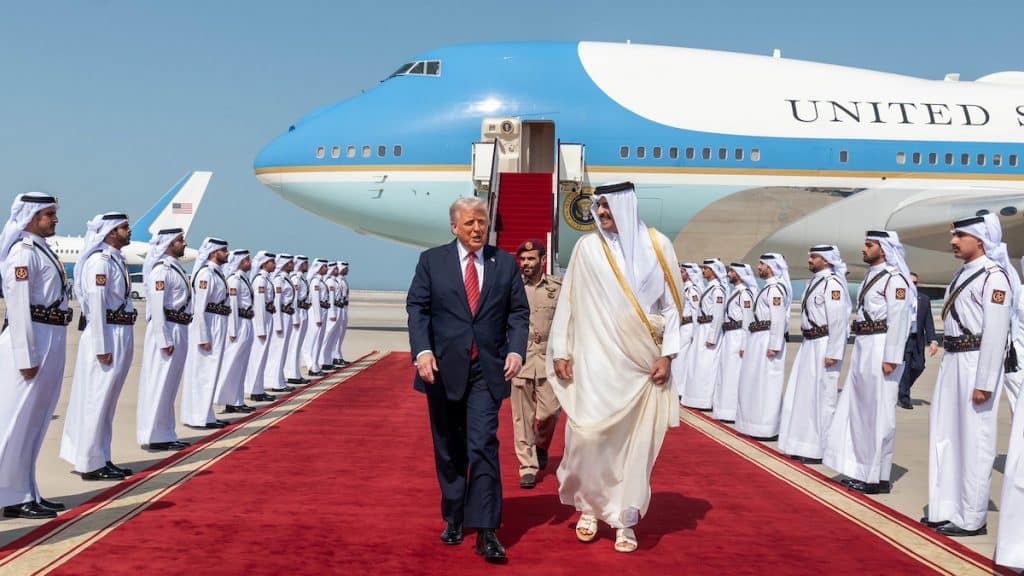
Donald Trump has completed his brief tour of Middle East states, the first of his second term in office. It was a headline-grabbing tour, with scandals, important announcements, and events happening alongside the President’s appearances. It was equally notable for what was missing: Palestine.
The issue of the genocide in Gaza could not be relegated to complete invisibility, of course. It’s too important to the host countries, Qatar, Saudi Arabia, and the UAE, all of whom have some interest in seeing the genocide end and allowing the comfortable fiction of a two-state solution to re-enter diplomatic discourse.
But the big announcements from Trump and the gathered Arab leaders did not include any measure to stop the genocide raging in Gaza, and didn’t even mention the escalation of ethnic cleansing in the West Bank or Israel’s recent decision on land registration which amounts to full annexation of more than half of the West Bank.
Trump would like the public to focus on his exaggerated, though still significant, trade and arms deals. And, indeed, it is important to recognize that Trump is sharply escalating the long-term American project of flooding the Middle East with ever greater quantities of increasingly sophisticated weapons. In the process, the Trump administration is dramatically strengthening support for some of the most brutal dictatorships in the world, and is very blunt about doing so.
While there were also some positive developments from his trip, including Trump’s promise to end sanctions on Syria, Trump’s silence on Palestine shows that while the administration might be cutting Israel out of its broader regional policy making, it is not interested in pushing Israel on what it considers “internal” matters like the genocide in Gaza, the ethnic cleansing and annexation of the West Bank, and the occupation and apartheid in general.
Ending sanctions on Syria
The most positive announcement was Trump’s announcement that he intends to drop sanctions against Syria and allow the new government there to stabilize the country.
It is not quite that simple. Congress still needs to go along with this, and during that process, a lot can go wrong, especially given that Israel isn’t at all pleased with the prospect. Israel, too, has been communicating with Syria about normalizing relations because they have to, given Trump’s desires. But they have also voiced objections to their allies in Washington, including leading Republican figures.
But if Trump continues to endorse it, sanctions will be lifted, and that is a necessary first step toward any progress in rebuilding Syria. Israel has been relegated to the position of frustrated junior partner and a voice that the Trump administration is ignoring on many regional matters outside of the boundaries of Palestine. But whether Trump will be willing to weather political backlash to lifting sanctions, if there should be any, will depend on how the new Syrian president is perceived.
Syrian President Ahmed al-Sharaa is a controversial figure, due to his past associations and clashes with both ISIL and al-Qaeda. Yet he has gone out of his way to be accommodating to both the United States and Israel. He has repeatedly offered normalization with Israel, despite Israel’s unprovoked attacks on Syria and its advances in occupying more Syrian territory since al-Sharaa toppled the regime of Bashar al-Assad. He has all but ignored the plight of the Palestinians during his time in office.
Al-Sharaa is in an advantageous position, as he is supported by Saudi Arabia and Türkiye, two powers often on opposite sides of regional matters. With Saudi Crown Prince Mohammed Bin Salman (MBS) and Turkish President Recep Tayyip Erdogan both advocating for dropping the sanctions, Trump was swayed.
Trump’s deals

A lot of numbers have been thrown about, but whether Trump is exaggerating the figures or not, the deals that have been announced are significant.
Saudi Arabia alone agreed to a $142 billion deal for military equipment and as much as $600 billion in investments. Qatar and the U.S. agreed to deals worth at least $243 billion, although the White House claimed they really amounted to $1.2 trillion.
Trump also brokered massive sales of highly advanced computer chips, particularly to the UAE. The deal, which will require the reversal of a 2022 law passed under Joe Biden that sharply restricts the export of such chips, could make the UAE a leader in AI tech on par with the U.S. and China.
Because so much of the money involved is based on American firms doing business in the Middle East and in the world of high technology, the number of jobs in the United States they will generate is likely to be far less than whatever Trump eventually claims.
Trump continued his self-contradictory approach to Iran while in the region. Speaking in Saudi Arabia, Trump ran down the litany of anti-Iran talking points, repeatedly threatened them with both military and economic devastation, but then reaffirmed his desire to reach an agreement with the Islamic Republic.
Of course, with Trump, there always needs to be an element of absurd comedy involved. On Thursday, he told reporters that Iran had “sort of” agreed to a deal. Reports are that Trump’s negotiator, Steve Witkoff, gave Iranian Foreign Minister Abbas Araghchi a written proposal last Sunday.
What Trump’s “sort of” means is that Araghchi took the proposal and said he would discuss it with Iranian leadership. The Supreme Leader, Ayatollah Ali Khamenei, has final say, but that is the last stage of the decision-making process in Tehran. Araghchi came to Oman with specific parameters and red lines, and if an American proposal fell within those boundaries of acceptability, Araghchi could tell his interlocutors that they would consider it. That’s the “sort of” agreement Trump is referring to.
But that does mean there is reason to hope that there can be progress toward an agreement. Trump has repeatedly stated that he has no desire for a war with Iran, and that is very likely true. It would contradict one of his key commitments to his base on an issue of “America First”—staying out of Mideast wars—that is important to that base as well as to many of the MAGA ideologues in his circle.
More to the point, it is important to his friends in Saudi Arabia, the UAE, Qatar, and Türkiye to avoid a regional war. It is also important to all the billionaire Americans who tagged along with Trump for this Mideast excursion.
Tehran, for its part, denied receiving a fresh proposal, but this could just mean that what Witkoff gave them was light on details. That is almost certainly the case in any event, but Tehran’s denial could indicate that they want to continue what has been a constructive dialogue but are not prepared to call something a new “proposal” unless it is fairly well fleshed out. That would be a sensible position, reflecting Iran’s preference for patience, in contrast to Trump, who very much wants to be able to claim a quick victory.

Israel’s fear of ‘nightmare scenario’ on Iran
Meanwhile, Israel’s opposition to the ongoing talks with Iran is barely registering for Trump. While Benjamin Netanyahu and the rest of his government are remaining silent for fear of incurring Trump’s wrath and perhaps being squeezed out even more, the far-right, pro-Netanyahu newspaper Israel Hayom headlined their article on Thursday about Trump’s trip, “Israel bracing for a ‘nightmare scenario’ in Trump visit.”
This was doubtless meant as a way of expressing Israel’s dismay without it coming from the government. Yet, ironically, Israel’s concerns, which are deeply rooted in their own wish for endless confrontation and conflict, echo realistic ones.
As Israel Hayom put it, Trump has a “tendency to pursue quick agreements without addressing the implications for the entire Middle East…”
That’s true, and it is a legitimate concern for reasons that have nothing to do with Netanyahu’s deep desire for war with Iran.
Trump is flooding the region with even more weapons and setting the major Gulf states up as leading competitors in cloud-based technology, especially AI, which has become a major focal point of global competition. He is also raising the stakes for regional nuclear energy agreements. Those may include Iran, but they may not, and the conditions for even civilian nuclear energy, if not spelled out clearly and monitored by the International Atomic Energy Agency, can lead to more tensions, just like those between the U.S. and Iran.
Those concerns could also turn out to be unfounded. The rise of a Mideast tech center that isn’t centered in Israel could force the U.S. and China into closer cooperation in the region, given the good relations the UAE and Saudis have with both powers. Civilian nuclear energy could likewise strengthen ties between Iran, Saudi Arabia, and the UAE.
The problem is, there is no reason to believe that Trump is considering these concerns at all. Making sweeping trade and defense deals always has the potential for unintended consequences. Some of those are foreseeable, and care must be taken in crafting agreements to address them. Trump’s track record and approach to these specific deals do not seem to bother with such trivialities, and we should all be worried about that.
Whither Palestine?
Trump has shown a clear willingness to cut Israel out of what he perceives as decisions that are about U.S. interests. These have included Iran, a Saudi nuclear program, the dropping of Syria sanctions, massive upgrades to the Arab Gulf states’ tech sector, and the cessation of the American bombing of Yemen. He has also shown a willingness to potentially put some political capital behind those moves, or at least he might if there is any congressional backlash to them.
But he is less willing to expend the sort of political capital it would require to force Israel to end its genocide in Gaza or to stop its ongoing annexation of the West Bank.
But “less willing” does not mean “unwilling.” The Qatari Emir made it clear that he hopes that Trump will use his influence to end the genocide in Gaza, a pointed reminder to the U.S. president who barely mentioned Gaza in his 45-minute speech the previous day in Saudi Arabia.
Still, it was notable how little attention was paid to Palestine during these events. The reason, of course, is that this is the one arena where Trump would have to directly confront Netanyahu to make changes on the ground. If he was pressed hard enough by his Arab partners, and if Netanyahu angered him sufficiently, one can see Trump doing so.
As journalist Jeremy Scahill put it, “It is an obscene reality that the best hope for ending the Gaza genocide may lie in the possibility that Trump determines that his personal priorities are in such sharp conflict with Netanyahu’s agenda that he decides the war must end.”
Scahill has it right. But the other necessary factor is pressure from the Saudis and Emiratis. While both of those states want to see the genocide end, they are less eager to see Trump use the sort of hardball tactics that would be required. A big part of Trump’s appeal to them is his mantra of not “telling other countries to act.” That’s not a precedent they are eager to see broken, as it would certainly embolden later presidents who might see political advantage in pressing the dictatorships on human rights, even if they do so cynically, as was the case with Joe Biden.
There seems to be even less interest in Israel’s annexation of the West Bank. On Monday, Israel’s security cabinet authorized a decision to implement land registration in Area C of the West Bank and to block a similar effort by the Palestinian Authority in other parts of the occupied territory. This is a direct contravention of the law of occupation because it essentially means the occupier is handing out property rights to its citizens and businesses. It’s annexation, pure and simple.
Yet there has been nary a sound about it from either Washington or the Arab states that claim to be so interested in an ephemeral “two-state solution.” Trump and most of his team probably don’t fully understand what Israel has done with this decision, but the Arabs do. They apparently do not care.
The Gaza genocide remains an irritant for Trump. It is an example of Netanyahu reneging on a deal brokered by the President of deal-making. It de-stabilizes the region, an economic concern for Trump’s business cronies and both a political and economic concern or his Arab partners.
That might eventually spur some action, but there seems to be little urgency among the Gulf states. While the genocide continues to escalate, and as Israel daily bombs hospitals, schools, and tent encampments, slaughtering hundreds, Saudi Arabia has de-coupled normalization with Israel from its pursuit of a nuclear program and a defense agreement with the U.S., and both Qatar and the UAE are getting what they want from Washington in the near term. Israeli adventurism beyond Palestine is quieting, with attacks on Lebanon less frequent and a potential deal with Syria now a real possibility. Even the Iran front holds out hope for a diplomatic solution.
With all of that, the Arab states’ motivation to speak out against the genocide is diminished. The Palestinians are being tossed aside again and left to the tender mercies of the Netanyahu regime. They have no $400 million palatial jets or billions in oil investment dollars to offer Trump. Unless the equation changes, even while Trump s likely to prevent Netanyahu from drawing the entire Mideast into a war, there remains little hope for action from Arab or western leaders for the Palestinian people.
Trump has proclaimed that if a state offends Trump, it can expect to brutality from the US military. Of course, crowds and leaders of the Gulf states show immense hospitality and gratitude for Trump’s peaceful visit. In the days of Genghis Khan, similar leaders and crowds showed immense hospitality and gratitude for Genghis Khan’s peaceful visit.
Saudi Arabia just keeps talking about standing up for the Palestinians and their right to self determination. Words are something. Deeds much much better. Long overdue for serious sanctions against Israel….way overdue