
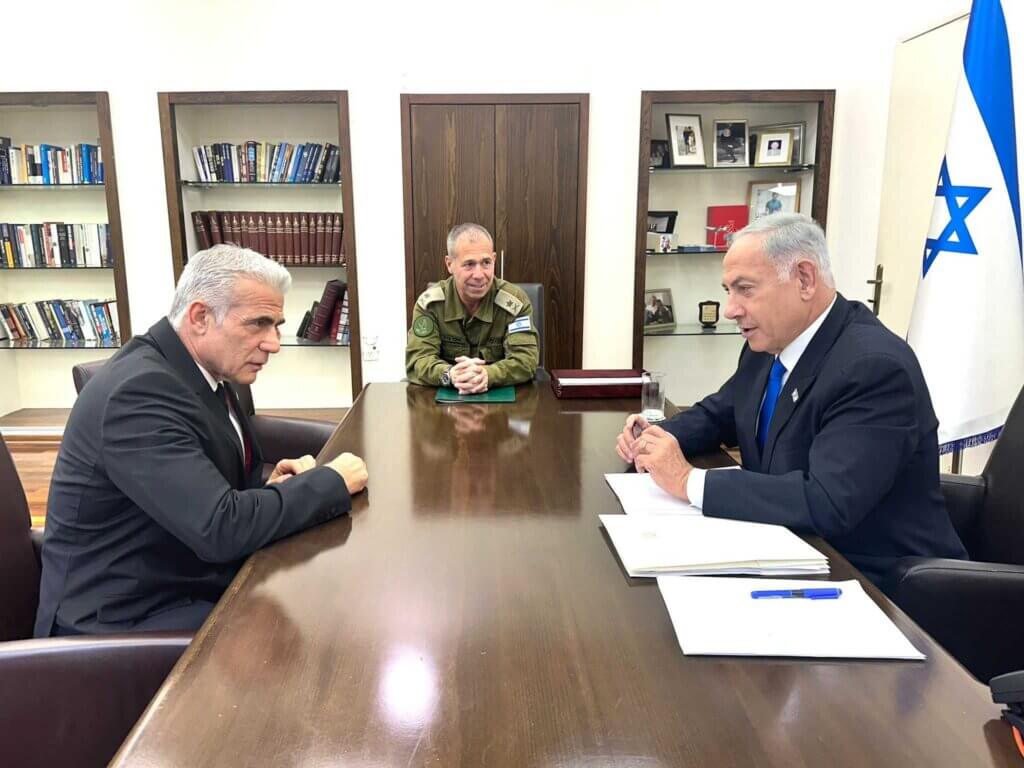
Liberals in the West who want to criticize Israel will often point to Prime Minister Benjamin Netanyahu as the source of the country’s issues. They will emphasize his corruption, his attempts to avoid prison, or his need to court those further to the right to explain away everything from expanding settlements in the West Bank to carrying our a genocide in Gaza.
They are now framing Israel’s aggression in Iran in the same way as Netanyahu’s war, but opinions within Israel, including those from ‘liberal Israelis’ suggest otherwise. In fact, war with Iran has historically, as well as currently, been pushed and supported by the entire Zionist political spectrum, from left to right.
It is important to understand this, in order to understand just how overwhelming the Israeli support for Israel’s illegal attack is.
The polling shows this to be the case.
A recent poll conducted by The Hebrew University of Jerusalem’s Agam Labs shows Israelis overwhelmingly support the aggression against Iran, with only 16% opposing it. The 16% is heavily weighed by the 68% of Palestinians who oppose it (20% unsure, 12% support). Among Jewish Israelis, less than 5% oppose it.
This has long been reflected among Israel’s political leaders, including the so-called opposition.
Less than a week before the attack, Israeli opposition leader Yair Lapid chided Netanyahu for not having attacked Iran earlier. In an Haaretz podcast he said:
“It would have been possible to handle it in a way, that you inflict a severe blow on Iran, a blow that would have the potential to topple the Iranian regime, because it collapses the economy, which was in trouble anyway… it was simply a much better opportunity, one of a great many opportunities which haven’t been taken advantage of.”
It is not uncommon that a figure associated with the Israeli liberal class would be more hawkish on Iran than Netanyahu himself.
In his memoirs, former Labor leader and Prime Minister Ehud Barak boasts of being more hawkish than Netanyahu on the issue of attacking Iran when Barak was Defense Minister under Netanyahu from 2009 to 2013. Barak, who is often nicknamed “Mr. Security” in Israel, didn’t believe Iran posed an “existential threat” – in his eyes, the issue was a change in regional balance of power, and the loss of Israel’s regional nuclear monopoly. Barak wanted to preempt Iran’s “zone of immunity” – where it was no longer possible to significantly damage the Iranian nuclear program. His idea was to message to the Iranians that “we could always attack again” and that it would not be worth rebuilding their nuclear facilities.
So Iran has always been a political question that Barak and many others have suggested should be handled with aggression and belligerence. And most of the Israelis are behind it. What is the objective now, more precisely?
According to the Israeli head of the National Security Council Tzachi Hanegbi (Likud), Israel does not even hope to destroy the Iranian nuclear project entirely, because this is deemed impossible. In an interview on Saturday with the Kan public broadcaster, he said that the goal was to force the Iranians into a new nuclear deal with the United States. Channel 12 news then reported that the government’s calculation before its attack on Iran was that it would cost between 800 and 4,000 Israeli lives. A price evidently worth paying to retain military superiority in the region.
Ehud Barak confirmed Hanegbi’s assessment of possible military achievement. Saturday, he told Christiane Amanpour on CNN:
“In my judgement, it’s not a secret that Israel alone cannot delay the nuclear program of Iran by a significant time period, probably several weeks, possibly a month—but even the US cannot delay them by more than a few months.”
Amanpour wonders: “What is the point then?”
Barak begins to mumble:
“It’s uh, it’s problematic, it still has a justification from the point of view of Israel. Uh, eh, instead of sitting idle, our government feels that they have to do something… probably together with the Americans we can do more.”
Barak repeats the “immunity zone” and the “threshold” idea that he has forever been pushing:
“My judgment is, that because Iran is already what is called a ‘threshold nuclear power’, then the only way to block it is either to impose upon it a convincing new agreement, or alternatively open upon it a full-scale war to topple down the regime. That’s something that together with the US we can do, but having said that, I don’t believe that any American President – neither Trump nor any one of his predecessors would have decided.”
Well, that sounds amazingly coherent. They are just going for destruction, and let’s see what comes out of it. That’s Barak from the “left” of Israeli politics. He’s actually supporting Netanyahu, no doubt because he has long been a proponent of this madness and overhauled him on the right.
‘The pilots of Kaplan’
Saturday night, an Iranian missile hit Tel Aviv in close proximity to Israel’s main military headquarters on Kaplan Street. This military headquarters, known as HaKirya, is situated in one of the most bustling civilian areas in the country. It is adjacent to the Sarona shopping mall, next to the Tel Aviv Museum, and close to many apartment residences. To be sure, if Hamas had such headquarters in such an area, it would be yet another pretext for Israel for its eternal propaganda claim that “Hamas uses civilians as human shields”.
Kaplan Street is also known in Israel for something completely different than the military headquarters – the wide street has been the stage for the massive demonstrations (before October 7, 2023) against the government’s judicial reform. These protests were often called the “Kaplan demonstrations”. Thus, it also holds an iconic place in Israeli liberal thinking as a signifier for “democracy.” On Friday, Orna Berry, who is a science entrepreneur and former chief scientist for the Israeli government, tweeted the meme: “At this time, all of Kaplan is above Tehran. Return in peace.” By this she was offering her support to the pilots who have also been prominent in the protest movement for Israeli “democracy” and are now the ones attacking Iran. Indeed, many of the same pilots who bomb children across Palestine also consider themselves liberals, and the Israeli public generally calls them “the best.”
This is how the Israeli public sees the aggression on Iran. Although they don’t exactly see how they will get out of this war and what they will get out of it, they have been told for ages, and by many, that attacking Iran is a good idea.
Netanyahu surely understands that this issue is one that can really unite the nation – and that’s something that he loves and needs, especially for himself right now. It also adds a smokescreen in relation to the Gaza genocide and the accelerated ethnic cleansing of the West Bank.


The Fragility of Jewish Supremacy in Israel
June 19, 2025
Israel’s new front with Iran signals the Netanyahu government’s willingness to induce terror in its own public, writes Miko Zeldes-Roth from Jerusalem.
“I arrived in Jerusalem last Thursday evening.
Twelve hours later, I awoke to the news of the Israeli military’s attack on Iran — having slept through the sirens in the night.
I am an American Jewish activist and researcher; I have spent time on and off in Israel/Palestine throughout my life. But this visit has been unlike any other. Four days in, I have found my eyes opened by the breathtaking recklessness of the current Israeli government.
The attacks on Iran are but the latest action by a political leadership that, lacking public legitimacy since the Oct. 7 attacks, seems determined to use terror to re-secure a public mandate for its otherwise vulnerable project of Jewish supremacy.
Power and violence, the political theorist Hannah Arendt argued, are negatively correlated. “Rule by sheer violence comes into play where power is being lost,” she noted in her 1969 treatise, On Violence.
Arendt’s argument rests on the insight that a government’s power is constituted through public support and participation. Violence can sustain regimes that otherwise lack public legitimacy, but at tremendous cost.
If the cost of Israeli state violence has been borne by Palestinians for decades — and with untold brutality since the Oct. 7 Hamas attacks — Israel’s new front with Iran signals the Netanyahu government’s willingness to use its own public as bait for Iran, in a desperate bid to re-secure legitimacy with that very public.
By initiating this confrontation, Prime Minister Benjamin Netanyahu and his government are knowingly courting a situation in which Israelis will be terrorized by Iranian missiles.”
https://consortiumnews.com/2025/06/19/the-fragility-of-jewish-supremacy-in-israel/
Very interesting, not only because it confirms what many analysts say, i.e. that it is impossible to destroy Iran’s nuclear program militarily, but also makes the case that Netanyahu et al know it, and went ahead anyway.