
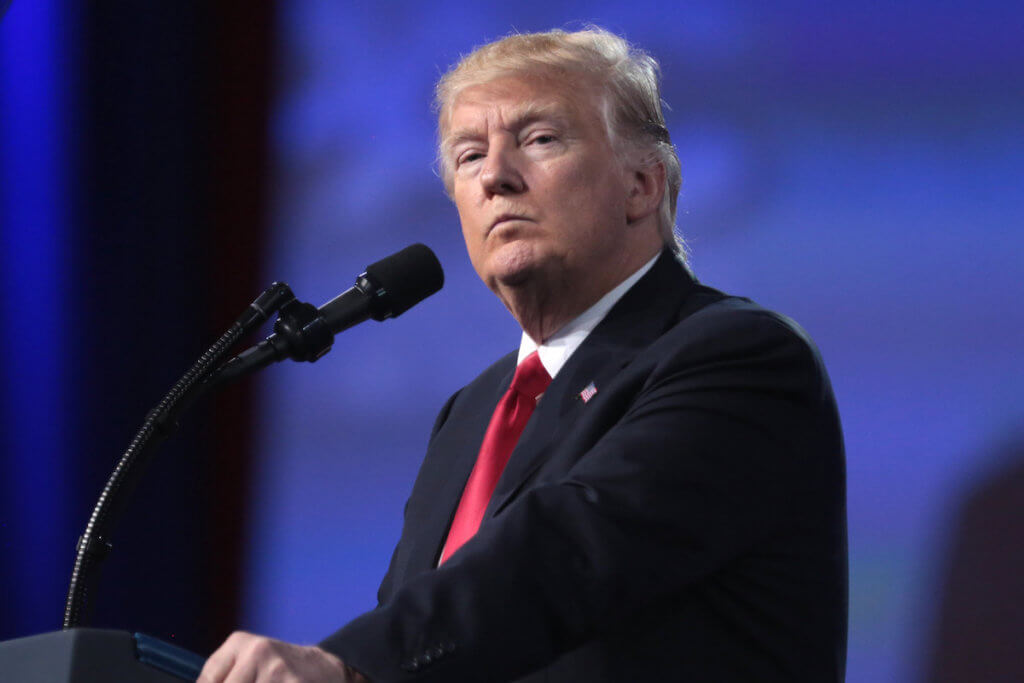
U.S. President Donald Trump said he was “not happy with Israel” on Tuesday after it launched an attack on Iran hours after Trump announced that a ceasefire would take effect between the two countries.
Trump had announced, in the early hours of Tuesday local time, that Israel and Iran had reached a ceasefire deal, and that it would take effect at 7:00 a.m. Iranian time. Although no written deal was announced, both sides halted their attacks, with Iran launching three volleys of missiles at Israeli targets in the last hour before Trump’s deadline.
Iranian Foreign Minister Abbas Araghchi stated that Iran would not “continue to retaliate” against Israel if the latter halted its operations. Israel, for its part, accepted the ceasefire, according to U.S. President Trump. Then, hours after the war officially ceased, Israeli sirens sounded again in the northern region of Haifa. The Israeli army said that it intercepted two Iranian missiles, while Iran denied having fired any missiles at Israel. Israel’s war minister, Israel Katz, said that he ordered the Israeli army to strike “strongly” in Tehran.
In response, the U.S. president said that he was “trying to get Israel to calm down.” Speaking to journalists before boarding a flight to attend a NATO summit, Trump said that “both sides broke it,” referring to the ceasefire, adding that Israel shouldn’t have sent its warplanes out to Iran, because of “a missile that landed nowhere and that was probably shot by accident,” referring to the alleged Iranian missile after the entry to effect of the ceasefire. “They don’t know what the fuck they’re doing,” Trump emphasized to reporters, referring to both Israel and Iran.
Trump later wrote on Truth Social that Israel was “not going to attack Iran. All planes will turn around and head home, while doing a friendly ‘Plane Wave’ to Iran. Nobody will be hurt.” Later, the Israeli army announced striking a radar station near Tehran.
The lead-up to the ceasefire started in the afternoon of Monday, after six Iranian missiles struck the U.S. Al-Udeid military base in Qatar. The attack was anticipated, as Iran had pledged to respond to the U.S. bombing of three Iranian nuclear facilities. An hour before the Iranian strike, Qatar announced it would close its airspace for the safety of its citizens and residents. After the attack, Trump thanked Iran, on his account on Truth Social, for giving the U.S. early notice before striking Al-Udeid base, calling the attack “weak,” and adding, “Now we can move to peace.” Hours later, Trump announced the ceasefire between Iran and Israel.
The direct fighting between Israel and Iran started on June 13, when Israel launched a series of surprise attacks on Iran, killing a number of Iranian military leaders and striking Iranian nuclear facilities. The attack included drone attacks launched from within Iranian soil by Mossad agents, according to Israel.
Iran responded on the same day with volleys of ballistic missiles on Israeli targets, some of which were intercepted by Israeli defenses, while some struck Tel Aviv, Haifa, and the greater Tel Aviv area. Israeli bombings continued, targeting Iranian state facilities in Tehran, Tabriz, Isfahan, Kermanshah, and Nahavand. Targets included military bases and nuclear facilities, but also scientists, residential buildings, the state television building, ministries, and a hospital. Iranian missiles struck the Haifa oil refinery, the Israeli war ministry, the Mossad headquarters, the Weizmann Institute of Science, air bases, and a hospital.
Israel’s attack on Iran came as the continuation of its military rampage across the region, which it started following the October 7, 2023, attacks. In addition to its absolute destruction of Gaza and the killing of over 60,000 Palestinians, 70% of whom have been women and children, Israel also launched a large-scale military campaign on Lebanon and an invasion and occupation of new territories in the south of Syria.
Last week, Israel’s Prime Minister Benjamin Netanyahu repeated what has become a regular talking point over the past 19 months when he told Israel’s Channel 14 that Israel is seeking to “change the face of the Middle East,” in order to achieve “a completely different Middle East.” According to Netanyahu, Israel wants to prove that peace can be reached in the region “without solving the Palestinian question,” and for that, he aimed at “removing the Iranian threat,” which he identified in its nuclear program, its ballistic arsenal, and its support to resistance movements in the region.
For decades, Netanyahu has made provoking a U.S. war against Iran a top priority. He personally advised the U.S. in 2003, during a congressional hearing, to attack Iraq, arguing that that would accelerate the downfall of the Iranian government, and urged the U.S. to continue to attack and topple governments in the region. Netanyahu wrote a book in 2001 advocating for this approach, and identifying Iran as a primary target. In 2012 and in 2015, Netanyahu warned that Iran was “months, maybe weeks” away from building nuclear weapons, and he fiercely opposed and criticized the Iran nuclear deal with European nations, Russia, and the U.S..
Although the U.S. did bomb nuclear facilities in Iran, it is not certain if the Iranian nuclear program was destroyed, as Iran claims that its enriched uranium had been secured beforehand. Iran’s ballistic capabilities continue to stand and function, Iran continues to be as influential in the Middle East as before Israel’s latest war, and there are no signs that Iran’s political system is changing anytime soon.
However, the region is now more volatile than ever. The scenario of a direct military confrontation between Israel and Iran, which all major actors in the Middle East have wanted to avoid for years, is now a fact. The current ceasefire between both is nothing more than a verbal understanding that risked falling apart only hours after taking effect, and most importantly, Israel is still waging military campaigns in the region, unchecked, while it commits one of the most obvious mass crimes against civilians in Gaza in total impunity. Although the 12-day war between Israel and Iran has ended, the possibility of a new conflict in the Middle East is still high, and peace is still far from sight.

Announcing a cease-fire before one has been agreed is a typical Trump tactic that we have seen several times since his return to the White House, in the Ukraine and Gaza conflicts. He hasn’t learned that trying to bounce warring parties into accepting whatever cockamamie plan he’s come up with doesn’t work.
The only entity that ‘doesn’t know what the fuck (he’s) doing’ is Donald Trump!
Bibi is working overtime now, feeling confident that he finally has the village idiot he needs in the WH to commit US troops to fight, and ‘defeat’, Iran for Israel. There is a ceasefire now, thanks to Trump’s having a hissy fit against Bibi. No worries, though, since Bibi will find a way to drag us (i.e. Trump) back into fighting Iran. There will be an ‘incident’, maybe a false flag, that will force Trump’s hand to send warplanes – and ultimately troops – into Iran.
Mark my words!
Neither the US nor israel are to be trusted…and not forgetting the UK.