

The ongoing Israeli war and blockade of food and humanitarian aid in Gaza have left pregnancy fraught with danger in the Strip, not only for mothers-to-be, but also for the midwives struggling to protect them.
“I work to support pregnant women in this makeshift hospital,” said Renad Salem, a 24-year-old midwife working at a UK-Med maternity facility. “But it feels like I’m the one in desperate need of support.”
Living in al-Shati camp in the north and serving in al-Mawasi Khan Younis in the south, Salem’s journey to work is a struggle in and of itself. She walks several kilometers before catching a ride at the al-Nabulsi roundabout in northern Gaza, which takes her to Tabet al-Nuweiri in Nuseirat in central Gaza. From there, a bus takes her to the hospital. “On July 17, I fell from a tuk-tuk — a three-wheeled rickshaw — while heading south and was injured because of the damaged road,” Salem recalled.
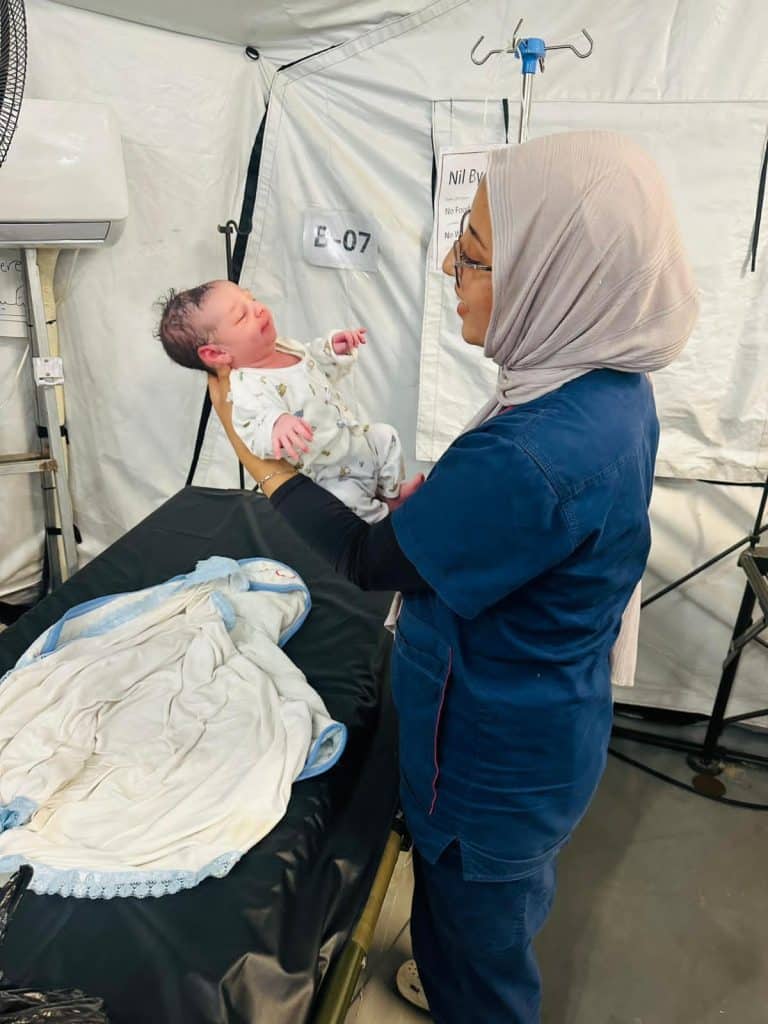
Perpetually short on food, Renad often works through headaches and dizziness brought on by hunger. “If we’re lucky and my family gets flour, I bring a single piece of bread to eat during a 24-hour shift,” she continued. “But there are days when I don’t have anything at all.”
Salem says that pregnant women arriving in their final month “look like walking skeletons,” explaining that the babies they give birth to are often just as fragile.
Power outages add another layer of danger. “During my last shift, the electricity cut out, plunging the delivery room into total darkness,” Salem said. “We had no choice but to use our phone flashlights to deliver the baby.”
Israeli shelling has left many women arriving at obstetric emergency departments with shrapnel wounds breaching their abdomens, striking both mothers and fetuses. In most cases, neither survives, but in other rare moments, life clings on.
“During one shift, I absorbed how life and death can coexist,” Salem said. “A woman, 34 weeks pregnant, was brought to us from Nasser Medical Complex. Her abdomen was bleeding after shrapnel tore through her body. Together with the surgeons, we performed an emergency cesarean. The baby was delivered safely, and, unexpectedly, both mother and child lived.”
But postnatal support in Gaza is now virtually nonexistent. “Our hospital used to provide new mothers with baby kits and basic items, but that’s impossible now due to the Israeli closure of the crossings,” Salem said.
Childbirth without painkillers
Childbirth without anesthesia, however, is where pregnancy becomes a nightmare. Pain medications in Gaza are now virtually nonexistent, and there are no substitutes. Oxytocin, vital for labor and postpartum recovery, is scarce, along with common drugs such as diclofenac, pethidine, and significant antibiotics like Rocephin, Cefazolin, and Zinnat.
Shaimaa Barakat, a midwife with Médecins Sans Frontières (MSF), has seen maternal healthcare fall apart in person. In northern Gaza, she worked through constant bombings, delivered babies in emergencies, cared for pregnant women overnight, and helped new mothers with almost no resources.
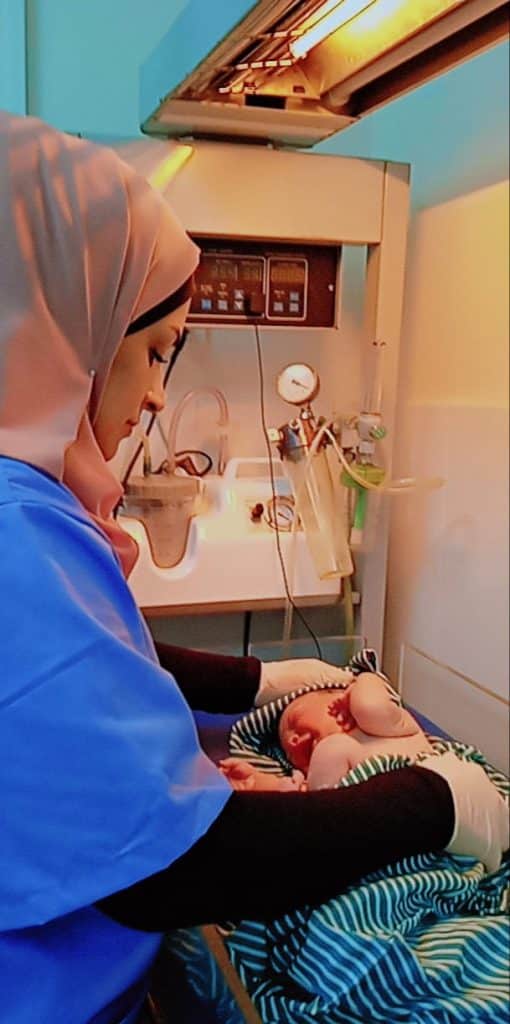
Before joining MSF, Barakat served with Project HOPE at the al-Sahaba Medical Complex, where the needs of mothers and newborns already far exceeded the available supplies.
When MSF’s maternity field hospital relocated to southern Gaza, Barakat could no longer make the dangerous journey north on a daily basis, so she decided to move there. The separation from her family was agonizing.
“There were days when I worked for hours in one place, while my husband and children were somewhere else under the airstrikes,” she recalled.
For mothers in the north, the situation is catastrophic. Pregnant women, new mothers, and infants receive almost no medical care. “We all know childbirth is one of the most painful experiences a woman endures,” Barakat told Mondoweiss. “Now imagine going through it without any assistance, without any pain relief, without anything to ease the suffering.”
Cesarean sections are being rationed out of desperation, with doctors forced to prioritize which women are given anesthesia.
Amidst this worsening crisis, the condition of newborns has deteriorated precipitously in the past few months due to the total obliteration of postnatal care infrastructures in Gaza. Israeli bombardment has destroyed nearly 80 percent of Gaza’s incubators, leaving babies without support. “Everyone knew there were no functioning incubators,” Barakat explained. “Any baby born with complications had almost no chance of survival.”
Famine leads to early births and miscarriages
The Ministry of Health in Gaza reported a catastrophic impact on the health of mothers and newborns in the first six months of 2025. Over 2,600 women had experienced an increase in miscarriages, and 220 pregnancy-related deaths occurred before childbirth. Premature births and low birth weight cases also increased: at least 2,500 infants were admitted to neonatal intensive care units, over 1,460 babies were born prematurely, and over 1,600 babies were underweight.
These famine conditions have fueled the crisis of pregnancy and childbirth in the Strip. “Expectant mothers need a healthy diet, but here they can barely find food,” Barakat explained. “When Israeli-imposed starvation struck the north at the beginning of 2024, miscarriages surged.”
Many women lost their pregnancies because they could not reach medical care in time. With bombs falling day and night, transportation during labor was often impossible. “I remember one woman who finally made it to us,” Barakat continued. “But she arrived carrying her unborn baby, the child she had long dreamed of meeting, already lifeless. She had spent the entire night searching for transport, but the Israeli airstrikes made it impossible.”
Today, the situation is far worse than in 2024. Earlier last month, the highest famine monitoring body in the world, the UN-backed Integrated Food Security Classification (IPC), officially declared famine in Gaza, stating that over 500,000 people in the Strip, roughly a quarter of the population, were either close to or had already reached catastrophic levels of famine (IPC Phase 5). The number is expected to rise to over a third of the population by the end of September, while 58% of the population is predicted to enter “emergency” levels of severe malnutrition (IPC Phase 4).
These harrowing conditions — in addition to the constant exposure to explosions that shock women’s bodies, the physical strain of hauling heavy water containers, the cooking over open fires due to gas shortages, and the psychological distress from the loss of loved ones — are all leading women to give birth prematurely.
“Every time I was at the hospital, I could almost be certain I would be dealing with multiple premature births,” Barakat recounted.
“One story that touched me was when a woman gave birth to a little girl and named her Amal, which means hope. When I asked her why she chose that name, she replied, ‘Because she is my last hope in this life after I lost all my children,’” Barakat added.
For babies in Gaza, survival doesn’t end with childbirth. Due to aid shortages, parents are unable to obtain even the most basic necessities, like food, clean water, and baby formula. Many families are compelled to raise newborns in makeshift shelters, and mothers lack access to sufficient nutrition, medical care, and protection before, during, and following childbirth.
According to UNFPA and Gaza’s Health Ministry, more than 50,000 pregnant and breastfeeding women face malnutrition as Israel’s blockade continues to choke off aid. The consequences won’t only endanger children today but will also reverberate for generations.
The British Red Cross cautions that long-term, frequently irreversible harm in children, such as stunted growth, impaired brain development, and organ dysfunction, can result from chronic malnutrition. Inadequate nutrition weakens immunity, increasing susceptibility to disease and infection in expectant mothers, new mothers, and infants.
Without immediate humanitarian assistance, Gaza faces the threat of losing both this generation and the next.

Holy Cow is right now devising a way to sneer at this.