

Every person on this earth has a special mission. The journey begins with searching for an answer to the question of knowing the secret of their existence. Some succeed in discovering this early, others late, and many never at all.
I believe I have recently found mine. I didn’t know it would weigh so heavily on my heart and mind, but for over a year now, I have carried it out—because it is worth it.
Most of my neighbors, friends, and family with whom I share memories and life experiences, have fallen victim to the ongoing genocide in Gaza. All that remains of them are brief snapshots preserved in my memory. In my neighborhood of Jabalia Camp in northern Gaza, I am the only writer, and my mission is to bring life to those memories and to honor the people we lost.
Beyond each statistic about the victims, there was a person with a name, a story, and aspirations for a brighter future. In their honor, I wrote the book, North Gaza Massacres: Jabalia Camp, which was published last August. It is a book of remembrance and resistance.
The Largest Massacre
On October 31, 2023, Israel dropped nearly 12 tons of explosives on Al-Sanayda, a neighborhood no bigger than a football field. The attack killed about 600 Palestinians from 40 families, the largest massacre in the history of the Palestinian-Israeli conflict.

I lived there. My earliest memories were shaped on Al-Huaja Street and its surrounding blocks. I memorized the colors of doors, the designs of windows, and even the distinct smell of each family’s home. Every alley held a story. These were the people who raised me and shaped who I am today.
Among them were farmers, doctors, engineers, bakers, teachers, taxi drivers, fishermen, nurses, students, and children with big dreams. They were not just numbers. But in a single day, dozens of families were wiped out.
The next day, November 1, 2023, Israel struck again in Block 7. This time 150 people were killed, including 65 members of one family—the Salim family. A year later, in October 2024, the Israeli army destroyed the rest of the neighborhood, killing those who had survived the first massacre. My entire community was wiped out in two attacks within a single year.
Memory is Resistance
Although the book is primarily human in tone, one of the core reasons I adopted this project is my engagement in a real struggle against Israel within the broader battle over narrative that began the moment Israel began to colonize Palestinian land.
The battle over the narrative is one of the arms of this colonization. I see it not merely as a military occupation but, above all, as an intellectual colonization seeking to alter facts and reshape Palestinian and global consciousness by sharing the narrative that serves Israel and misleading the global community from knowing the truth.
That is why, since its founding, Israel has pursued hundreds of Palestinian intellectuals and writers—by killing or imprisoning them. The most prominent examples include the writer and poet Ghassan Kanafani, assassinated in Beirut in the early 1970s; the detention of the revolutionary poet Az al-Din Manasira; and the killing of the cartoonist Naji al-Ali. Perhaps the saying sometimes voiced among Israeli leaders—“the good Palestinian is a dead Palestinian”—about how to deal with Palestinians, sums up what they intend to convey.
The same strategy continues today. Nearly 300 journalists have been killed in Gaza in the last two years—an average of one every two days. If Israel cannot kill the journalist, it targets their family or destroys their home. The goal is always the same: to block the truth, to control the narrative, and to replace our lived reality with Israel’s version of history.
Visual Storytelling
Alongside the book, I have been working to expand these stories through new forms of storytelling—short videos that summarize each family’s story, followed by carousels of their photos. These efforts aim to ensure the victims’ faces and voices reach audiences worldwide, especially when mainstream media reduces them to anonymous casualties.
Why It Matters
North Gaza Massacres is not only a book but a plea: to see Palestinians as people, not numbers. Each page carries the lives of those who once filled Jabalia’s alleys with love, work, and laughter. Their stories demand to be read, shared, and remembered. If they are remembered, then Israel’s attempt to erase them fails. And that is where hope begins.
For this reason, I am working on the second volume to continue telling the story of Jabalia’s martyrs.
For me,every person who reads this book is a victory for the blood of the victims. Even if only one person reads it, it will mean that their voices have broken the silence.

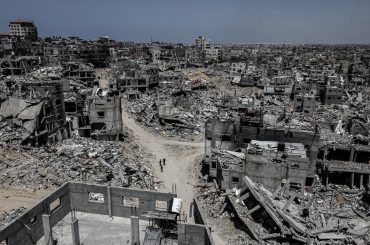
“The battle over the narrative is one of the arms of this colonization…. seeking to alter facts and reshape Palestinian and global consciousness by sharing the narrative that serves Israel and misleading the global community from knowing the truth.”
________________________________________________________________
Greater Israel zealots not only silenced proponents of co-existence, but armed and encouraged Palestinian zealots who sought to “free Palestine of Israelis”. They pretended to ignore the excavated dirt from hundreds of miles of tunnels and other evidences of an attack.
Were they successful at shaping consciousness?