

The story of N.A., a Palestinian woman detained and allegedly raped by four Israeli soldiers, sent shockwaves through a community already ravaged by war. Detailed in the shocking report by The Palestinian Centre for Human Rights (PCHR) last month, N.A.’s story was one of many, revealing the systematic rape and sexual torture of Palestinian detainees in Israeli captivity.
Her subsequent refusal to seek follow-up medical care after her release, retreating back into a circle of silence, highlights a pervasive and devastating reality in the Gaza Strip. Despite repeated attempts by human rights organizations to document her case and provide support, N.A. declined any further interviews, embodying the fear that paralyzes countless survivors.
“The cases that do speak to us fundamentally do not feel safe disclosing their experiences,” says Yasser Abdel Ghafour, deputy head of the documentation unit at a local human rights center. “They prefer not to expand the circle of people who know about their situation, which would further expose their identity.”
According to Abdel Ghafour, this is not an isolated incident. “We are aware of many cases that have endured similar experiences,” he explains. “We have approached them repeatedly to share their stories, but they have flatly refused, believing it would endanger their lives even more violently. This is especially true for women.”
Sexual violence as a weapon of war
Local and international human rights organizations indicate that the use of sexual violence by occupation forces is not a collection of isolated incidents but part of a repeated pattern of behavior within detention centers. While no international body has yet conducted a full investigation, the recurring patterns in testimonies, especially from female detainees, reflect a systematic practice of sexual humiliation, degradation, and identity destruction.
“What is required is not just documenting violations, but establishing a neutral international mechanism to investigate the use of sexual violence as a weapon of war,” Abdel Ghafour insists. “What is happening to women in detention is part of a widespread and systematic attack, not individual transgressions by soldiers.”
In a statement, the BADIL Resource Center for Palestinian Residency and Refugee Rights asserted that Israeli sexual assault must be treated as a political and societal issue, not an individual one. “As a political-societal issue connected to colonial policies of oppression,” the statement reads, “it is akin to assassinations or the use of extreme force. The victim must not be isolated or degraded; rather, she should be embraced, her struggle honored, and all necessary support provided.”
Persistent threat of retaliation
For released detainees, the psychological and physical devastation is immense. The trauma of their experience lingers long after they return home. One testimony documented by the PCHR captures this despair: “In terms of my mental health, I am not myself anymore. I am talking to you now about my tragedy and I feel unstable, I cry and laugh at the same time. I have become soulless when I look at my children and fear that one day they will go through what I went through.
Another survivor describes her shattered mental state: “They violated our dignity and destroyed our spirits and our hope for life. I had wanted to continue my education; now I am lost after what happened to me”
According to professionals, despite such profound trauma, very few survivors seek medical or psychological care. The constant threat of reprisal from Israeli occupation forces for speaking out prevents them from fully disclosing their experiences.
This fear is corroborated by the May 2025 GBV Trends Analysis: Gaza report from the United Nations Population Fund (UNFPA), which noted that survivors “are often reluctant to name armed perpetrators due to fear of retaliation.”
This climate of fear extends beyond gender-based violence to all forms of documentation. Munir al-Bursh, a director within the Gaza health ministry, confirms this trend to Mondoweiss. He says he has encountered cases where individuals repeatedly insisted that their identity and medical details remain confidential, citing direct threats of revenge from the Israeli occupation if their stories were made public.
The threat is not limited to survivors. Human rights workers, monitors, and local civil society organizations—such as PCHR, Al-Mezan Center for Human Rights, and the Women’s Affairs Center, are also systematically targeted for their work exposing Israeli crimes. These organizations, already struggling to operate, face constant intimidation by Israel.
This includes direct physical attacks, such as the complete destruction of Humanity & Inclusion’s (HI) office in Gaza City in January 2024, despite its coordinates being registered with the UN’s notification system. Human Rights Watch (HRW) has also documented at least eight Israeli strikes on aid worker convoys and premises, even after their locations were provided to Israeli authorities.
Silent hotlines
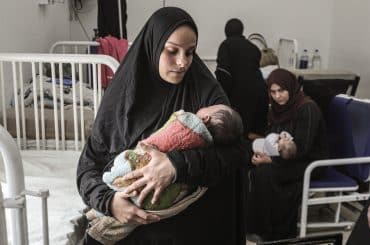
While reported cases of rape and sexual exploitation and abuse (SEA) remain low, these incidents are severely underreported. GBV case managers on UNFPA in Palestine have shared concerning testimonies in task force meetings and trainings, including cases involving adolescent girls and women with disabilities raped by family members and strangers.
Despite rape appearing as 0% in the data, there has been severe underreporting due to fear of retaliation, stigma, and lack of awareness about available services and the collapse of justice system, with survivors not consenting to the recording of their cases. “Many women prefer silence,” says Zainab Al-Ghunaimi, director of Hayat Center for the protection of battered women, considered the primary safe house in Gaza, “not because their experience is any less real, but because speaking out can mean exposing themselves and their families to renewed violence, social ostracism, and practical ruin.”
This challenge cripples reporting mechanisms. An August 2025 report from the Gender-Based Violence Area of Responsibility (GBV AoR) “reported severe disruption to women’s specialized service centers, with the majority either non-operational or only partially functioning,” while access to what remains of reproductive and mental health services is fraught with danger.
No safe shelters
In the absence of formal systems, some organizations have sought alternative justice and protection methods. Al-Ghunaimi, describes their efforts.
“We tried to find alternative ways to protect abused women during the war,” she says. “We established a tent to shelter women facing first-degree threats, meaning those at risk of being killed. We resorted to temporary solutions like a mediation system instead of the judiciary.” This system, she explains, involves committees of respected community figures, such as displacement center managers and family elders—to resolve conflicts and offer protection.
However, Al-Ghunaimi refuses to call these shelters completely “safe.” In the presence of the occupation, there is no real safe place. Recently, as this report was being written and despite a ceasefire, an Israeli strike hit a house next to the Hayat Center’s camp, destroying more than half of it. While no one in the camp was physically harmed, the bitter trauma of losing shelter was felt once again.
A void of accountability
International investigations into sexual violence in Gaza cannot proceed without witnesses. Yet, those who might testify live under constant fear, persistent threats, displacement, and deep psychological trauma.
The relentless insecurity, compounded by the destruction of homes and essential services, has made it nearly impossible for survivors to safely come forward. This creates a staggering gap between the sheer scale of the violations and the ability of human rights organizations to document and pursue justice for them.
“We have collected numerous testimonies over the years, but we lack witnesses willing to step forward,” says Abdel Ghafour, deputy head of the documentation unit at PCHR. “The silence forced by fear and social stigma means that files on rape and sexual torture remain some of the most challenging, and heartbreaking—to work on. Without witnesses, accountability remains almost entirely out of reach, and survivors continue to bear the weight of these crimes alone.”
Delete BBC cookies to get access:
Palestinians tell BBC they were sexually abused in Israeli prisons….Two Palestinian men have told the BBC they personally experienced the kind of beatings and sexual abuse highlighted in recent reports into the treatment of prisoners in Israeli detention….The United Nations Committee against Torture said last month that it was deeply concerned about reports indicating “a de facto state policy of organised and widespread torture and ill treatment” of Palestinian detainees in Israeli jails. It said the allegations had “gravely intensified” after the Hamas-led attacks on Israel on 7 October 2023….Other reports by Israeli and Palestinian rights groups have detailed what they say is “systematic” abuse….A recent opinion poll by the widely respected Israel Democracy Institute indicated that the majority of the Israeli public oppose investigating soldiers when they are suspected of having abused Palestinians from Gaza…There are over 9,000 Palestinian security detainees held in Israeli jails, nearly double the number before the 7 October attacks. Many have never been charged…In a report submitted in October to the UN Committee against Torture, five Israeli human rights groups said there had been “a dramatic escalation in torture and cruel, inhuman and degrading treatment across all detention facilities, carried out with near total impunity and implemented as state policy targeting Palestinians”.
Palestinians tell BBC they were sexually abused in Israeli prisons