
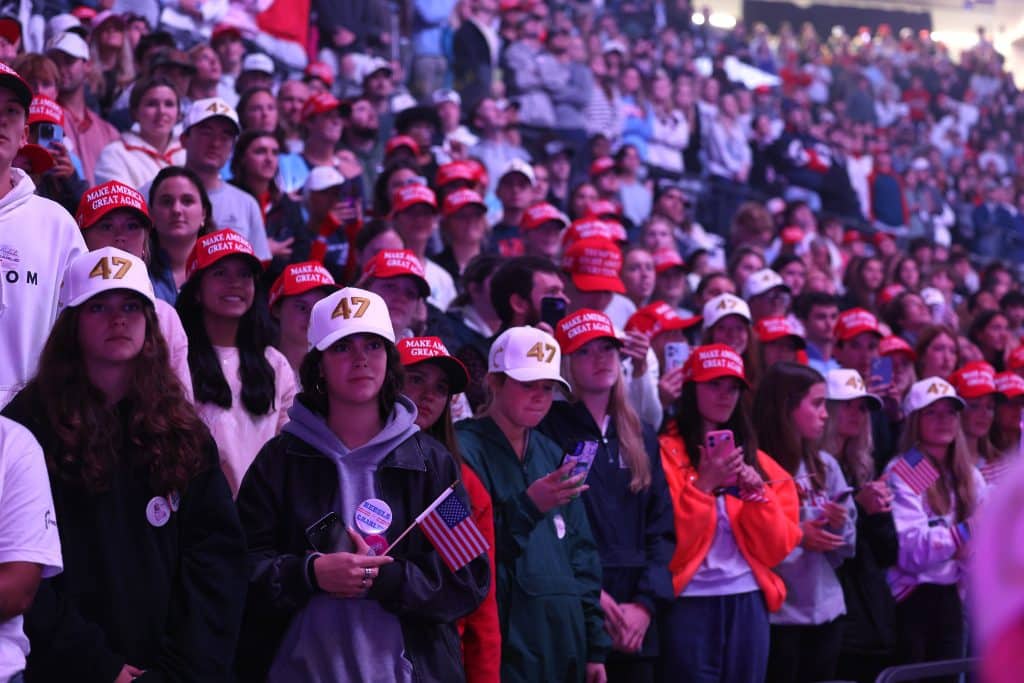
A new poll from the Institute for Middle East Understanding (IMEU) and YouGov has provided us with some extraordinary data regarding the changing view of Israel in an unexpected place — inside the Republican Party.
While we have often seen some isolated, and isolationist, Republicans breaking from the party’s consensus on Israel, the support for pro-Israel policies has long been overwhelming among Republican voters. The new poll provides some strong indications that this might be changing.
This is not about the libertarian politics of someone like Ron Paul in the past or Thomas Massie today. Nor is it about political calculations, such as Marjorie Taylor Greene’s turnaround on this and other issues due to what she sees as a betrayal by Donald Trump.
This is about a shifting ideological view, particularly among young Republicans.
According to the new poll, there is a sharp generational split among Republican voters, mirroring in some ways a similar age gap among Democrats.
Republicans under 45 years of age still overwhelmingly support Donald Trump, support congressional Republicans, and in general still appear to hold to conservative, right-wing views on many issues. But they are breaking with their elders on Israel.
Younger Republicans have a much less favorable view of Israeli Prime Minister Benjamin Netanyahu (31% favorable vs. 29% unfavorable) than older Republicans (59% favorable vs. 19% unfavorable). The young were closely divided on whether the U.S. should sanction Israeli officials found by international courts to have violated human rights (30% yes, 35% no), a sharp contrast to older ones (21%-57%).
Perhaps most important for the immediate future, 51% of young Republicans said they would prefer to support candidates who would reduce the amount of aid we give Israel. 53% say we should not renew the annual aid commitment to Israel, and 51% oppose the idea of a 20-year enhanced agreement of the type Israel is said to be seeking now.
The fact that, when asked, these younger voters objected to weapons grants funded by American taxpayers by a 2-to-1 margin, while being split close to evenly on selling weapons to Israel, suggests that there is a mix here of opposition to foreign military aid in general and a growing alienation toward Israel.
When the question of aid was weighed against domestic spending, the responses became even more negative toward taxpayer dollars going to Israel.
IMEU wrote, “President Trump has advanced over $18.5 billion in weapons deliveries to Israel this year, while he slashed support for programs like Medicaid. These policies are deeply unpopular with Republicans. 65% of all Republicans and 74% of Republicans under age 45 agree that taxpayer-funded weapons to Israel should be reinvested in lowering the cost of healthcare.”
What does it all amount to? It’s compelling evidence that Israel is on the clock.
We have already seen cratering support for Israel among Democrats, especially younger ones. But that was not entirely surprising to Israel under Netanyahu. He has always been much closer to Republicans and decided years ago to punt on the Democrats and rely on right-wing support as Israel’s methods became even more draconian and brazen, while the rise of new technologies and social media made it harder to conceal Israeli crimes.
But the long-term Republican support he was counting on doesn’t seem so solid anymore.
A bad bet on the GOP
All the way back in 2010, the former Israeli diplomat and current pundit Alon Pinkas wrote, “Netanyahu’s actions are a distinct break from the past 40 years, when Israel’s strengthening ties with Washington were all a product of bipartisan support — regardless of who was in the White House or who controlled Congress… The ‘special relationship’…is a central pillar of Israel’s national security and deterrence power…(which) was developed and can be sustained only if it is based on bipartisanship.”
Pinkas saw what Netanyahu was doing even before it became a more common topic of conversation in 2015, when Netanyahu threw off any pretense and openly collaborated with Republicans to undermine Barack Obama on the Iran nuclear deal.
Netanyahu believed that Republicans would remain lockstep supporters of Israel, due to their natural sympathy with a Western-oriented state among Arabs, racism, and a more hawkish outlook. Of course, the fact that Christian Zionists were so ubiquitous in the overwhelmingly Republican, right-wing Evangelical churches was a key factor.
But even aside from those whose support for Israel is based on a fire and brimstone interpretation of the Bible, it is fair to say that Netanyahu believed that he would have a much longer time before a real rupture appeared in the Republican party. Thus, he was willing to alienate most liberal and centrist voters in the Democratic party, destroying the bipartisanship that Pinkas quite aptly called an indispensable Israeli security and diplomatic asset.
Netanyahu made a bad bet on the Republicans. His miscalculation probably stems from overestimating the influence of Christian Zionism and underestimating the coming resurgence of isolationism in the party.
While most American voters would agree that the U.S. government should prioritize its own country over the interests of even its closest allies, Democrats are more inclined toward engagement with the rest of the world than Republicans.
That is where Netanyahu misunderstood the party with which he feels so much more at home. While the wealthy have always been the guiding force in both parties, the Republican Party that Netanyahu knows is the party of the oligarchs, who were able to manipulate the rank and file to support them.
America First changed that. By its very nature, the America First rhetoric must increase isolationism and will engender hostility from the sector of the Republican Party that depends on government services. Those people, working people, who account for most of the votes in both parties, are exactly the voters who want to see the money going to Israel rerouted to the U.S., and significantly more of them live in red states.
Netanyahu was no more mindful of those people than he was of tossing aside Democrats and Israel’s bipartisan support.
Certainly, Israel’s escalating and increasingly visible brutality—up to and including the ongoing genocide—helped make Israel more controversial in the United States. But Netanyahu’s decision to count on rock-solid Republican support and alienate Democrats has gone a long way toward opening up debate on Israel and U.S. policy. He may have thought that was a risk, but it is likely he expected that debate to occur between Democrats and Republicans, not within the Republican party.
An opportunity to seize
Of course, Congress and Washington in general continue to lag far behind voters. However, the gulf between elected officials and their voters is now wider than it has ever been in the past, and the larger it becomes, the less sustainable it is.
That gap is visible enough that AIPAC has become toxic in American politics. A recent poll of Democratic voters in selected districts in four different states that are expected to have hotly contested primaries showed that “…nearly half of voters…(48%) agreed with the statement that they ‘could never support’ a candidate for Congress that was funded by AIPAC or the pro-Israel lobby more generally. Over a quarter of voters, 28%, said they strongly felt they could never support a candidate backed by AIPAC.”
On the GOP side, the IMEU/YouGov poll of Republicans asked voters if they would prefer a candidate who took money from AIPAC or one who didn’t. Only 16% said they would prefer the candidate backed by AIPAC, while 39% said they would prefer one who refused AIPAC’s backing. In this case, the difference between younger and older voters was minimal.
Of course, Republicans tend to despise lobbyists and “special interest groups” in general, but these numbers are still significant.
The decline in blind support for Israel is bipartisan, and the age gap indicates it is growing. Republicans do not differ much from Democrats in that both groups tend to support Israel in the abstract, but either do not like the current government or find current American policy wrong-headed, for various reasons.
As the IMEU/YouGov poll shows, young Republicans, like young Democrats, have a particular distaste for Netanyahu compared to their elders. Netanyahu is, therefore, driving at least a sizable portion of negativity toward Israel. That makes capitalizing on this growing, bipartisan shift all the more urgent.
While it is always dangerous to count Netanyahu out, there is a significant chance that he will not win the next Israeli election. The likely replacement, at this moment, is former PM Naftali Bennett.
While Bennett’s politics, particularly regarding the Palestinians, are not much different from Netanyahu’s, he will differ from Netanyahu in two ways. First, he is unlikely to team with Itamar Ben-Gvir and Bezalel Smotrich or any other figures who are so blatantly grotesque. His partners in anti-Palestinian politics will be more subtle.
Second, he, or anyone else who might oust Netanyahu, will be very keen to restore Israel’s image in the United States and, more importantly, revive the bipartisan consensus that dominated Washington for so long. We have already seen the seeds of a strategy being planted, as pro-Israel forces have frequently striven to distinguish between Israel and Netanyahu with an eye toward reforming the view of Israel in the West in general and the U.S. in particular.
If the IMEU/YouGov poll demonstrates anything, it is that the incoming generations of both Democrats and Republicans need to be immediately mobilized and focused on raising a voice against a new U.S. commitment to ten or twenty years of military aid to Israel. That is not just an important policy goal in itself; it is also a way to start building a bipartisan consensus against military aid to Israel and, eventually, we can hope, for justice for Palestinians.


Marco Rubio even said Hamas members can keep their personal weapons. See Rubio: US must clarify ISF mandate before we can expect countries to contribute troops | The Times of Israel — Rubio indicates US could accept Hamas keeping certain arms if they aren’t enough to threaten Israel
So Trump and Witkoff have negotiated with Hamas and will let them keep weapons. They obviously aren’t as dangerous as Antifa, Trish James, Jimmy Kimmel, or Stephen Colbert. YMMV.
[1] The Split Among Evangelical Christians
1. The main evangelical split (big picture)
Evangelical Christianity in the U.S. is no longer a single coherent movement. It has fractured into at least three major camps:
A. Christian Nationalist / MAGA Evangelicals
This faction remains institutionally powerful (megachurches, media, donors).
B. Traditional / Institutional Evangelicals (splitting away)
Many leaders here say openly that “evangelical” has been politically captured and are abandoning the label.
C. Post-Evangelical / Deconstructing Christians
This group is growing fastest, though it has less institutional power.
2. Are evangelicals splitting over Israel / Palestine?
Yes — dramatically.
Where the split is sharpest:
Key points of conflict:
Many younger evangelicals now say openly:
That would have been unthinkable in mainstream evangelical spaces 20 years ago.
[2] The Split Among Evangelical Christians
3. Palestinian Christians are a breaking point
One of the most destabilizing factors is Palestinian Christians themselves:
This has caused:
4. Evidence of the split
You can see it in:
Some prominent former evangelicals now say:
5. Bottom line
Yes — Evangelical Christians are splitting, and the split is: