
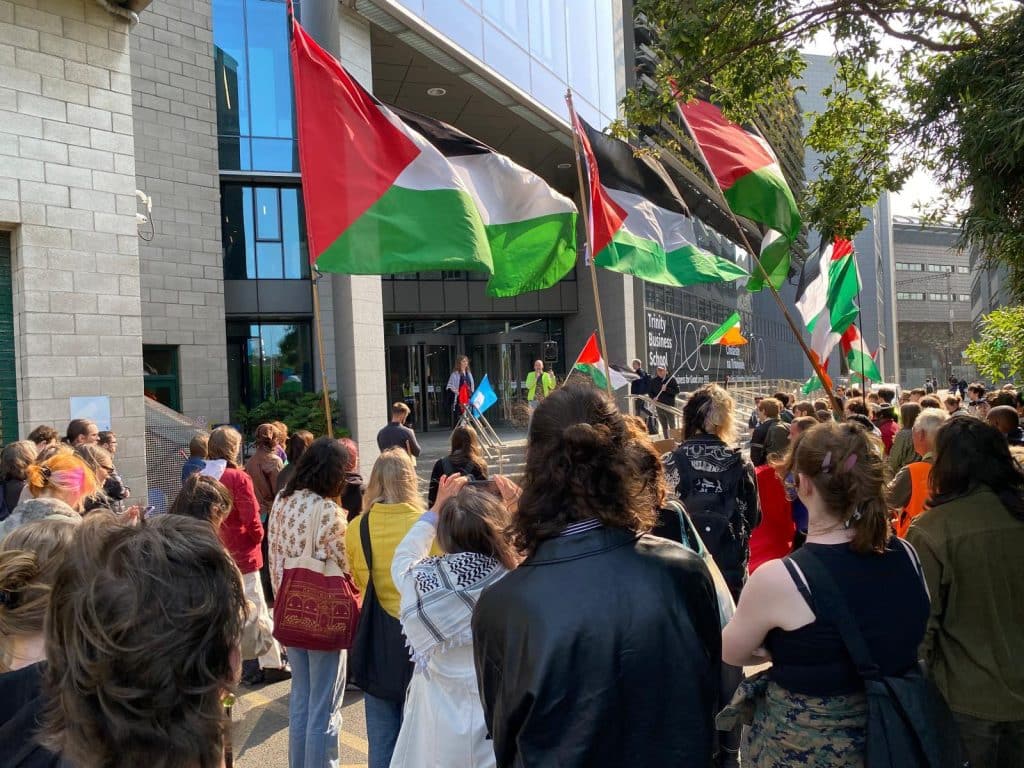
Beginning amid Israel’s scholasticide and genocide of Palestinians—still ongoing—the sustained global student uprising for Palestinian liberation, or the Student Intifada, has energized, nay radicalized, an entire generation of politically engaged youth and taught them what it means to be counted.
Since 2023, students have reckoned with suspensions, evictions, and expulsions; police and rogue violence; arrests and deportations; and general harassment. But students’ tireless, principled organizing secured academic boycotts, divestment, and institutional severances. Every material win—spurred by powerful symbolic actions, backed by painstaking research—propels us closer to something resembling justice for Palestinians.
If in 2024 students mobilized en masse internationally in solidarity with Palestinians and their cause for liberation—with actions from Mexico City to Prague, Pondicherry to São Paulo, Wroclaw to Tokyo, Sydney to Santa Cruz—then 2025 student organizing took root and bloomed, with all the struggles, achievements, and setbacks that entail.
Seeing global patterns of student action makes more comprehensive what can feel like distant, horrific geopolitics and, simultaneously, local institution-level activism. But looking back on 2025 reveals the points of connection and unity of thought and action that have existed between students, young people, and much of the general public.
Students everywhere heard history’s urgent call. They answered it resolutely. Here’s how students organized, struggled, and ultimately won in 2025—and what’s next.
Knowledge base for the movement
The student intifada’s foremost weapon, like every movement, is information. Winning material change requires a serious analysis of particular contexts, including how institutions relate to crimes committed by states and corporations, both at home and abroad. Vis-à-vis Palestine and the two-decade-long BDS campaign, students’ principal aims are academic boycotts and institutional divestment.
This year, students and academics armed themselves with meticulous research on how their institutions further the genocide in Palestine.
LSE-affiliated researchers updated 2024’s Assets in Apartheid with 2025’s deeper, expansive report Stakes in Settler Colonialism. It identifies £130m-plus “egregious” investments into companies complicit in Israeli apartheid, war-crimes—like genocide and occupation—arms trades, or fossil fuels.
Oxford University campaigners cited 49 companies involved in “illegal Israeli activities in occupied Palestinian territories” (OPT), amounting to £19m. Edinburgh University’s campaigners identified £25.5m in funds “financially entangled with corporations central to Israel’s surveillance regime and military aggression.” Edinburgh students denounced the normalization of Israeli research partnerships.
Queen’s activist researchers uncovered $43m invested in Israeli occupation. UBC researchers identified $113m invested in “corporations and weapons manufacturers complicit in Israel’s illegal occupation and genocide in Palestine.” University of Michigan activists called for $15m (<0.1% of near-$18b) divestment from Israel-linked companies, which Regents refused. Harvard-based campaigners found $150m linked to illegal Zionist OPT settlements alone.
Moroccan students denounced their government’s billion-dollar contracts with Israel. Argentine arts students opposed Haifa partnerships, while São Paulo students targeted oil shipments to the apartheid regime. Technical University Berlin students accused university-affiliated weapons makers ThyssenKrupp of circumventing the university’s Civil Clause by presenting submarine projects as serving civilian purposes, meanwhile openly marketing their military applications.
The financial and institutional architectures of occupation and genocide are globalized. So are students’ responses.
Diverse strategies
Students also merged history, culture, and political education as fronts for conscious solidarity.
Students drew similarities between Palestine and Kashmir; Gaza and the Korean island Jeju. Students from Olomouc to York to Brno to Cambridge saw imperial parallels in Sudan. Tokyo’s students crafted solidarity magazines; Guadalajara’s students painted Palestine murals; Santiago’s students crafted tatreez, a Palestinian embroidery, amidst conferences on Palestinian resistance; Mexico City’s students hosted political-cultural events; Lima’s students hosted documentary screenings on Palestine.
Sciences Po’s Palestine Committee, with other pro-Palestine groups, organized a street football tournament “for peace and against colonialism.” Radboud students planted olive trees on university grounds, representing Palestinian resistance. Students led walkouts, marches, occupations, and encampments (some suffering arson attacks); blockades, vigils, targeted disruptions, art exhibitions, assemblies, and (hunger) strikes. Teach-ins continued regularly, across continents and contexts.
Students took to the streets or campus spaces and engaged in material disruption. They blockaded trams in Prague; ports in Antwerp and Dublin, alongside Milan, Bologna, and Genova; trains across the Netherlands; Israeli and Egyptian embassies in Mexico, England, Korea, and Catalonia. Finnish students led weekly walkouts disrupting “campus as usual.” Sorbonne students sprayed red paint on Jussieu Tower to denounce their university’s investments in companies involved in the genocide of Palestinians. British student coalitions shunned the proscription of anti-war group Palestine Action as “terrorists“.
Cheick Anta Diop University students, Senegal, forced Israeli ambassador Yuval Waks off campus amid chants of “Free Palestine” and “Israel is war criminal,” waving Palestine flags. CCNY students disrupted Zionist film screenings; Helsinki students disrupted UoH’s annual opening ceremony; Manchester students disrupted their unresponsive Governors’ meetings; Maastricht saw Zionist agitator lectures disrupted and buildings painted red; UvA (Amsterdam) students disrupted events and occupied campus buildings.
Often overlooked, these actions were ongoing everywhere in 2025. Daily, united in spirit. But not without personal costs to students.
Growing repression
Student activism for Palestine sprang into international consciousness in 2025 when Donald Trump’s ICE thugs illegally abducted and detained Columbia post-grad activist Mahmoud Khalil. Scant pretenses were made about intentions behind Khalil’s detention: ‘antisemitism’ weaponized to quash pro-Palestinian dissension; border regimes utilized to target extra-vulnerable overseas activists. Despite warranted condemnations—from Mexico to Malaysia—of Khalil’s high-profile arrest alongside U.S. activists like Tufts’ Rumeysa Ozturk, repression often went more unnoticed.
Hundreds, if not thousands, of U.S. student visas were revoked over Palestine-related protests in 2025. Yale suspended Dr. Helyeh Doutaghi, while Ohio suspended Professor Tom Haynes for joining the Sumud Flotilla. Columbia University suspended 80 students involved in pro-Palestine activism, before signing deals with Trump’s administration and the Anti-Defamation League. SOAS fully expelled activist Haya Adam following her year-long suspension. Berlin immigration authorities moved to deport four international students for involvement in Gaza solidarity protests.
Vrije Universiteit (VU, Amsterdam) students were violently evicted by police when VU refused to negotiate. Berlin police brutally assaulted and arrested five protestors at Humboldt University. Indian policemen attacked, detained, and pointed guns at Hyderabad students. Two Moroccan protestors were tragically killed, hundreds arrested, in youth-led uprisings against corruption and Israeli collusion.
At a silent march against Radboud University’s ties to Israel, police and campus security attacked students—breaking bones, using police dogs, and making arrests—sparking calls for the Board head’s resignation, including from 133 staff. Students were arrested in Türkiye for protesting Erdoğan’s complicity with Zionism. Student activists in Madrid and Zaragoza faced Spanish police scrutiny. Cambridge University criminalized protest on campus; LSE’s Marshall ‘Bloom’ Building remained under an anti-protest court injunction following 2024’s five-week occupation.
VU’s eight-day encampment was evicted by police force, and several students were hospitalized, similar to Leiden University. In Prague, a Mexican student was detained for 19 hours on ‘terrorism’ charges, all for displaying a Leila Khaled poster. One Bangor University, Wales, pro-Palestine protestor submitted legal claims for assault, battery, unlawful detention, and freedom of expression breaches.
Clearly, global patterns are normalizing state-led and university administrations’ attacks on students’ age-old tradition of organizing for political progress. Nonetheless, they’re not defeating the movement—quite the opposite.
Student victories
Despite repression, students achieved immense victories in 2025. Trinity College Dublin achieved full divestment and severed its academic ties with Israeli institutions. This win followed King’s, Cambridge committing to divest from arms and Israeli occupation. Students were critical in Oxford City Council’s unanimous BDS motion committed to cutting ties with complicit companies and Barclays bank (10th British council win). Queen’s University Belfast won (partial) divestment after widespread student and staff pressure. Students and workers forced CUNY to divest from Nestlé, which operates in the OPT.
These are all, materially and symbolically, very significant wins—and divestment are not the student struggle’s only fruit.
London students defended UN rapporteur Francesca Albanese from Zionist mobs at UCL. Pisa University terminated ties with Reichman University and Hebrew University. São Paulo celebrated its philosophy, languages, and literature department (FFLCH) breaking ties with the University of Haifa, which operates on stolen Palestinian land. “This great achievement was a direct result of the mobilization of students, faculty, and staff.” Two encampments, the blocking of degree courses, and the participation of two staff members in the Global Sumud Flotilla collectively pressured FFLCH. Action wins action.
Meanwhile, TU Delft announced cessations of collaborations with Israeli universities or organizations, including consortium agreements and Horizon Europe projects. Another Dutch university, Radboud, has announced its preliminary decision to suspend ties with Tel Aviv University and the Hebrew University. Students criticized the decision for not suspending consortia, institutional frameworks through which most academic collaborations are undertaken. However, such victories matter, as they are steps in a longer process of isolating apartheid.
Maryland students passed a historic BDS resolution, cutting all ties to Israeli occupation. They also won a $100,000 settlement against university repression. UvA suspended institutional collaborations with Israeli partners, announcing publicly that UvA will “not be entering any institutional collaborations in education and research with Israeli partners…[noting] with horror the growing (scientific) evidence that genocide is taking place in Gaza.” This came late—following October’s non-ceasefire—but every severance with genocidal apartheid must be celebrated.
Goldsmiths and Sussex students won scholarships specifically for Palestinian students. The ‘Berlin Four’ won court appeals against deportation; the world condemned German ‘Staatsräson.’ Two million Italians went on a general strike supporting the Sumud Flotilla, students foremost. Madrid witnessed its first cross-union, infancy-to-university general educational strike in 12 years—though not directly supporting Palestine, unions involved consistently showed their solidarity. The strategic melding across students’ and workers’ movements is vital to success. Long may it proliferate.
Students can win again
Despite the destruction of every university in Gaza, Palestinian students continued to learn. In December, 168 doctors qualified amidst the rubble of al-Shifa hospital; weeks earlier, 150 Al-Aqsa students graduated in tents where classrooms once stood. Education and healthcare persist not as mere functions, but acts of defiance.
In 2025, students united across the world, exposing the farce of “institutional neutrality” that enables such destruction, while universities answered with untold repression. Even as the grammar of ‘intifada’ is cynically criminalized by politicians and pundits in Britain, Australia, and beyond, the movement it names continues to grow. History marches on.
What was won in 2025 (and before) in one place can be won in many others in 2026. It’s essential to learn from one another and unite efforts. If your actions, hardships, or achievements were missed here, more power to you.
In numbers and in refusal, students are strongest.

“In numbers and in refusal, students are strongest.”
___________________________________________
A well understood narrative enhances student strength.