
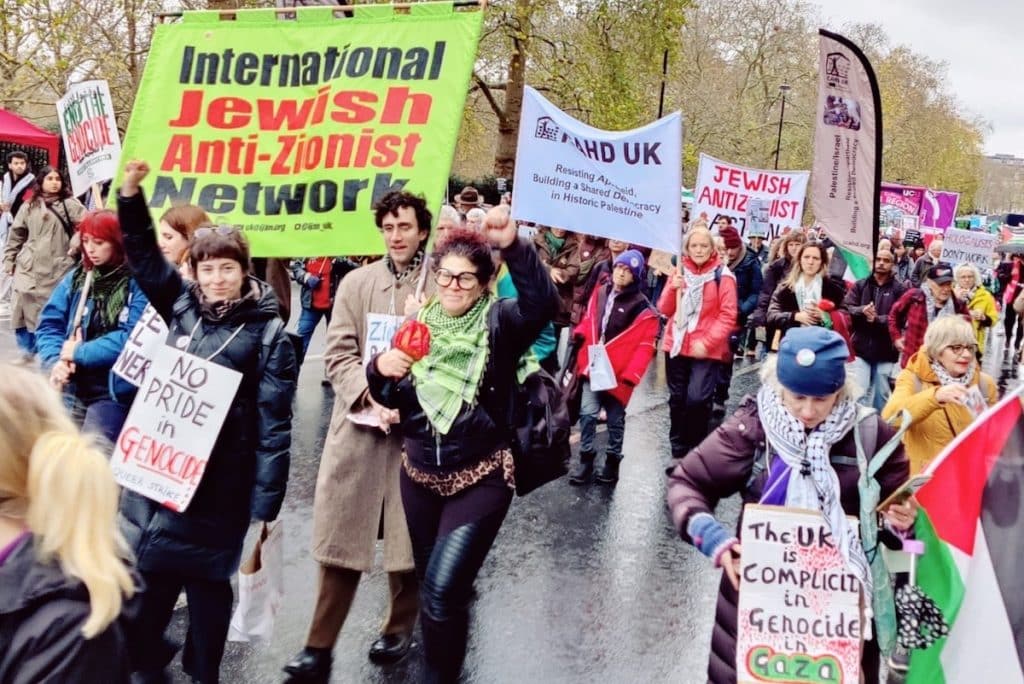
The clarity and questions raised by Lara Kilani’s astute piece, “Liberation Is Not Integration: On liberal Zionism, one-state fantasies, and what Palestinians actually want” and Rima Najjar’s incisive response, “The Settlers Are Not Leaving: Decolonization, not coexistence,” place the discussion of the future Palestine where it belongs – among Palestinians. The questions both pieces raise affirm a long-standing opinion of the International Jewish Anti-Zionist Network, of which I am a co-founder, that Jews do not and should not play a role in envisioning, directing, or participating in the designs of a liberated Palestine. Instead, as anti-Zionist Jews, our role lies in expediting the dismantling of Zionism – both its genocidal, colonial expression and expansion in Palestine and its fortification through organizations and institutions across the globe. As Najjar argues, such de-Zionization is a precondition of sorts for Palestinians to have the space and possibility to determine what liberation looks like and the society they want to build in its aftermath.
As anti-Zionist Jews, our role lies in expediting the dismantling of Zionism – both its genocidal, colonial expression and expansion in Palestine and its fortification through organizations and institutions across the globe.
It is and has always been Palestinians who must determine the nature of “the state” and the society they want to live in once colonialism is dismantled. “Greater Israel” is closer to being secured than ever before – through collaboration and shared interests of the ruling elite in the United States, Saudi Arabia, the United Arab Emirates (UAE), Qatar and Turkey. As Najjar notes, calls for one state without a clear plan for decolonization and de-Zionization risk replicating rather than dismantling Zionism. Furthermore, discussions of a one-state solution that fails to assert the centrality of Palestinian self-determination – particularly the right to not be forced to integrate with those who have not only committed but celebrated genocide against you – is not only abstract, but damaging.
When Jewish academics, activists and organizations call for and lift up their vision of a one-state in Palestine, it is Zionism. One way or another, it is based on an investment in Palestine remaining a place in which Jews are central to the vision of the state and society. It is, therefore, our mandate to be unwavering in our support for the decolonization and de-Zionization of Palestine and the means necessary to shift the structural conditions in this direction.
At minimum, this includes engaging in the divestment and dismantling of all Zionist institutions and structures and BDS, and reinforcing, without hesitation, the Palestinian right to resist, right to return, and right to rebuild, as well as broader anti-imperial, anti-monarchy, anti-capitalist struggles in the region.
Our mandate to be unwavering in our support for the decolonization and de-Zionization of Palestine and the means necessary to shift the structural conditions in this direction.
For the very small number of anti-Zionist Jews from ‘48 (“Israelis”) who have worked, often over decades, with Palestinians calling for a “democratic one-state,” it could be argued that the role in these discussions might be different. However, this movement does not currently exist. Until there is a mass movement led by Palestinians in which Jews on the ground in Palestine are participating in the dismantling of colonialism, fully supporting the right of return, and taking action in solidarity with Palestinian resistance, any individuals currently dedicated to one state are just that – a handful of individual Jews against a majority that is actively participating, complicit and/or not active in stopping genocide and colonial expansion. In light of this reality, when anti-Zionist Jews from ‘48 or elsewhere organize with the explicit goal of a one-state solution, they are assuming that Jewish people remain a central consideration and feature of Palestine once Zionist colonization is dismantled.
Our work against Zionism is specific and, of course, different from the work of Palestinians in their own liberation. The self-determination of Palestinians includes their agency to set the terms of their struggle, to not, as Najjar says, have their aspirations overwritten by the interests of others. Against “neutralizing” the “political meaning of Palestinian suffering” through liberal and abstract notions of integration, “equity” and/or “co-existence” in an attempt to ameliorate Jewish anxiety and advance self-interest, the goal of anti-Zionist organizing is, as she names, supporting the conditions for “building decolonial power.”
Kilani’s questions highlight the need to translate this goal into concrete strategies. In addition to participation in the broader work of the growing mass movement for Palestine, Jewish anti-Zionists can play a more specific role in expanding BDS to target Zionist organizations, funders and corporations. Campaigns like Stop the Jewish National Fund, can expose the parastatal nature of Zionist organizations (directly facilitating the work of the State of Israel through funding, lobbying and attacks on its opponents). It should not just be the State of Israel who returns “more than a hundred years of looted wealth, land, and resources.” As we call for the stripping of their farcical “non-profit” status, we can also call for seizing of the assets of Zionist organizations as a consequence for their participation in genocide; redirecting them towards the rebuilding of Gaza and Palestine more broadly as a form of reparations.
Additionally, it is our work to expose, dismantle and/or reclaim so-called Jewish community organizations, and institutions, including religious ones, that have been repurposed, warped into vehicles for defending and advancing Zionism. Jewish Anti-Zionists can organize civil society and social justice groups to isolate and begin to reject funding from Zionist funders, such as the Jewish Federation, who both use their funding of social justice organizations as a “form of philanthropy-washing” and economic coercion to silence criticism and solidarity. Another role of Jews living outside of Palestine could be to facilitate the mass exodus of Jews who do not have the means and wish to relocate. This could mean turning the early “Renounce Aliyah” campaigns of anti-Zionist Jews into a practical project – a sort of anti-Zionist Jewish (relocation) Agency, particularly for working class and poor Southwest Asian North African, Ethiopian, ultra-Orthodox (anti-Zionist), and Russian Jews.
As raised by both pieces, harder questions arise about the process of decolonization in relation to the settlers committed to retaining “sovereignty, military dominance, and demographic permanence.” The de-Zionization of Palestine is unlikely without the forced removal of settlers that will be met with the violence they have consistently used and are prepared to escalate. As Najjar names, this is a reality that cannot be avoided nor the flight of settlers assumed. Instead, anti-Zionist Jews must be ready to support how Palestinians chose to address this aspect of their anti-colonial struggle.
Picking up where Najjar concludes, “A just future depends not on selecting the correct blueprint but on reorganizing Palestinian political life, weakening the structures that sustain Israeli supremacy, cultivating international leverage, and restoring Palestinian agency to the center of political imagination.” As Palestinians reorganize and reestablish the representatives of that self-determination in the aftermath of the long-standing political undermining and assassinations of their political leaders, it is imperative that the “left,” including and particularly anti-Zionist Jews, does not rush in to pre-define the “endpoint of Palestinian liberation.” Just as the liberation of Palestine is not limited to the choice of liberal or reactionary Zionism, Palestinian liberation and political imagination is not limited to either a liberal one-democratic state or a two-state solution. The endpoint must and will arise from the decolonization itself; the needs, priorities and political imagination of Palestinians, and not from a proscribed state vision of socialism, secularism or liberal democracy.
The proximity, stake and therefore role of anti-Zionist Jews in the process of de-Zionization is, of course, different than that of Palestinians. It is, first and foremost, solidarity with the struggle for the survival, self-determination and liberation of Palestinians, yet dismantling Zionism is ultimately also critical for Jews. It is central to redirecting history away from the most violent strands of the 20th century, including the most successful genocide of Jews, but moreso, it is central to the collective future of humanity. In 2005, we traveled to Palestine to present the idea of an international network of Jewish anti-Zionists to combat the international role and impact of Zionism to Palestinian organizers. Founding organizer of the Palestinian BDS National Committee (BNC) and founder of Stop the Wall, Jamal Juma’s response was that, “we don’t need Jewish people for the liberation of Palestine, we need anti-Zionist Jews as part of the broader global struggle against imperialism,” of which Israel, with the U.S., is a watchdog and key beneficiary.
Meaning, the stake is not based on the “intertwining of fates” or vague concerns for “safety” that liberal Zionists attempt to push and that leave Jews short from truly fulfilling our mandate as anti-Zionists. It is the willing, principled and self-motivated participation we enact as anti-Zionists in anti-imperialist struggle, which represents a return to and affirmation of historical Jewish participation in struggles towards collective liberation. This is not only a mandate for anti-Zionist Jews but for all those who understand that Zionism is part of the devaluing of life, the unsustainable extraction and depletion of resources, the destruction of the planet, and escalating authoritarianism required to suppress growing dissent. Therefore, contributing to the conditions in which Palestinians build the power to decolonize their homeland is at the heart of building the power we all need for the pressing fight for the preservation of humanity and life on the planet. Anti-Zionist Jews are part of this, but not exceptionally so. Our ability to participate with clarity is part of rejoining us with the rest of humanity from which Zionism – its Jewish exceptionalism and supremacy – has separated us. To do so, we need to know and claim our place without displacing the centrality of Palestinian will and imagination.


One more bit about the ‘counter-Zionist’ Jew Avraham Burg, who writes in Jewish Voice For Liberation:
Here Avrum Burg expresses some of our frustration that the Israeli government and its unwavering and uncritical supporters continue to allege antisemitism as the motivation for criticising what Israel is doing in Gaza….It no longer works: “Opposing Israel’s actions today is a moral obligation,” says Burg, “And it is not antisemitism. It is love of humanity.”….More importantly, he shows the similarity in thinking between Zionists and Antisemites both of which want to exceptionalise Jews, negatively or totally positive…..For Burg the real division is not between Jews and non-Jews but between those who believe in equality and those who do not. Hence Israel is linked to those advocating white supremacy rather than to those who advocate democracy.
It is about humanity and not antisemitism | Jewish Voice for Liberation
Here’s an example of an anti-Zionist Jew, or at least a Jew whose views don’t exactly square with Zionism:
‘Jews, Rebel!’: Ex-Knesset Speaker Calls on World Jews to Take Israel to ICJ Over Gaza War Crimes…Avraham Burg, who also headed the Jewish Agency and World Zionist Organization, called for a million Jews to file an appeal to the International Court of Justice over crimes against humanity in Gaza: ‘This is not a rejection of our people; it is a defense of its soul’
‘Jews, Rebel!’: Ex-Knesset Speaker Calls on World Jews to Take Israel to ICJ Over Gaza War Crimes – Israel News
Take the long view: the human species is about 300,000 years old, the scientists tell us. If we’re going to survive even 100 more years we’re going to have to construct societies based on human rights and equality, not ethno-religious identities. I have no illusions about that project being easy.
As a Palestinian and long-time participant in our nationalist, anti-colonial struggle against Zionism, author Kershnar and those who think like her have got it very wrong. Palestinian revolutionaries worthy of the name welcome the participation of Jewish Israelis in our national liberation struggle as equals even at the leadership level. Given the sad state of the highly divided and ideologically backward legacy political factions, especially Hamas and Fatah, there does not exist a proper political home for most Palestinians much less the small numbers of anti-Zionist Israelis who seek to actively support Palestinians in our struggle for liberation and decolonization. I ask you are the Ilan Pappe’s, Jeff Halper’s, Gideon Levy’s, Alon Mizrahi’s and unnamed others who have been leading advocates of one democratic Palestinian state from the River to the Sea any less worthy of full participation in our movement than Muslim and Christian Palestinians? Hell no! Are they not already playing a very welcome and leading role albeit mainly in the ideological and educational sphere? Hell yes! Our struggle is in most if not all respects just like the South African anti-apartheid struggle. Were white South Africans not an integral and equal part of the ANC and the South African freedom movement including at the leadership level? Of course they were, Joe Slovo and Ronnie Kasrils being two prominent examples of Jewish South African revolutionaries who were among the leadership of the anti-apartheid struggle for liberation.I fail to see the logic of this article and others like it that advocate for Jewish Israelis to take a back seat in the Palestinian struggle for liberation and decolonization. Palestinians have nothing to fear in being replaced or made less central to the Palestine national liberation movement by the participation of anti-Zionist Israelis in our movement and in its leadership. To think so is to underestimate the Palestinian People and engage in a very false identity politics that will undermine the integrity of our anti-colonial struggle. How can we possibly build one democratic state in all of historic Palestine offering full equality for all if our movement can’t guarantee full equality for all members of the anti-Zionist camp regardless of their religious and ethnic identity?
To me, Kershnar’s opinion sounds quite extreme. One should not treat Israeli Jews as underlings to Palestinians. This is an extreme, identity-based view.
…
I have a values-based view, based on the UN-principle of “equal rights and self-determination of peoples”. States should be states of all the people who belong to their territory, irrespective of race, creed or colour. Zionism should accept this or disappear. That should solve the problem of Zionist racism. Ethnically cleansed Palestinians should then be able to return and Palestinians should recieve redress. However Israeli Jews should be able to stay as equals.
…
Kershnar’s opinion sounds like a new “Jewish Question”. The first made the presence of European Jews in Europe a problem. This one makes the presence of Israeli Jews in historic Palestine a problem. Zionism’s “Arab Question” made Palestinian presence in Palestine a problem. They are all racist “Questions”. I know there is no racist intent here, but … do not go in that direction!
I thought this was a really useful contribution to the discussion held in the previous articles linked to in the piece. The author recognizes the privilege Jews bring with them into the movement. Our engagement in it requires serious reflection because, as the author rightly recognizes, Palestinians must be the leaders of this movement. Thanks for the thoughtful response.