
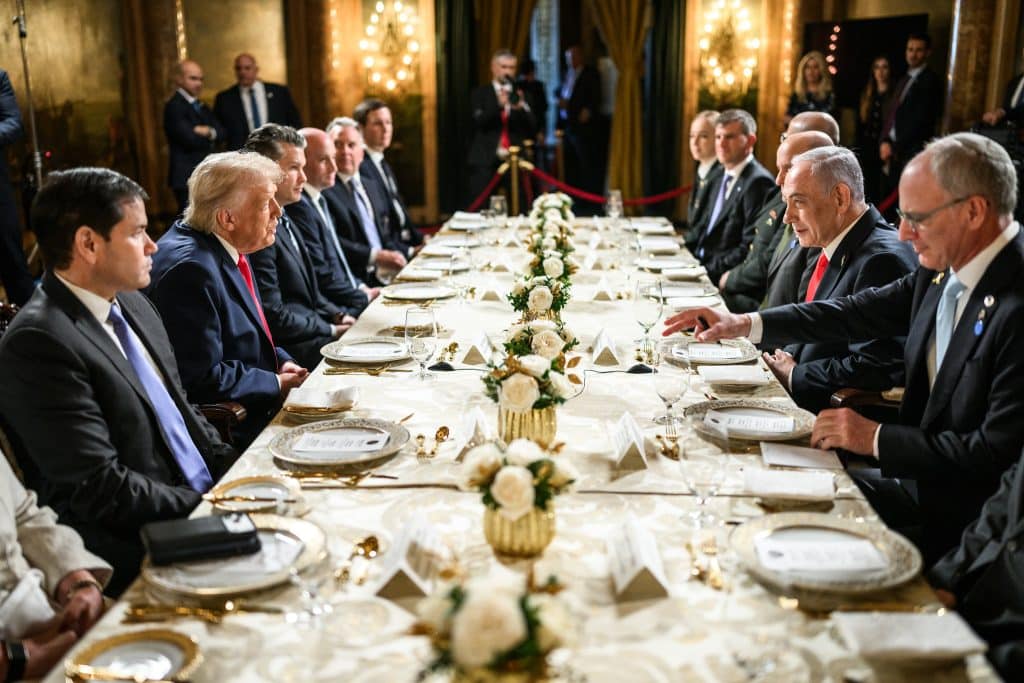
In comments to reporters after his meeting with Israeli Prime Minister Benjamin Netanyahu, President Donald Trump reiterated his support for another strike on Iran.
“I hope they’re not trying to build up again, because if they are, we’re going to have no choice but very quickly, to eradicate that build up,” said Trump, referring to the alleged expansion of Iran’s ballistic missile program.
“We’ll knock them down,” he added. “We’ll knock the hell out of them.”
Netanyahu has consistently pushed for a wider war on Iran, and was expected to make the case for further attacks during his Mar-a-Lago visit.
Trump’s comments prompted an immediate response from Iranian officials.
In an article in The Guardian, Iranian foreign minister Seyed Araghchi called on the Trump administration to defy Israel on the issue.
“The US administration now faces a dilemma: it can continue writing blank cheques for Israel with American taxpayer dollars and credibility, or be part of a tectonic change for the better,” he wrote. “For decades, Western policy towards our region has been mostly shaped by myths originating from Israel.”
“The response of the Islamic Republic of Iran to any oppressive aggression will be harsh and regrettable,” tweeted Iranian President Masoud Pezeshkian.
In a post on the meeting, Quincy Institute for Responsible Statecraft Vice President Trita Parsi wrote that an attack on Iran could easily lead to retaliatory strikes.
“Tehran has gone to great lengths to avoid a military confrontation with Washington, but just because it has shown restraint in the past does not mean that it can afford to do so in this scenario,” wrote Parsi. “Indeed, given that Iran will be totally exposed without its missiles, it will likely reckon that it has no choice but to strike directly at U.S. targets.”
“Even if Trump opts to ‘only’ support Israel defensively in yet another Israeli choice of war — which is the position Biden took — it nevertheless incentivizes Israel to restart war, as the U.S. is lessening the cost for Israel to do so,” he continued.
Sina Toossi, a senior non-resident fellow at the Center for International Policy, says that Netanyahu’s designs go far beyond Iran.
“Netanyahu’s visit unfolds against a backdrop of unresolved fronts, with widening disputes with Washington over the second phase of the Gaza ceasefire, including postwar governance, reconstruction, and Turkish involvement,” he said in a statement to Mondoweiss. “At the same time, Israel is seeking greater latitude to escalate again against Hezbollah in Lebanon, an end to U.S. accommodation of Syria’s new leadership, and firm assurances on expanded military aid. What remains unclear is Netanyahu’s actual order of priorities, even as a transactional give and take appears inevitable.”
Israel’s repeated violations of the recent ceasefire have seemingly postponed the Trump administration’s postwar plan for Gaza, but the President expressed no frustration over the timeline and embraced Netanyahu’s call for Hamas to disarm.
“They’re going to be given a very short period of time to disarm and we’ll see how that works out,” he told reporters. “[Trump advisors] Steve Witkoff and Jared Kushner will be in charge of that, from our side. But if they don’t disarm, as they agreed to do — they agreed to it — then there will be hell to pay for them. And we don’t want that. We’re not looking for that. But they have to disarm within a fairly short period of time.”
“We have 59 countries that signed on, big countries, countries that are outside of the Middle East as you know the Middle East,” Trump continued. “They want to go in and wipe out Hamas. They don’t want Israel, they don’t need Israel; they want to do it because it’s the right thing to do. Because they were for the deal, based on the fact that Hamas pledged, they swore, that they were going to disarm. Now, if they’re not going to disarm, those same countries will wipe out Hamas.”
U.S. officials with knowledge of the meeting told Axios that Trump aides called on Netanyahu to change his policy in the occupied West Bank, where violent escalations run the risk of derailing Trump’s vision for the region.

How dare the government of Iran make preparations to defend its population against attacks by Israel and the USA? Don’t those Iranians know that they aren’t even human beings, just anonymous, Jew-hating, Muslim monsters, according to the corporate media? In reality, of course, Iran has the moral right to build a conventional defence system as well as nuclear weapons to any extent it wants. When Israel, the US and the UK have dismantled their own gigantic arsenals, Iran will be obliged to do the same.
Has anyone anywhere got any idea what the idiot is talking about?
“Trump reaffirms his support for another strike on Iran after meeting with Netanyahu”
All of this stuff is done in support of Israel. How much does this cost us? There’s the financial cost and the price of the enmity the U.S. earns for its support of genocide. Brown University has a project titled the “Costs of War Project”.
Findings | Costs of War | Brown University
In the two years since the October 7, 2023 Hamas attack on Israel, the U.S. government has spent $21.7 billion on military aid to Israel.
At least 5.27 million people have fled or been forced to leave their homes (as of early September 2025) in the post-Oct.7, 2023 wars in Gaza, Iran, Israel, Lebanon, and the West Bank. This total includes an estimated 1.85 million children under 18.
U.S.-backed Israeli military operations since Oct. 7, 2023 will lead to far higher indirect death than direct death rates.
Americans are inundated with cultural products that promote militarism – many of them influenced by the Pentagon. From movies to sporting events, the entertainment we consume normalizes war, reducing reflection about U.S. policy choices and their consequences