
Last month, 300 people—led by the Patriarchs and Heads of Churches in Palestine— gathered in Bethlehem to launch the second Kairos Palestine document: A Moment of Truth: Faith in a Time of Genocide. 140 Palestinians and 160 internationals spent the day unpacking the theological and political descriptions of the conditions that Palestinians face and attending to the indigenous church’s call for Palestinian resistance and Christian solidarity. The conference was hosted by Kairos Palestine, the largest Palestinian Christian ecumenical nonviolent movement for freedom and justice.
Mays Nassar, Kairos Palestine staff, introduced the 14-page document, saying, “With the beginning of the genocidal war on Gaza and the worsening reality of apartheid and ethnic cleansing in the West Bank, we reached a decisive moral and theological turning point. Our hearts were compelled to reflect on the meaning of faith in such a time of horror. We asked ourselves what must we say to our people now? What is the Christian word in the face of genocide?”
Kairos II doesn’t mince any words.
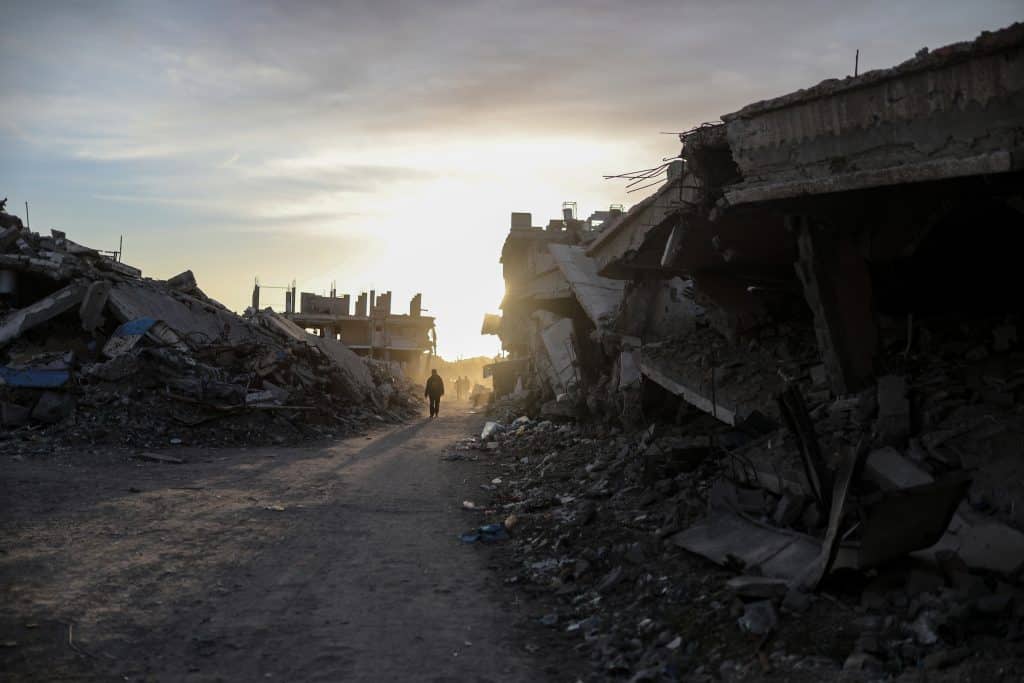
In the first part of the document, “The Reality: Genocide, Colonization and Ethnic Cleansing”, the authors lament, “We raise this cry from the heart of the assault on Gaza — a war that has left behind hundreds of thousands of martyrs and wounded, and nearly two million displaced people. Many were buried beneath the rubble, burned alive, tortured to death in prisons or forcibly displaced more than once. Others endured starvation, targeted even as they ran in search of food. Tens of thousands of children were killed in the most horrific ways. Gaza’s health, education, economic, and environmental sectors—indeed, every component of life—have been destroyed.”
“Exposed today,” the document states, “is the true face of Zionist ideology: a system that over decades has entrenched an organized and sophisticated regime of apartheid supported by advanced technologies that exercise total control over every aspect of Palestinian life—fragmenting the land, dividing its people, and turning Palestinian existence into an unbearable hell.”
Genocide is both a cumulative process, according to the document, “one that began in the minds of the settler-colonial powers of Europe when they denied the image of God in others and legitimized death, domination and slavery,” and a “structural sin against God, against humanity, and against creation.”
“We consider the State of Israel, established in 1948,” Kairos II maintains, “to be a continuation of that same colonial enterprise built on racism and the ideology of ethnic or religious superiority.”
Authors of the document charge that “the genocidal war has laid bare the hypocrisy of the Western world, its hollow values and its empty boasts of commitment to human rights and international law. In truth, the Western world has sacrificed us, revealing racism and double standards toward our people.”
Turning to the global reality of Christian Zionism, the document describes the ideology as a “theology of racism, colonialism and ethnic supremacy… a theology that has produced apartheid, ethnic cleansing and genocide of indigenous people.”
“Christian Zionism calls on a tribal, racist god of war and ethnic cleansing, teachings utterly alien to the core of Christian faith and ethics,” Kairos II continues. “Christian Zionism must therefore be named for what it is: a theological distortion and a moral corruption.”
In what some may consider the document’s most controversial call, Kairos II insists that religious conversations and interfaith dialogue with Christian Zionists must be ended.
“After all efforts to invite Christian Zionists to genuine repentance have been exhausted,” Kairos II reads, “moral, ecclesial and theological responsibility requires that they be held accountable and that their ideology be rejected and boycotted. The time has come for the churches of the world to repudiate Zionist theology and to state clearly their position on Palestine: this is a case of settler colonialism and ethnic cleansing of an indigenous people.”
The document goes on to describe the increasingly violent actions of settlers: “Across the occupied West Bank… [t]hey wreak havoc upon the land, destroy crops, poison or seize water resources and attack residents—all under the protection, support and even participation of the Israeli army in acts of violence, killing, home demolitions and forced displacement.”
Regarding the Palestinians living within the state of Israel, the document states, “blatant racism and discrimination persist. Palestinian communities face intimidation, criminalization of free expression, and persecution of any effort to defend Palestinian rights, along with [Israel’s] deliberate neglect of rampant organized crime in Palestinian towns. Those displaced within Israel in 1948, whose lands were confiscated, are still denied the right to return to their villages and rebuild their homes. Bedouin communities remain victims of systematic displacement and ethnic cleansing….”
The document doesn’t hesitate to name challenging internal conditions that have been increasingly exacerbated over Israel’s 77-year-long dispossession and occupation:
Political division, rivalry and exclusion have deepened. The majority of Palestinians have lost confidence in their political leadership. As a result of the Oslo Accords and their aftermath, the Palestinian Authority has been trapped in serving the interests of the occupier….
Signs of disorder have… become part of our reality, largely due to the absence or weak enforcement of the rule of law. This has led to a rise in intimidation, land encroachment, tribalism, favoritism and corruption in its various forms at the expense of the common good, deepening people’s frustration and despair. Amid the vast destruction and genocide in Gaza, acts of violence, revenge, chaos and theft have only added to the suffering of the Palestinian people.
The document also describes a worrying external reality.
In recent years, our region—the Middle East—has undergone major political and regional transformations shaped by a deliberate plan to impose Israeli military dominance over the entire area with the support of Western powers, drawing a new political and demographic map. Backed systematically by its allies, Israel has attacked many countries of the region, violating their sovereignty and that of their peoples, flouting international law and entrenching itself as an aggressive, bullying state as if it stands above all laws and conventions—pushing the region and indeed the world to the brink of catastrophe.
The second part of Kairos II, “A Moment of Truth for Us”, is focused inwardly on Palestinian society. “In the face of this harsh reality and at this decisive moment we raise this cry—first to ourselves, to the sons and daughters of our churches and congregations, and to our entire people in the homeland and the diaspora.”
The document calls “for a comprehensive national reevaluation of our reality to draw lessons and insights leading to a unified, collective vision and a clear strategy for future action… within a legitimate representative framework” and warns “against giving our national struggle a religious character or turning it into a religious issue that pits religions against one another.”
In almost lyrical prose, Kairos II addresses:
- the Palestinian woman, “the unbending backbone, partner in the struggle, holding together home, land, memory and future all at once… There can be no true liberation without her full participation at every level of decision-making and nation-building.”
- the Palestinian Church: “We are the sons and daughters of the first Church… those who cultivated this land, built its cities and villages and drank from its waters. We do not live on the margins of this land. We are woven into its fabric. We carry its history and heritage. Its very soil knows us as its own. Many empires have passed over this land and disappeared, buried in the dust of history, yet the bells of our churches continue to ring—bearing witness to the truth and proclaiming resurrection every day.”
- “our youth”: “You are the living Church…. We see your anger, your sorrow, your fear. We also see your strength…. We do not call you to naïve optimism, but to hope that is rooted in action…. Express yourselves. Write. Sing. Create. Organize. Resist through your humanity in a world that seeks to strip it from you.
- “our people in the diaspora”: “You may be geographically far from Palestine, but Palestine lives within you…. Your voice has the power to shift realities. Share our suffering and our stories of steadfastness and success…. We will not lose our dream of reunification, nor will we abandon our right of return.
In the third part of the document, “A Call to Repentance and Action”, the authors make their appeal to persons around the world.
To Christians: “working together with both religious and secular coalitions… pressure [your] governments to isolate Israel, hold it accountable… press for the prosecution of war criminals whoever they may be… ensure reparations for the Palestinian people… work for the immediate return of the displaced through the reconstruction of Gaza and the strengthening of its people’s steadfastness.
To people of conscience: “believers in God from every faith and persons of conviction… join together in coalitions that safeguard humanity from further descent into the reality of injustice, tyranny and domination.”
“We call for a global theological movement built on the pillars of God’s Kingdom — a movement that arises from the contexts and struggles of peoples suffering from colonialism, racism, apartheid and the structural poverty produced by corrupt economic and political systems that serve the interests of the world’s empires.”
To the Jewish voices that oppose the war and confront Zionism from moral, faith-based and human conviction: “[W]e find [in you] partners in our shared humanity and in the struggle for freedom and human dignity—partners also in religious and political dialogue.
Rejecting the conflation of Jew and Zionist, the document draws a clear distinction. It declares, “Not every Jew is a Zionist and not every Zionist is a Jew.”
At the heart of the document’s plea to all is a clarion call to costly solidarity, the risking of one’s self for the sake of the other. “By its very nature,” the document insists, “true solidarity is costly. It has a price. It is a faith-based stance, a human commitment and a moral responsibility. True solidarity is also the embodiment of our shared humanity and fraternity. Either we live together—or we perish together. Today it is Palestine. Tomorrow it will be other marginalized and oppressed peoples.”
The final section, “Faith in a Time of Genocide”, is the briefest, and offers a reaffirmation of the Palestinian Christians’ steadfast faith and this honest assessment of the possibilities for peace:
To speak of a political solution today is futile unless we first undertake the serious work of acknowledging and rectifying past wrongs—beginning with recognition of the historic injustice done to Palestinians since the rise of the Zionist movement and the Balfour Declaration. Any genuine beginning must involve dismantling settler colonialism and the apartheid system built on Jewish supremacy…. What is required is international action and protection…. Enduring solutions will not rest on the logic of force, but on the foundations of justice, equality and the right to self-determination.
In her address at the conference, Dr. Muna Mushahwer, an ophthalmologist and member of the board of Kairos Palestine, acknowledged, “Yes, we are angry, furious even. Jesus himself got angry at the Temple as we read in Matthew 21:12-13. He got angry because the house of the LORD was to be a house of prayer, but it was turned into a den of thieves. How angry do you think he is now that the land of the LORD has been turned into a place of death and desolation? But from this anguish and pain comes this moment of truth for us. As we write in Kairos II, we raise this cry… a cry of steadfastness.”
“Faith in a Time of Genocide” will stand alongside Chrisian confessions written in other times of crisis, such as the Barmen Declaration during the rise of Nazism (1934), MLK, Jr’s Letter from the Birmingham Jail during the U.S. Civil Rights Movement (1963), and The South Africa Kairos Document during the struggle to end apartheid in South Africa (1985).
Jeff Wright
Jeff Wright is an ordained minister of the Christian Church (Disciples of Christ).


What does the Holy Bible say about genocide? Now kill all the boys. And kill every woman who has slept with a man, but save for yourselves every girl who has never slept with a man.
(Numbers 31:17-18)
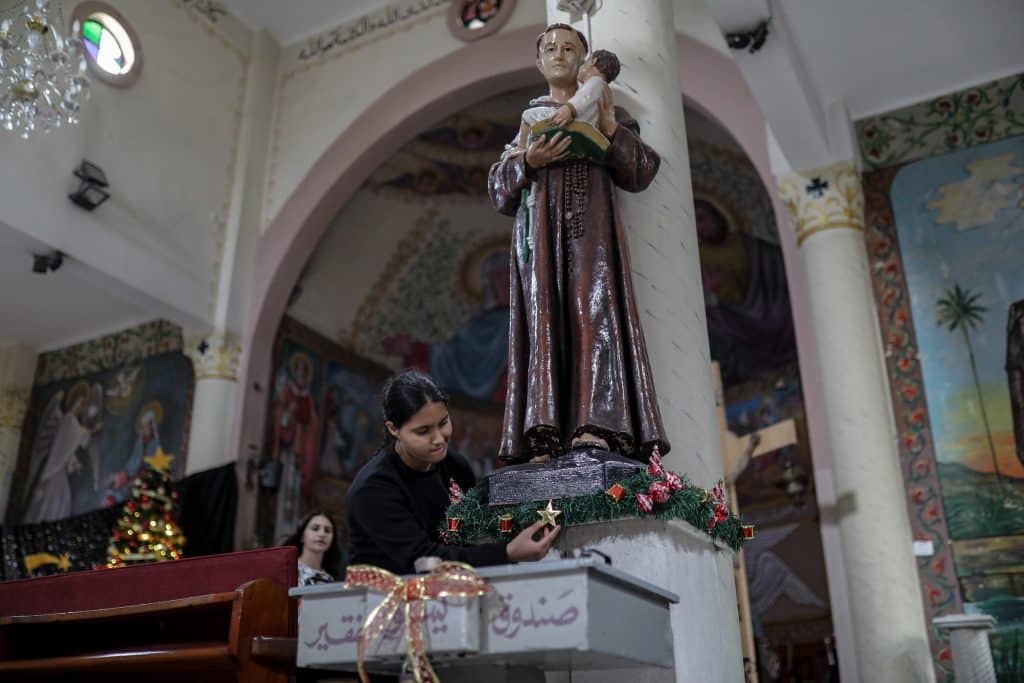
Israeli forces detain Santa Clause in raid on Palestinian Christmas celebration
24 December 2025
“Israeli police arrested a Palestinian man dressed as Santa Claus during a raid on a Christmas celebration in Haifa earlier this week, a local rights group has said.
Police forcibly dispersed festivities held by Palestinian Christian citizens of Israel in the Wadi Nisnas neighbourhood on Sunday and confiscated equipment from the event.
According to the Mossawa Centre, an organisation advocating for the rights of Palestinian citizens of Israel, police used excessive force while detaining the man dressed as Santa Claus, as well as a DJ and a street vendor.
All three were released on Monday but were expected to be summoned to court again.
Mossawa said police also raided a music institute without legal authorisation.”
https://www.middleeasteye.net/news/israeli-forces-arrest-santa-clause-raid-palestinian-christmas-celebration
“The document calls “for a comprehensive national reevaluation of our reality to draw lessons and insights leading to a unified, collective vision and a clear strategy for future action… “
____________________________________________________________
Without vision, people perish.
““Faith in a Time of Genocide” will stand alongside Chrisian confessions written in other times of crisis, such as the Barmen Declaration during the rise of Nazism (1934), MLK, Jr’s Letter from the Birmingham Jail during the U.S. Civil Rights Movement (1963), and The South Africa Kairos Document during the struggle to end apartheid in South Africa (1985).” No, it will wind up on the scrap heap of history as a self-righteous anti-Israel screed that totally disregards the fact that the greatest threats to Palestinian Christians are the same as the greatest threats to Christians in Israel’s neighboring countries: Fanatical Islamist fundamentalism, as witnessed by the drastic reductions on the Christian populations of Lebanon, Syria, Iraq, Pakistan, Egypt et al over the last generation. By contrast, Christians in Israel worship and conduct their lives largely unmolested and under guarantees of complete religious freedom. Given the choice of being a Muslim or a Christian in Israel on the one hand or a Jew or a Christian in any other Middle Eastern country, what sane person would hesitate?
BTW, how many churches, synagogues or ashrams are there in Saudi Arabia? You could never count them on the fingers of one hand, because you could never start.