
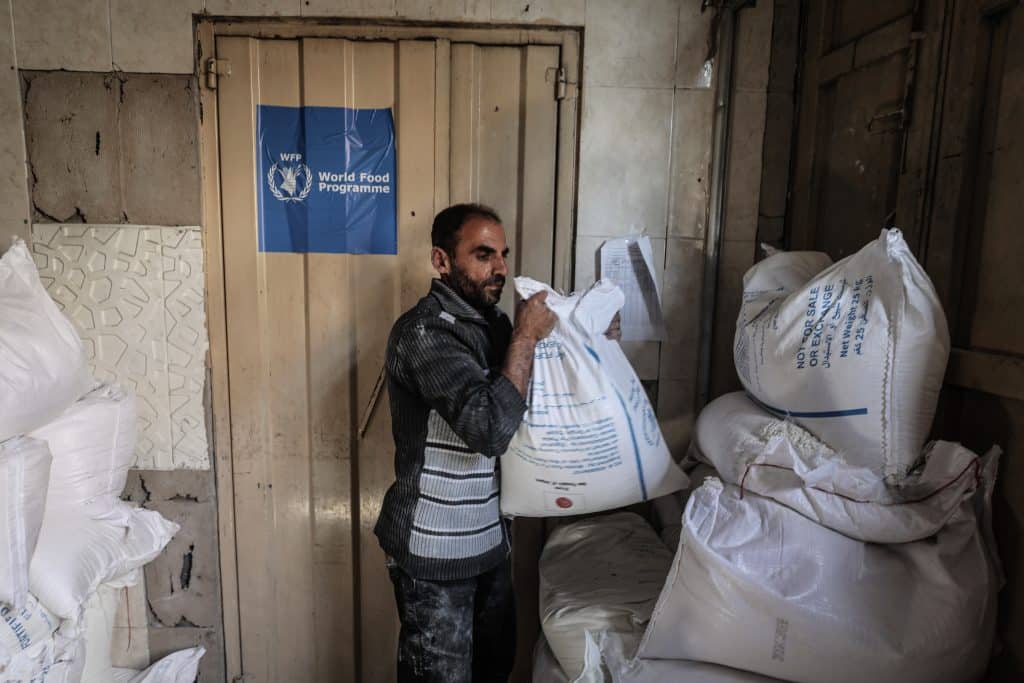
For 35-year-old Abdelkarim Al-Shawwa, aid is not supplementary. It is the line between hunger and survival.
On Thursday, Israel announced it would revoke the licenses of 37 international non-governmental organizations operating in Gaza, alleging they failed to meet new requirements under revised registration rules. The move, the European Union has warned, would obstruct life-saving assistance from reaching Gaza’s population, further worsening already dire living conditions.
Among the affected organizations are Action Against Hunger, We World, and Doctors Without Borders — groups central to food distribution, healthcare, shelter, and water provision across the Strip.
The decision has intensified fear across Gaza, including for Al-Shawwa. “When aid stops, how am I supposed to survive?” he asks.
Al-Shawwa is the sole caregiver for his elderly parents and the children of his brother, who was killed in an Israeli airstrike in August 2025 while attempting to obtain a sack of flour at an aid distribution center in eastern Gaza. Months earlier, another brother was killed in a separate Israeli strike.
Since the early months of the war, Al-Shawwa’s family, like many others in Gaza, has survived almost entirely on humanitarian assistance provided by international organizations.
“They have been our lifeline,” he says. “They cover a large part of our basic daily needs.”
Although assistance arrives only once every three or four weeks, it provides essential items the family depends on. “We receive sugar, oil, rice, pasta, beans, and canned food,” he explains.
This limited support eases part of the burden Al-Shawwa carries, allowing him to allocate his small income to other necessities. After months of unemployment caused by bombardment, displacement, and repeated evacuation orders, he was only able to find work when the ceasefire took effect in October 2025.
He now spends at least ten hours a day standing on his feet in a small restaurant, serving fast meals for a daily wage of around $15 — barely enough to sustain his household.
“My salary, although small, allows us to buy medicine for my parents, clothes for my nephews, and to pay for charging phones and batteries through our neighbors’ solar panels or generators,” he says.
Despite the availability of vegetables, meat, and chicken at markets, soaring prices keep these items out of reach for most families. Al-Shawwa says his income allows him to buy what he calls a “rich meal” only once or twice a week.
“The rest of the time, we survive on rice, pasta, and canned food,” he adds.
Like Al-Shawwa’s family, more than 90 percent of Gaza’s population relies entirely on humanitarian assistance, according to a November statement by UNRWA. Many Palestinians, the agency noted, survive on only one meal every 24 hours.
Human rights groups and humanitarian agencies say the ban on international and UN aid organizations represents yet another escalation in Israel’s efforts to make life in Gaza unlivable.
At the same time, Israeli restrictions on aid entry have left organizations struggling to meet overwhelming needs. Under the current ceasefire, agreements stipulate that 500 to 600 aid trucks per day should enter Gaza, a target that has never been met. According to OCHA, only 3,185 trucks entered the Strip between October 10 and November 10, averaging just 102 trucks per day.
Human rights groups and humanitarian agencies say the ban on international and UN aid organizations represents yet another escalation in Israel’s efforts to make life in Gaza unlivable. Since October 2023, Israeli attacks have killed at least 579 aid workers—including more than 400 UNRWA staff, as well as over 1,700 health workers, more than 140 Civil Defense personnel, and 256 journalists. In total, Israel’s genocidal war has killed more than 71,000 people in Gaza, which itself is widely regarded as likely a significant undercount.
Water trucks stop, life nearly pauses
Under the UN’s coordination system, Gaza is divided into humanitarian clusters, each led by an international organization responsible for providing aid, shelter, healthcare, food, and, most critically, water.
After fifteen months of Israel’s genocidal war, over 80 percent of Gaza’s water and sanitation infrastructure has been partially or entirely destroyed, including all six major wastewater treatment plants. In the absence of functioning municipal systems, water trucks funded by international aid organizations have become the main source of survival for displaced families.
“All families in our camp stand in queues from the very early hours of dawn waiting for the water trucks to fill their gallons,” says Saja Al-Louh, 26, displaced from northern Gaza to the al-Zawaydeh area in central Gaza with her mother and younger brother after losing her father during the war. “They usually come once a day.”
With 67 percent of Gaza’s 368 municipal wells either destroyed or unable to function due to fuel shortages or the lack of generators, families rely on water trucks not only for drinking water, but also for washing, cleaning, and laundry.
“We fill between five and seven jerrycans of water per day — around 50 to 70 liters,” Al-Louh explains. “That barely covers our daily use. We don’t use water extravagantly.”
The situation becomes even more desperate when families miss their turn.
“Our harshest battle is when we miss the water truck or when it is depleted before we reach it,” she says. “We then ask displaced neighbors for a few sips of water until the next day comes and the battle starts again.”
Most days, water trucks reach the camps regularly, except on Fridays.
“Fridays are the days we live austerely,” Al-Louh says.
Around 85 percent of Gaza’s small desalination plants have been partially damaged or destroyed by Israel’s bombardment, leaving these trucks as the only accessible source of water for many families. As a result, the potential suspension of international aid organizations threatens to deepen an already catastrophic reality.
“If funded water trucks stop,” Al-Louh warns, “we will have to walk long distances to reach desalination plants and pay for water.”
The ban on international organizations would also mean the suspension of banking transfers conducted through the Bank of Palestine, the only institution authorized to process international transfers in the Gaza Strip. Without these transfers, aid organizations would be unable to pay for desalination plants, operate water trucks, or provide even minimal local assistance.
The Gaza community believes the decision goes beyond Israel’s stated claims that aid organizations employ Hamas-affiliated staff. Instead, they argue, it reflects an effort to force international aid groups to operate under Israeli control — governing their work, reports, documentation, and evidence.
Israel’s standards for humanitarian access prioritize political discipline and narrative compliance over the scale or efficiency of aid delivery, limiting operations through restrictive oversight and reporting requirements tied to public perception.
This isn’t the first time Israel restricts the work of aid organizations in Gaza either. In early 2025, more than 100 international aid organizations accused Israel of blocking life-saving assistance from reaching Gaza and called on it to end what they described as the “weaponization of aid.”
“If aid stops completely,” Abdelkarim Al-Shawwa says, “we won’t just be hungry. We won’t even be able to buy medicine, clothes, or anything else needed to live.”
He pauses, then repeats the question that defines his desperation. “When the aid stops,” he asks again, “how am I supposed to survive?”

It’s about asphyxiating Palestinian life – slowly reduce the amount of food, water, fuel and living space until life becomes impossible. Today the U.N. posted a new report on the West Bank and East Jerusalem:
This thematic report considers the human rights situation in the occupied West Bank, including East Jerusalem, with a focus on Israel’s discriminatory administration there in violation of international law, including Article 3 of the International Convention on the Elimination of all Forms of Discrimination (ICERD). The Office of the High Commissioner for Human Rights (OHCHR) has raised concerns of discrimination against Palestinians for decades, alongside other violations of international humanitarian law and international human rights law. The report does not reflect the situation in Gaza, which is documented in other reports…..
20260105-thematic-report-israel-discrimin.pdf
The table of contents says it all:
Unlawful killings of Palestinians,,,discriminatory movement restrictions…detention, civic space and freedom of expression,,,settlement expansion and appropriation of resources…state violence and settler violence,…taking over ‘area c’….demolitions and evictions…
A ceasefire/peace agreement is only as good as its mechanism for enforcement. The three stooges (Witkoff, Rubio and Kushner) sent by Trump seemed to think that suggesting a few countries might like to send some peacekeepers would magically result in success.