
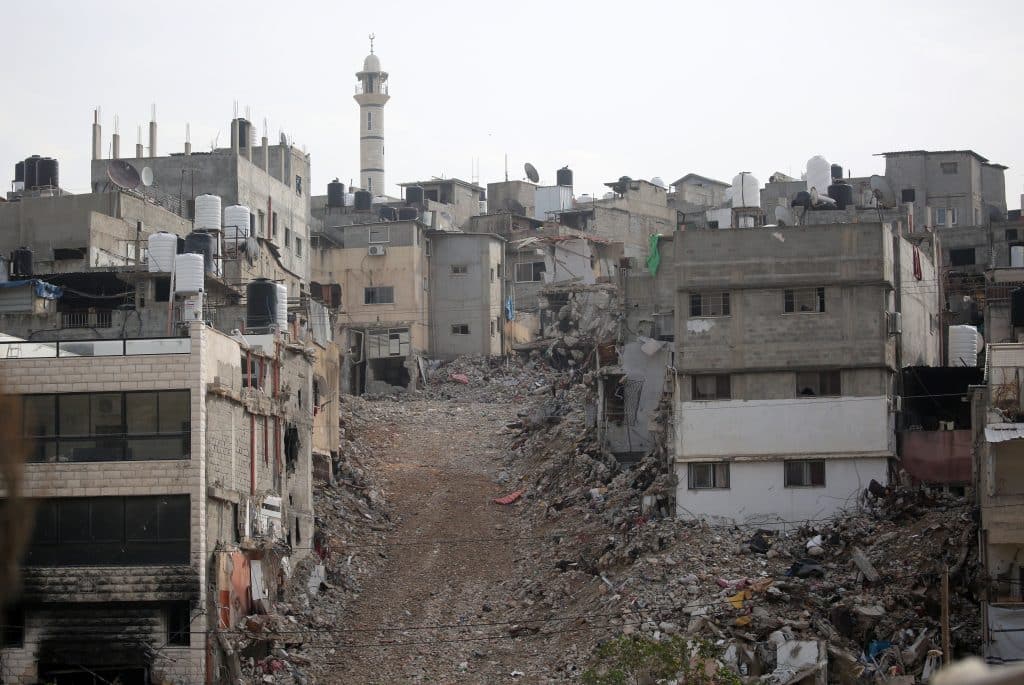
Last week, the Israeli army demolished 25 residential buildings in Nur Shams refugee camp in Tulkarem in the northern West Bank. The homes used to belong to dozens of families who were displaced from their homes a year ago, alongside the rest of the camp’s residents. Now their displacement has become permanent.
“The neighborhood is gone, and our house is being demolished by the Israeli army,” Motaz Jamil, a young resident of the camp, told Mondoweiss as he watched his home being leveled. “Our neighbors, our families, our sad and happy memories — all of it is being erased.”
This is not the first time Jamil’s community has experienced displacement. Being refugees, they all came from the villages dotting Palestine’s coast in 1948, when the state of Israel was founded. “We were displaced from Jaffa, and today we are being displaced once again,” Jamil explained.
During the Nakba, Israel altered the geography of the over 500 Palestinian villages that it ethnically cleansed in 1948. This included demolishing homes, planting forests on their remains, and erasing traces of the people who used to live there.
Today, camp residents say Israel is doing something similar — engaging in a process of “re-engineering” the camp through extensive demolition operations. Residents who spoke to Mondoweiss say that the aim is to “kill the idea of the refugee camp” by altering its features.
In January 2025, the Israeli army launched “Operation Iron Wall,” the most wide-ranging military campaign of its kind meant to root out resistance groups in the towns and refugee camps of the northern West Bank.
The Israeli strategy for “re-engineer” the camps is part of Israel’s broader project to alter the social, demographic, and geographic characteristics of the West Bank, especially communities that have served as incubators for resistance.
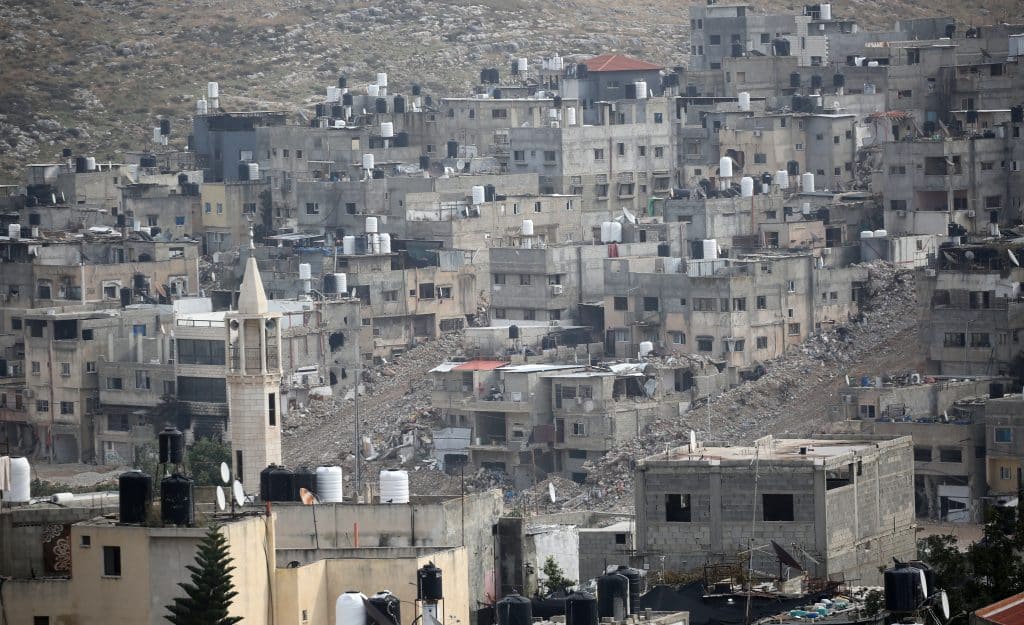
Years prior, in 2022, communities in Jenin, Tulkarem, and Tubas had witnessed the revival of armed resistance and the rise of resistance “brigades” largely based in the refugee camps of Jenin, Nur Shams, Tulkarem, and al-Far’a. During the multi-year crackdown that followed, the Israeli army launched repeated raids into the refugee camps, where it faced operational difficulties due to the camps’ narrow alleyways. During its most recent “Iron Wall” offensive, Israeli forces bulldozed many of them while demolishing entire residential blocks and carving new military paths into the heart of the camps, meant to create “safe roads for our forces,” according to the Israeli army.
Israel’s most recent demolition orders are an extension of this logic — the destruction of Palestinian homes not because they were used for military purposes, but because the architecture of the camps does not conform to Israel’s security vision.
The Israeli strategy to “re-engineer” the camps is part of Israel’s broader project to alter the social, demographic, and geographic characteristics of the West Bank, especially marginalized communities whose societies have served as incubators for resistance.
Razing homes for ‘future military needs’
Faisal Salameh, head of the Popular Committee of Tulkarem refugee camps, told Mondoweiss that the 25 new buildings demolished by the Israeli army in Nur Shams housed dozens of families. “Over 100 Palestinian families have now become homeless,” Salameh says, adding that a total of over 5,000 families have been displaced from both of Tulkarem’s refugee camps since early 2025, comprising over 25,000 people.
In all of the northern West Bank, the total number of Palestinian refugees who have been displaced from their homes is well over 40,000. To this day, entrances to both camps remain sealed off with dirt mounds, and refugees are prevented from returning despite recent demonstrations organized by residents demanding to go back.
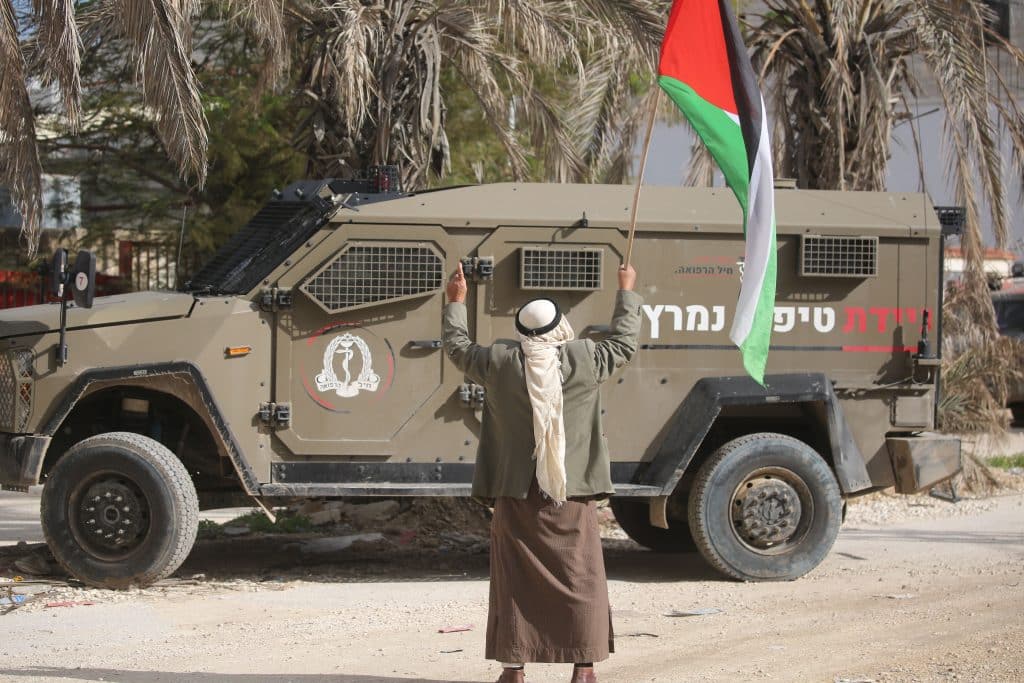
Since 2025, the Israeli army has demolished approximately 2,000 housing units belonging to 2,000 families in Tulkarem’s two refugee camps. Around 4,000 additional housing units have sustained partial damage due to explosions, army vandalism, destruction, arson, and live gunfire, rendering most of them unfit for human habitation, Salameh says.
“If there is ever a return to the camps, the owners of the demolished homes will have no houses to return to,” he explains. “There is no alternative, not even a glimmer of hope of providing the displaced with alternative housing. They’ve been pushed outside the sphere of human life and left without shelter.”
In the lead-up to the demolition, the residents whose homes had been singled out contacted the Adalah Legal Center to file a petition with the Israeli Supreme Court, which froze the decision for one week. But the Israeli army submitted an appeal, and the court approved the army’s request.
Even though the prosecution admitted during the hearing that the targeted buildings were civilian residential homes not used for military purposes — and belonged to families with no connection to any military activity — the court approved the demolitions due to “security considerations” and a “justified military need.”
According to Salameh, the court decision to move ahead was based on the presence of “secret documents” that were not disclosed to the defense.
According to Adalah, Israeli authorities also justified the move on the grounds that it would facilitate military movements inside the camp “in the future,” and “not due to existing or urgent military necessity.” The Israeli authorities acknowledged that there was no immediate urgency in carrying out the demolition, and that the area had been free of any combat activity for more than a year.
Salameh says that the infrastructure in the three camps has been completely destroyed. “No sewage networks, no communications, no electricity, no streets or roads, no human presence,” he said. “There is no justification for the occupation to demolish these homes other than destroying the geography of the camps.”
“We, the popular committees, the national forces, the camp residents, the Palestinian National Authority, and all other official institutions reject this ongoing demolition policy,” he added.
The politics of reconstruction
In an interview with Fox News, Israeli Prime Minister Benjamin Netanyahu said he wanted “peaceful coexistence” between Palestinians and Israelis in the West Bank, stressing that the territory should ultimately come under Israeli rule. This has already begun in the refugee camps, which are being refashioned according to Israel’s designs.
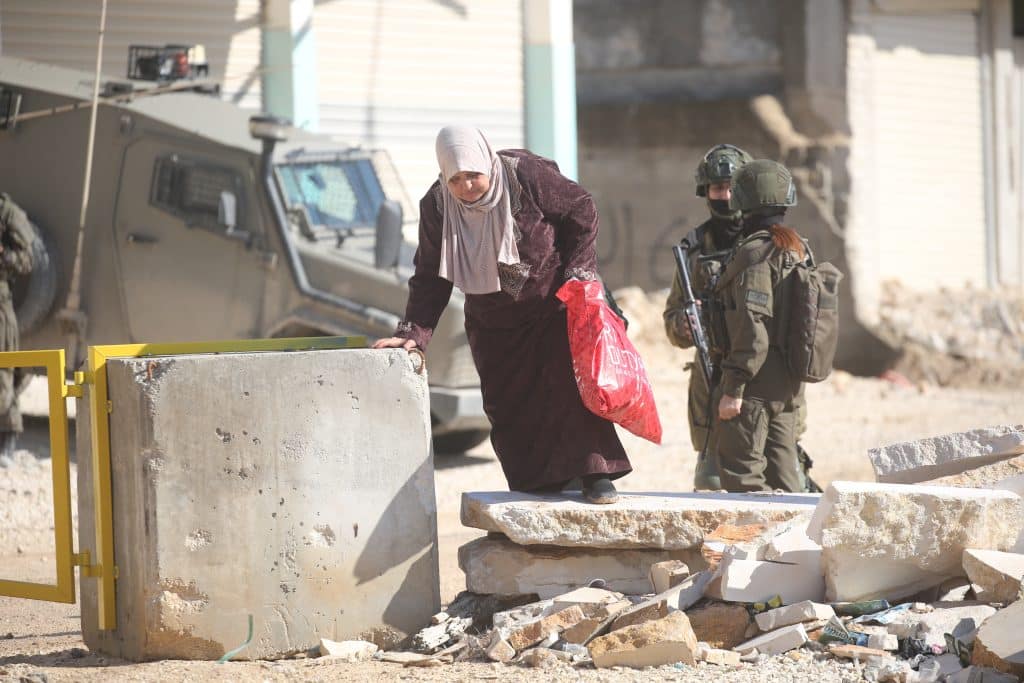
Israeli forces have begun bringing in road-paving equipment into some refugee camps in the northern West Bank following the refusal of the Palestinian Authority (PA) to do so.
The PA refusal is based on a rejection of imposed Israeli conditions for allowing the commencement of reconstruction and the return of residents. Speaking to Mondoweiss on the condition of anonymity, a local source states that the PA is refusing to proceed with repaving plans without clear prospects for compensating families whose homes were demolished.
“Paving may appear minor, but it advances a military solution imposed through force,” the source said, adding that U.S., Palestinian, and Israeli talks are discussing a package of conditions focused on security rather than humanitarian aspects. “The PA’s position is weak because it is economically and financially exhausted, and it fears the worsening of the camp crisis. No one has presented any solutions for compensating families, and no one has an answer regarding their fate.”
In essence, Israel is rejecting any resettlement of these refugees as their own distinct demographic concentration, even if outside of the boundaries of the camp itself, the source says. “Even the idea of mobile homes was rejected by Israel, which does not want a new camp or demographic concentration to emerge outside the existing camps.”
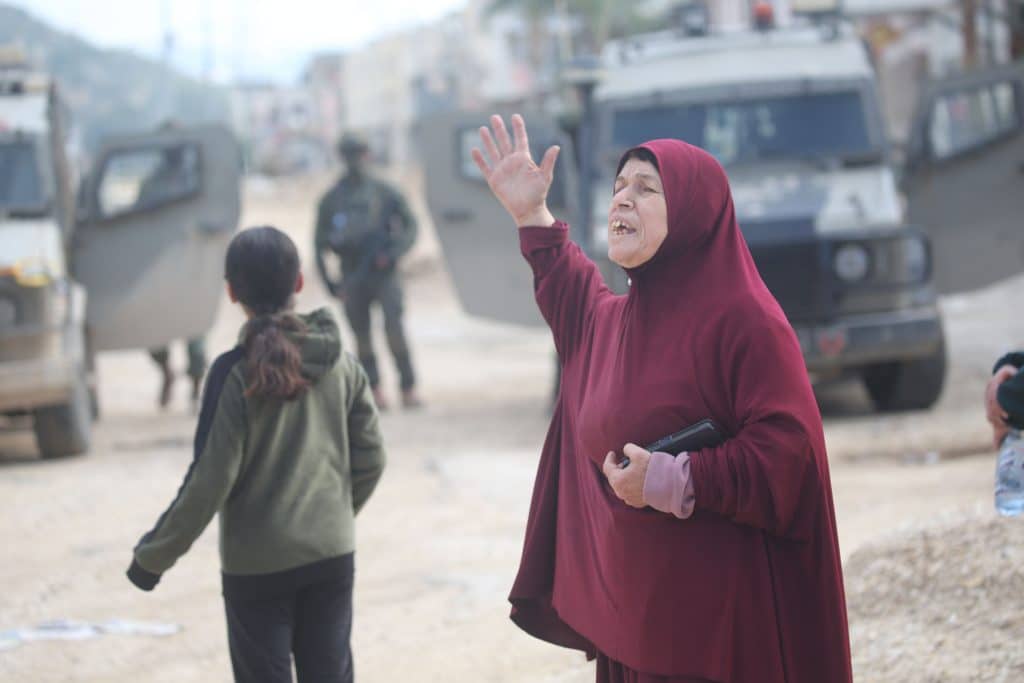
Mahmoud Khlouf, a local political analyst, says the demolitions are aimed at altering the characteristics of the Palestinian refugee camp to no longer appear like a camp and become an extension of its adjacent cities. “It is an attempt to annex the camps to the nearest cities in a way that serves Israel,” he said, explaining that the refugee camps are a living embodiment of the right of return and the Palestinian refugee issue.
Khlouf also says that during the year in which the refugee camps have been emptied, the Israeli army has used them as training grounds for its reserve and regular forces, benefiting greatly from the camps’ alleyways for training in urban warfare in densely populated areas.
“We as residents of the area feel the intensity of daily gunfire during training with heavy and light weapons,” Khlouf explains.
As for when the Israeli army might withdraw from the camps, Khlouf says, that largely hinges on whether Israel is able to effect the infrastructural changes it seeks to achieve in the camps. This includes fortifications, electronic and concrete walls, the installation of towers, and the preparation of housing for settlers in nearby Israeli outposts that used to be settlements. Evacuated in 2005 as part of Israel’s unilateral Disengagement Law, four Israeli settlements around the Jenin area are now being rebuilt, the result of a re-legalization process that culminated in the reversal of the Disengagement Law in July 2024.
Khlouf says that he fears the experience of the northern West Bank could be repeated in the central and southern parts of the territory. “Israel is waiting for the opportunity to do so, and it is determined, with U.S. cover, to end UNRWA,” he says. “It is a prelude to putting an end to the right of return and then expanding settlement construction.”
Shatha Hanaysha
Shatha Hanaysha is a Palestinian journalist based in Jenin in the occupied West Bank.


The true face of Zionist eliminatory settler colonialism, and what they call “peaceful coexistence”: conquering, destroying, and ethnically cleansing Palestine without opposition. The Zionist entity is such an abomination that its “birth” has been in progress since 1948. Is it a coincidence that others abused terms like “military needs” or “military necessity” to justify protecting their crimes and atrocities, and miserably failed at the Nuremberg trials?
A coupla items… “[T]he PA is refusing to proceed with repaving plans without clear prospects for compensating families whose homes were demolished.” AIPAC is already lobbying Congress to pay for any such plans, minus an “administrative fee.”
Back on Oct. 28, 2023 Netanyahu gave a frothing-at-the-mouth briefing self-justifying a war on – actually, of course, the extermination of – the Palestinians. In it he referenced the “Amaleks” who, from 3,000 years ago, Netanyahu maintains they are still out to get him and the Israelis. Of course no one aside from the Israelis/Zionists heard of, know of the Amaleks, so I did some online checking.
If I recall correctly, there has yet to be found any archeological, historical, or other evidence that the Amalekites ever existed, only in the Old Testament is there mention of them, and we all know accurate, trustworthy, and indisputable a source that is.
Point is, Israel relies on things that don’t exist, or they can make disappear, in order to justify itself.
Tender posted for construction of 3,401 homes in settlement designed to ‘bury idea of a Palestinian state’….The Israel Land Authority in mid-December quietly posted a tender for construction of 3,401 homes in the “E1” project, which will effectively sever the north and south of the occupied West Bank for Palestinians, and further cut off East Jerusalem….
Israel pushes ahead with vast illegal settlement in heart of West Bank | West Bank | The Guardian
Expelling a people and erasing their refugee camps is not only pure racist evil, but also clear evidence of the genocidal intent inherent in eliminatory settler colonialism. This is not merely the tribal mythical fiction of ‘returning to an ancestral homeland’.
For once, the PA is refusing to do Israel’s dirty work for it.