Two months before the war on Gaza began, 16-year-old Shahd al-Afifi returned to Gaza to visit her family, carrying a sense of hope. For the previous three years, she had been living abroad, receiving specialized medical treatment in Australia through a medical scholarship. There, she was not only receiving consistent care but also living something close to an ordinary teenage life.
“I was receiving good treatment and going to school normally,” Shahd tells Mondoweiss. “My condition was stable, and I was feeling good.”
The visit back home was meant to be temporary, and Shahd planned to return to Australia to continue her treatment. Then the war began.
Borders closed, movement stopped, and she was unable to leave. Since then, her life has been defined by pain, loss, and confinement.
Her mother had inhaled phosphorus during the 2008 war on Gaza when she was pregnant. Shahd was later born with Lamellar Ichthyosis, commonly known as “fish scale disease,” a rare genetic disorder that causes skin cells to build up into thick, plate-like scales rather than shedding naturally. These scales are rigid and brittle. They do not bend with the body’s movements.
“My body always feels thick and dry,” Shahd says. “This causes severe burning and cracking, and sometimes my skin starts to bleed.”
There is no cure for Shahd’s condition. It can only be managed through a strict daily routine that includes constant moisturization, careful hygiene, and a humid, climate-controlled environment in a clean, safe home. Before the war, maintaining this routine was difficult but possible. The war stripped all of this away.
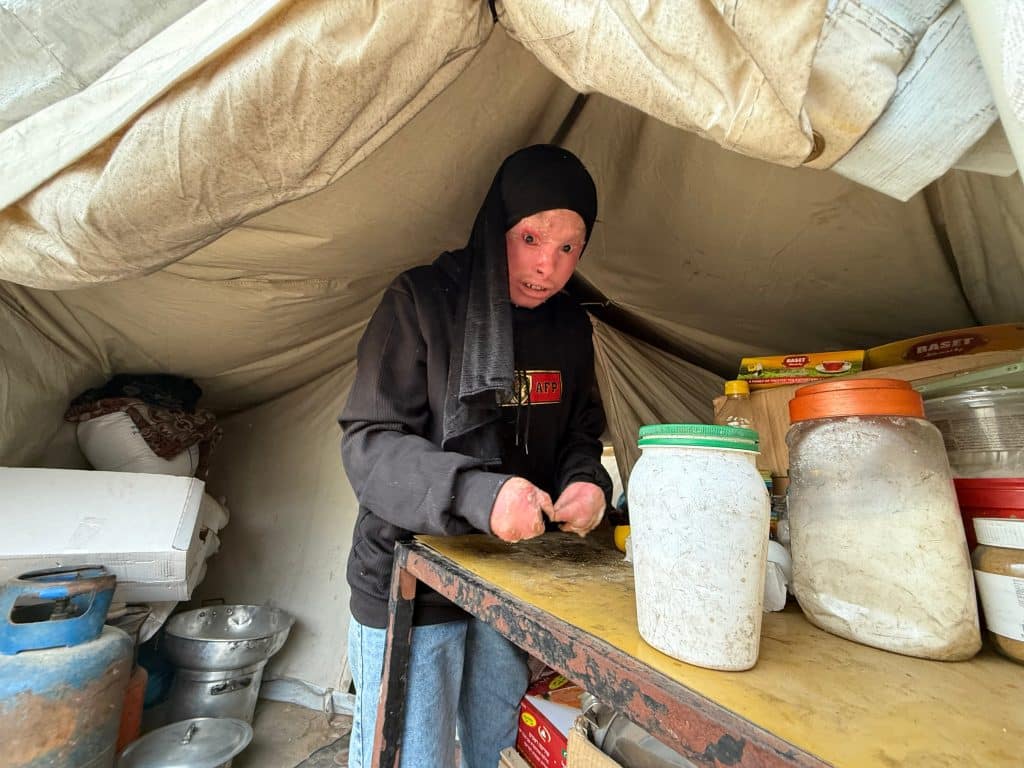
After losing their family home in Beit Hanoun, in northern Gaza, Shahd endured repeated displacement between the north and south of the Gaza Strip. Eventually, she ended up living in a cramped, torn tent with her grandmother, two aunts, and her uncle.
The tent offers little protection from rain, heat, dust, or overcrowding. For someone with her condition, heat is especially dangerous. Because her skin is so thick, Shahd struggles to sweat normally, which prevents her body from regulating its temperature. Cold weather also worsens her condition, making her skin drier and more painful.
To manage her illness, Shahd is supposed to take a shower every day. But even this basic routine has become almost impossible. Water — one of the most essential elements for managing ichthyosis — has become a luxury.
“We hardly have access to water,” her grandmother says. “My young son has to stand in long queues every day to bring bottles of water that must be shared between cooking, drinking, laundry, and sometimes bathing.”
“Shahd can barely shower once a week,” she adds. “After each shower, her body needs moisturizing to keep her skin from cracking.”
“We usually use Vaseline,” the grandmother explains, “because it is the only moisturizer available in Gaza now.”
After each bath, Shahd needs an entire large container of Vaseline to cover her body.
Shahd also requires between 500 and 700 Israeli shekels ($160 – $220) each month for medical supplies, including creams, ointments, and other basic medical supplies. For her family, this amount is nearly impossible to secure. “Medicines are either expensive or plain scarce,” the grandmother says.
Despite the ceasefire, Israeli authorities have continued to restrict the entry of medical aid. Gaza’s Ministry of Health reports that less than 30 percent of the Strip’s monthly medical aid needs are being allowed in, with 62 percent of primary health-care medicines currently unavailable. More than 288,000 patients are affected by these shortages.
“We don’t have a stable source of income,” her grandmother says. “One month, if we’re lucky, she can get part of her treatment. The next month, she can’t.”
The grandmother is now the family’s sole provider and caregiver. Like tens of thousands of families in Gaza, they rely entirely on humanitarian aid for basic survival and on charitable donations to cover other necessities, including Shahd’s medication.
Barred from treatment
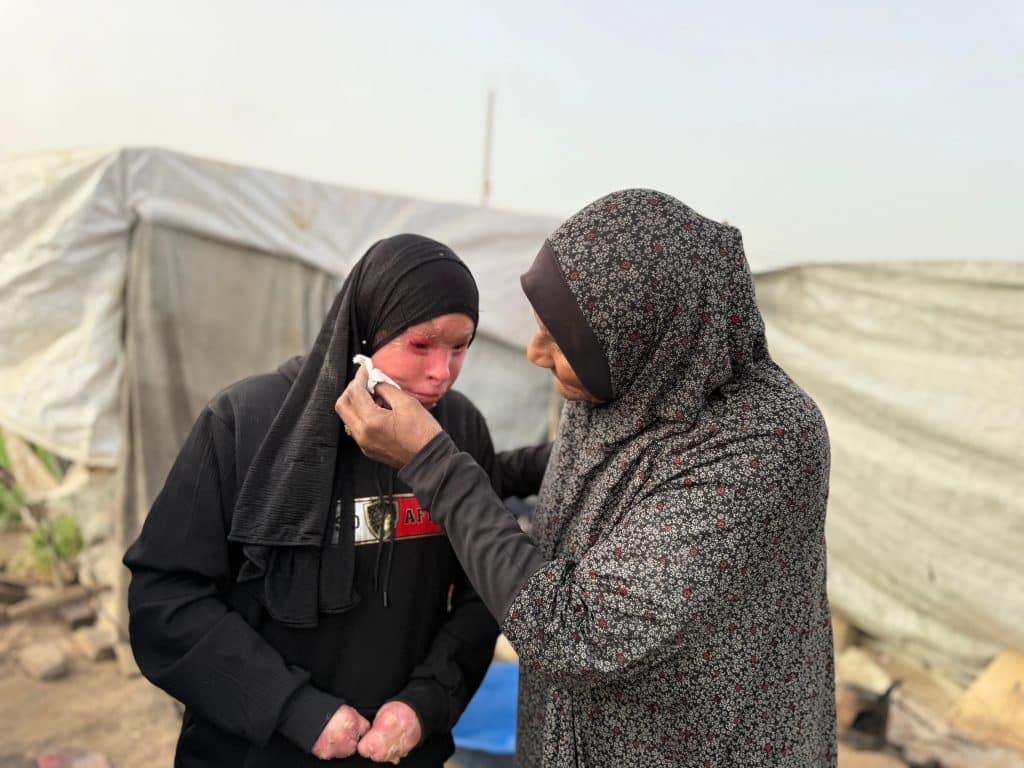
Shahd’s mental health has also deteriorated. “She is usually alone,” her grandmother says. “She has no friends, and she cries a lot. If she had received proper treatment, she could have lived normally and made many friends.”
Shahd has never known the care of either parent. Her mother abandoned her at birth, unable to accept her condition. Her father was killed in an Israeli attack in 2008, two months before Shahd was born. So her grandparents raised her instead.
“She became a daughter, not a grandchild,” her grandmother says. “She was very attached to her grandfather. He was the father she never knew.”
In May 2024, her grandfather was killed in northern Gaza after refusing to leave the city at the start of the war. “This added another layer of pain for Shahd,” her grandmother says.
Shahd’s grandmother also says that even education has become a source of suffering. “I am always afraid to send Shahd to school,” she explains. “Any sudden movement, accidental push, or crowded space could cause her skin to split and bleed.”
There is another reason as well. Now 16 years old, Shahd is at an age when friendships shape identity, yet she lives in near-total isolation. She has no close friends in the camp and spends most of her days inside the tent.
“Children her age are afraid of her,” her grandmother says. “They avoid her, and sometimes they bully her.”
The isolation has taken a visible toll. Shahd lives in constant grief. She cries often, withdraws, and struggles with sadness.
“She is always sad,” her grandmother says quietly.
For now, the family believes it may be safer for Shahd not to return to school. Her social world is limited to her aunts and a few relatives who accept her condition. “Shahd longs to feel comfortable and protected,” her grandmother says. “She wishes to receive an education and to live like any other child.”

Since the war began, Shahd’s family has been trying to obtain medical permission for her to travel abroad and complete her treatment.
“We know that traveling outside won’t cure her disease,” her grandmother says. “But at least it would allow her to access the medication and treatment she needs, so she can live like any other child her age.”
Although the Rafah crossing recently reopened, only a very limited number of Palestinian patients are allowed to leave or enter the Strip, and those who were allowed through report intensive interrogation, mistreatment, and humiliation. Israeli authorities continue to impose strict restrictions on passengers, further deepening the humiliation and suffering of those in need of urgent medical care.