
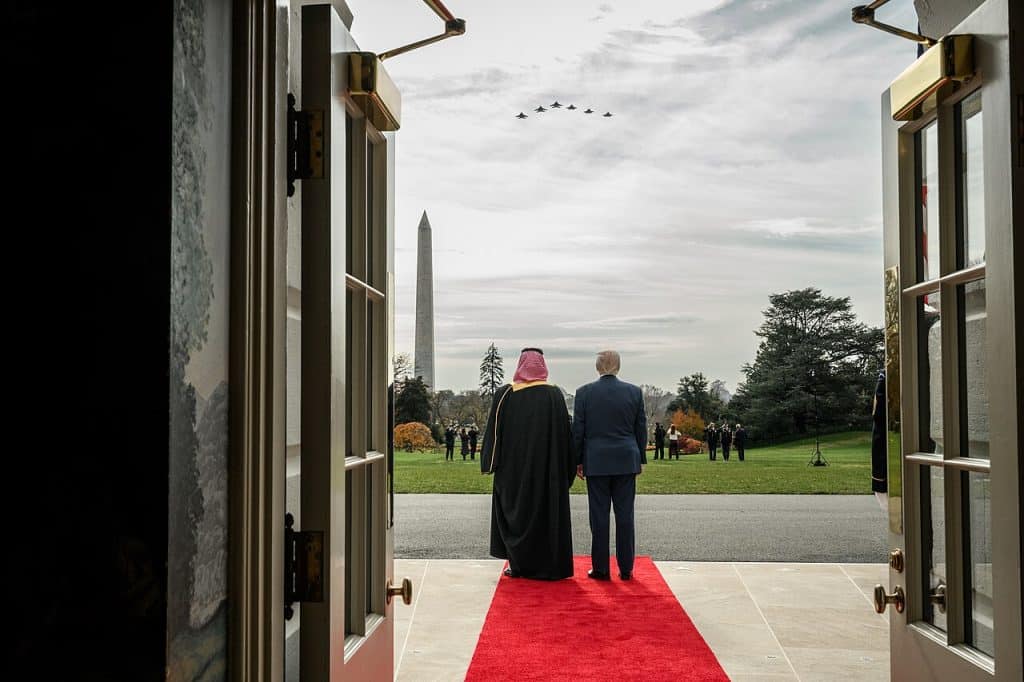
In recent months, Saudi Arabia has been moving toward a significant realignment of its national security strategy and foreign policy. This goes well beyond its confrontation with the United Arab Emirates in Yemen or its competition with the Emirates in Sudan, though both are components of the broader Saudi realignment.
It involves a total rethinking of its relationship with the United States.
But what is the nature of this realignment? What spurred it on? And what are the implications for other actors, especially Israel, Palestine, and the U.S.?
Diversified alliances
Saudi Arabia attracted international attention to its shifting strategy last September when it signed a defense pact with Pakistan. The two countries had long been friendly and shared many similar interests, but the formal agreement signaled something new.
In particular, it meant that Pakistan, one of the world’s few nuclear powers, agreed to extend its nuclear umbrella over Saudi Arabia. Pakistan’s military strength will also be helpful to Saudi ambitions for security independent of the West.
The Saudis, of course, can do a lot to help Pakistan’s difficult economic situation, as well as boost Islamabad’s position on the global diplomatic stage which Pakistan hopes will win it more sympathetic audiences outside of the South Asia region.
In January, there was talk of Türkiye potentially joining this pact, but that idea seems to have fizzled out. Nonetheless, Ankara maintains strong ties with both Saudi Arabia and Pakistan, and it is a significant part of Saudi Arabia’s new strategy.
The states have a common regional vision which includes economic diversification and the stability of existing states. That is reflected in desires for unified futures for states such as Yemen and Sudan, as well as vocal opposition to Israel’s recent recognition of Somaliland, a breakaway state from Somalia.
For the Saudis, the strategic shift is dramatic but dictated by equally dramatic decisions in Washington.
The decades-old agreement between Riyadh and Washington where Saudi Arabia ensured the free flow of low-priced petroleum in exchange for the U.S. granting it military protection has been fracturing for years. The kingdom has not forgotten Washington’s lack of response during Donald Trump’s first term when their oil fields were attacked by drones and missiles launched by Ansar Allah (the Houthis) in Yemen. Both Saudi Arabia and the United States blamed Iran for the attack, and the Saudis expected the U.S. to hold Iran accountable.
But Trump decided not to act beyond a minor increase in already crippling sanctions against Iran. This shook Saudi confidence in the long-time agreement. But it was only one factor in the growing sense in Riyadh that they could not count on the United States to fulfill their part of the bargain.
Trump’s rhetoric at the time did not help matters, and neither did his generally unpredictable behavior. Then Joe Biden sent messages that were little better. It was not lost on the Saudis that, when Russia invaded Ukraine, Ukrainian President Volodymyr Zelensky had to work night and day just to maintain a level of financial and military support sufficient to slow the Russian advance down. Despite the European and American promises after the fall of the Soviet Union that they would guarantee Ukraine’s security if they gave up the nuclear weapons that they had left over from Soviet rule, Ukraine has lost large portions of its territory and has suffered terrible devastation.
Whether that was the right policy decision by the U.S. and Europe or not, it raised even more questions in Riyadh’s mind about American security guarantees.
Biden’s suicidally myopic support of Israel as it carried out its genocide in Gaza also profoundly concerned the Saudis. American foreign policy of the twentieth century was generally guided by a desire for stability in the Middle East. Even Israel was pressed, sometimes unwillingly, to support that agenda.
The neoconservative administration of George W. Bush broke from that tradition with its invasion of Iraq. Trump’s erratic and transactional approach aggravated that shift. And Biden’s permissiveness not only with Israel’s genocide but also its attacks in Lebanon and invasion of Syria made it clear that the U.S. was not a reliable partner in the effort for stability in the Middle East.
The Saudis understand only too well that the major force undermining regional stability is not Iran but Israel. While they have no interest in getting into confrontations of any kind with Israel, there is clearly a need for Saudi Arabia to find ways to balance Israel’s chaotic behavior. That means, inevitably, reducing Saudi Arabia’s dependence on the United States.
The growing Israel-UAE axis
The partnership between the United Arab Emirates and Israel is another major factor in the Saudi realignment. It is all the more concerning for Riyadh because the UAE has grown its influence in Washington substantially in recent years.
Emirati interests often break from the consensus among the rest of the Gulf Cooperation Council, of which Saudi Arabia is the most powerful and influential member. Whether that is with the UAE’s nearly unconditional partnership with Israel, support for secessionists in Yemen, or their arming of the Rapid Support Forces in Sudan (which the UAE denies, but is an open secret, similar to Israel’s nuclear arsenal), the UAE has consistently prioritized what it sees as its own interests over concerns about regional stability that Saudi Arabia and the rest of the GCC prioritize.
While the other GCC countries are trying hard not to choose between Saudi Arabia and the UAE, that is becoming an increasingly precarious tightrope for them to walk, especially as the UAE deepens its ties with Israel. While the UAE will occasionally join other Arab states in a critical statement about some Israeli action or other, it is notable that Israel never lashes back at Abu Dhabi for siding against it.
That’s a reflection of the closeness of their relationship and the fact that the UAE never goes beyond the performative public statement, despite the fact that its normalization agreement with Israel gives it a unique sort of influence.
The relationship between the two is deeply worrisome to Arab Gulf states. As Professor Andreas Krieg noted in speaking about Oman to analyst Giorgio Cafiero, it raises anxieties to see Emirati-Israeli cooperation via proxies in places such as Libya, Somalia, Sudan and Yemen.
“They do not see this as power politics, but they are seeing it as a Trojan Horse that can potentially fragment Gulf societies,” Krieg said.
The Saudis want to maintain cohesion in the GCC, but not at the cost of regional stability. They were reluctant to use their full military force in Yemen, but eventually they recognized that it was their only path toward restoring a unified Yemen, which they hope to eventually do. When Saudi Arabia brought their force to bear, the Emiratis quickly retreated, and, while they may very well try to assert themselves in Yemen again, it was still a clear statement about what the Saudis could do when they decided to use the kind of force they are capable of and which the UAE cannot match.
But confrontation does not bring cohesion, and the Saudis are more inclined to try to change the Emirati strategic calculus by forging powerful alliances like the pact with Pakistan and building on existing relationships, such as the one with Türkiye. That’s a strategy that the ostensibly neutral GCC countries will be supportive of.
Israel’s response
Israeli Prime Minister Benjamin Netanyahu spoke at a meeting of his cabinet on Sunday about the growing threat of a “Sunni axis.” It’s a play on the so-called “Shi’a axis” which stretched, from Israel’s point of view, from Iran, through Syria, and into Lebanon, with branches in various Shi’a populations throughout the region.
It’s not completely clear what Netanyahu was referring to, but there has been a great deal of talk recently about the Muslim Brotherhood, painting the organization as a growing threat (it’s not, as the group renounced violence many years ago, although some of its offshoots, like Hamas, continue to embrace armed struggle). The United States recently added the Jordanian and Egyptian branches of the Brotherhood to its list of Designated Terrorist Organizations.
The Brotherhood’s state support is largely found in Türkiye and Qatar, while the Saudis have always opposed the Brotherhood’s ideology, and still do. But that wouldn’t stop Netanyahu from conflating the two, just as, two decades ago, he and others had no problem conflating Iran with al-Qaeda—a group Iran had been fighting against from its very beginning and before the U.S. saw it as a major threat.
Netanyahu made his remarks as he announced the upcoming visit of Indian Prime Minister Narendra Modi to Israel. With Modi on the way, and given both Israel’s increasingly close relationship to India and Pakistan’s growing connection to the Gulf, Netanyahu is telling us he intends to counter Saudi Arabia’s move toward regional partnerships outside the American sphere of influence with a bloc of his own.
Netanyahu spoke of a “hexagon of alliances” that would counter what he is presenting as a rising threat of a Sunni “axis.” Along with India, he mentioned Greece and Cyprus, and claims there are other Arab, African, and Asian states that would join in.
While Saudi Arabia is trying to build a strategic bloc of alliances to diminish its dependence on the increasingly fickle U.S. and to balance Israel’s growing regional aggression, Israel and its supporters are mischaracterizing these actions, whether intentionally or out of paranoia, as attempts to confront Israel.
Certainly, Netanyahu is primarily focused at least publicly, on Türkiye and Qatar. That’s why he has mentioned the Muslim Brotherhood.
But this is also a response to the possibility of a Saudi policy less beholden to Washington and in increasing regional competition with the UAE. It’s clearly making Israel’s supporters very nervous.
There are increasing accusations of antisemitism being directed at Riyadh. The ADL, always ready to weaponize spurious accusations of antisemitism in service of Israel, has been elevating their anti-Saudi rhetoric. On January 22, they tweeted, “ADL is alarmed by the increasing frequency and volume of prominent Saudi voices — analysts, journalists, and preachers — using openly antisemitic dog whistles and aggressively pushing anti-Abraham Accords rhetoric, often while peddling conspiracy theories about ‘Zionist plots.’”
The right-wing journalist Lahav Harkov wrote about concern among pro-Israel forces over the apparently horrifying fact that the Saudis and Qataris led the push to try to convince Trump not to attack Iran. Yet she only cites non-governmental Saudi speakers whose remarks are mostly directed at Israel’s actions. Her concerns, and those of the pro-Israel figures she spoke to, seem to mostly stem from consternation over Saudi Arabia’s negative attitude toward the increasingly close ties between Israel and the UAE.
In reality, Netanyahu will have precious few allies for his “hexagon” in the Arab world. Jordan and Egypt will have to be polite to continue to receive American aid, but will certainly not be a part of such a grouping, as it would be dangerously unpopular in both countries. Few others have much incentive to side with Israel and the UAE over Saudi Arabia and Türkiye if forced to choose.
What does it mean for the United States?
The Saudi realignment is by no means an abandonment of its long-term partnership with the United States. Saudi Arabia will always want welcome access to the American market, and that will become even more important as it expands its efforts to diversify its economy away from its dependence on oil.
Also, regardless of partnerships with relatively strong military powers like Pakistan and Türkiye, no country, or even combination of countries, can replace what the United States can provide militarily. Saudi Arabia very much wants to maintain a warm relationship with Washington so it can get the U.S.’ help in developing a civilian nuclear program of its own.
That prospect is currently very controversial in DC, as there are reasonable fears that Saudi Arabia might, one day, divert such a program to military uses. Indeed, there have been recent signs that not only have the prospects for U.S. support for a Saudi nuclear program gained momentum, the Trump administration is working to remove the safeguards that would prevent such a program from kicking off a weapons program.
The biggest headache for Washington, whether that means Trump’s White House or a future one of either party, will be Israeli fretting over Riyadh’s more independent course.
Israel will promote a more hostile attitude from Washington, but this will be a tough battle for them. While both Saudi Arabia and its de facto leader Mohammed Bin Salman, are unpopular in the U.S., both lawmakers and many American voters recognize the economic need for partnership with Saudi Arabia. And, given Israel’s diminished image even among mainstream Democratic voters, Israel’s concerns won’t be able to impact policy much, though they won’t be ignored.
In the end, this could all be a boon for U.S. policy. A strong relationship between Washington and a Saudi Arabia that is pursuing stability on its own and, therefore, is less dependent (though still dependent) on U.S. security support is one that could diminish the need for an American footprint. If it can make Israel think twice about launching attacks on its neighbors, that benefits everyone (including Israeli citizens). And, in partnership with Türkiye and Qatar, it even has the potential to revive at least the kind of support, meager though it always was, that resulted in the Arab Peace Initiative in 2002.
The only real loser in this is Netanyahu, and that seems perfectly OK.

Former head IAEA nuclear weapons inspector Scott Ritter has been warning for decades that Israel has been wanting to take Iran out. That Israel and the I lobby have been trying to manipulate U.S. foreign policy for decades..specifically to attack Iran.
Scott Ritter has been spot on about Iraq. About Iran. About Israel’s aggressive, militaristic intent.
His latest. Today Feb 28,2026.
https://www.youtube.com/watch?v=2zjuZqUrCAo
Prof Mearsheimer had been hopeful that Trump was looking for an off ramp. Way to bad/sad his reading of the situation was incorrect.
https://www.youtube.com/watch?v=vx1KnspP1gM
Re: no country, or even combination of countries, can replace what the United States can provide militarily.
Nope. Our own trillion dollar budget can only produce a couple of weeks worth of muntitions. France, the UK, and Germany can condemn Iran for counterattacks launched against US bases, but they are simply supporting the aggressors impunity, and failing.
The USA complained when Australia tried to buy its submarines from France in 2016. They cancelled and are now being told the USA can’t produce them, and is demanding bases there for US submarines instead. Likewise, in Canada our US Ambassador has threatened to cancel NORAD and take over sovereignty of Canada’s airspace, since they’ve refused to purchase our F-35s. The USA allowed Israel to strike Qatar, then promised to give them the same mutual defense from attack as NATO. Earlier today, Qatar reported it had been attacked by 44 missiles and 8 drones in the first wave. The problem for Saudi Arabia, Bahrain, Qatar, Kuwait, Iraq, and Jordan is that allowing US bases to be used to attack Iran makes them a valid military objective. If the join in the coup attempt, the targeting will expand to their own infrastructure and oil fields. How does that improve their security?.
Inviting the Iranian people to have a regime change won’t matter, because we’ve been engineering regime changes there since Moses Montefiore demanded reforms in the early 19th century. Herzl demanded a Jewish State and Weizmann demanded a share in the UK-French-Russian Sphere of Influence that resulted in the Oil Cartel Red Line map and broken Feisel-Weizmann agreement by 1920. FDR endorsement of ZOA Jewish State and ethnic cleansing in 1944. Kermit Roosevelt and MI-6 engineered an overthrow, and then Carter sent General Robert Huyser to attempt a military and SAVAK coup to prevent the assumption of power by revolutionary leaders who replaced the Shah. Netanyahu and Trump will only find different Iranian adversaries if they succeed. The Iranian regime governs 90+ million people with a heavily armed 200,000 force of militias and the IRGC. They have a constitutional line of succession just like the USA. We would readily replace Trump if he were found dead without missing a beat. They can do the same thing. The question is how long China will wait to reopen the Strait and resupply their oil lifeline? I’d guess not as long as Trump and Netanyahu will need. YMMV
Iran has every legal right to respond to Israel and the U.S.’s deadly aggression in Iran in proportionate ways. Big problem is that Israel and the U.S. never operate within legal agreements, treaties, UN resolutions.
Watching Fox News “Live Now” this morning/Sunday. As is always the case lots of coverage on destruction in Israel, the 4 deaths in Israel. Nothing, zero, nada about the hundreds of Iranians killed by Israel and the U.S. Iranians injured by Israel and the U.S.’s deadly aggression.
Over and over again we hear how the United States of Israel does not value Iranians, Palestinians lives. Only Israeli lives. Such arrogance, narcissism always on display. Shameful and nauseating.
There are real reasons why so many in that part of the world hate Israel and the U.S.
As of February 2026, Saudi Arabia, Qatar, and the UAE have made pledges to the new Board of Peace Gaza reconstruction fund totaling over $3.2 billion combined.
On 2 March 2026 Business Insider reported Saudi Arabia, Abu Dhabi, and Qatar chipped in a collective $24 billion to help Ultra-Zionists Larry and David Ellison purchase Warner Brothers Discovery. I can think of better ways to make a profit than underwriting the Oracle-Paramount-TikTok-WBD business plan.