The jeep that takes us to Umm al-Khair rocks from side to side, as if we were on a boat in open water. At the wheel is Ali Awad, a Palestinian journalist from the nearby village of Tuba. Almost every formal route connecting Tuba to Umm al-Khair has been destroyed by the Zionist state; what remains is a single dirt road, crudely carved through the hills of the southern West Bank’s semi-desert of Masafer Yatta by the local residents themselves. Few vehicles can make the journey: tractors during the planting season or when feed must be hauled in for livestock; military vehicles, which patrol the area day after day; and the occasional car engineered for rough terrain. Ali’s jeep is one of them.
Ali has brought us here to show us how the Zionist state is advancing its colonial project on the ground, turning Umm al-Khair, piece by piece, into what can only be described as an island encircled by a colony.

He glances into the rear view mirror, scanning for soldiers. Nothing, the road is clear. He takes a drag from his cigarette and presses down on the accelerator. “It’s illegal to be here,” he tells us.
In May 2022, Israel’s High Court authorized the expulsion of thousands of Palestinians from Masafer Yatta, designating 3,600 hectares as a “closed military zone” called Firing Zone 918. Anyone found inside it — especially non-residents — faces detention and potentially deportation. “It’s risky,” Ali says. “But it’s very important to document what’s happening in Umm al-Khair.”
To our left, Israeli flags line the roadside by the dozens. To our right, Hebrew lettering announces the settlement ahead: Carmel. Established in 1980 as a military outpost, Carmel was formalized into a settlement a year later — a familiar tactic in the Zionist expansion across the West Bank. Over time, it became a town: hundreds of settlers, dozens of houses, a school, a synagogue, shops, and even bars. It looms over Umm al-Khair, just a few meters away.
The jeep follows the road tracing the settlement’s edge. Stone walls rise beside us, reinforced with metal fencing and surveillance cameras. As we turn the first bend, we encounter about ten settlers. Several are armed with semi-automatic rifles. Some are minors, or even children, though a few of them are armed as well.
They stand in the road, unhurried, blocking our path. Ali tenses up. He eases onto the brake, slowing the jeep, and takes a deep breath, collecting himself. He asks us not to film. The settlers part just enough to let us through, gripping their weapons as we move past. One of them shouts: “Go away!” We drive another ten meters and finally stop. We have arrived in Umm al-Khair.
The village’s social center looks, at first glance, like any other. Children run playfully back and forth. People sit in a circle, chatting and drinking tea or coffee. There are swings and slides for the kids. Everything appears normal.
Except for the names of the martyrs painted among the bright colors of the wall. Except for the armed settlers lingering just outside the fence, beside the playground full of children. Except for the fact that anyone here could be detained at a moment’s notice, simply for being present, and that the social center itself could be demolished at any time.

“Every construction that you see in front of you — either it was demolished once or twice, or it has already a demolition order,” says Ahmad Hathaleen, resident of Umm al-Khair. “Even a simple playground, which is only ground and benches and some games for the children, has a demolition order.”
Demolitions in Umm al-Khair began in 2007, following approval of a plan to expand the Carmel settlement. Since then, the army has destroyed hundreds of structures, some more than once, as residents insist on rebuilding what the Zionist project repeatedly tears down.
The Hathaleen family arrived in Umm al-Khair more than 70 years ago, displaced during the Nakba — catastrophe, in Arabic — when around 700,000 Palestinians were expelled from their homes and over 500 villages and towns were destroyed following the creation of the state of Israel. Around that time, the Hathaleens were forced out of Arad in the Naqab desert. Today, Arad is a city of nearly 30,000 settlers.
Ahmad Hathaleen was born here, in Umm al-Khair, thirty years ago: “Every single day, since I was born until today, there’s a daily struggle because of the occupation.”
As Carmel expanded, with the state’s support and the army’s protection, so did the pressure on the village. In recent years, settler violence has escalated — harassment and attacks, olive trees cut down, agricultural fencing destroyed, animals stolen, and land confiscated. Nearly all agricultural land and grazing areas have been taken by settlers. “The village used to have 3,500 sheep and goats,” says Ahmad. “Now,” between the roughly 40 families of Umm al-Khair, “you can’t find 150.”
“You see the setters?” Ali Awad asks, pointing towards a group singing and dancing on the other side of the fence, about ten meters from where the interview is taking place. “People cannot move outside in that direction. Only from the road we used, with a car. You see a lot of land around Umm al-Khair, but it’s under the control of the settlers.”
Last year, in 2025, settlers from Carmel pushed the expansion further. They placed caravans beside Palestinian homes, enclosing yet another section of the village. “Now the village is going to be completely surrounded by a settlement,” Ahmad says, “putting the houses of Umm al-Khair in the middle.” Like an island inside a settlement.
On July 28, after weeks of escalating attacks, Yinon Levi arrived with an excavator. Levi is a settler known for his violence who has been sanctioned by both the United States and the European Union due to repeated attacks against Palestinians. He established the Meitarim Farm outpost, was one of the people responsible for the ethnic cleansing of the Palestinian village of Zanuta, and was now leading new land grabs in Umm al-Khair. “He was constructing where they [the roughly ten settlers nearby] are praying exactly, and where they erected the caravans,” says Ahmad Hathaleen.
At first, he says, no one confronted him. But when he began tearing up water pipes and uprooting trees that sustained nearby families, Ahmad stepped in front of the machine. He pleaded – in Arabic, English, Hebrew. Levi did not stop. He drove the excavator into him, hitting him with the hammer, and Ahmad lost consciousness.
People ran towards the commotion, residents and international activists alike. Among them was Awdah Hathaleen, Ahmad’s cousin, a 31-year-old English teacher and well-known organizer in Umm al-Khair. Awdah stood near the playground, filming the scene unfolding before him. And then, suddenly, Yinon opened fire. In the video Awdah recorded himself, one can hear his breath faltering after the bullet strikes his chest. He collapsed and was taken to the hospital, where he was pronounced dead.
“Yinon shot Awdah because he knows that Awdah is a very popular activist and they don’t want media coverage here. They don’t want people to write or talk about their harassment and their policies against the Palestinians,” Ahmad said. “The killing of Awdah was a clear targeted assassination because he was not just a random person. He was known for his writings and for his connections to the world.”
Awdah’s death was devastating for Umm al-Khair. He was a central figure in the resistance not only in Umm al-Khair but across Masafer Yatta. “It’s hard. It’s really hard,” says Alaa Hathaleen, Awdah’s brother-in-law. “Because, I tell you, if it was anybody but Awdah, it would be easier. Awdah is loved by everyone. You will not find anybody who hated Awdah. He’s the best. He was working for everybody, helping the community, trying to get funds for the community.”

After Awdah
The same day Awdah was killed, the Zionist army detained and expelled people from the village. Several were taken to the Ofer military prison in the West Bank, including Ahmad Hathaleen and Ali Awad. “We were tortured with all kinds of means of torture,” Ali says. The army then withheld Awdah’s body. Their condition for returning it: a funeral of no more than fifteen people, held at night, and in the city of Yatta, not Umm al-Khair where Awdah had lived his entire life.
“The people said no,” Ahmad recalls. “Awdah needs a funeral as big as what he did for his community.” The army refused. Four days later, Yinon Levi, who had been placed in house arrest, was released. He returned to Umm al-Khair as if nothing had happened.
After every avenue — media presence, diplomatic appeals, activist campaigns — failed to get Awdah’s body back, 70 women from Umm al-Khair decided to take matters into their own hands and launch a hunger strike. “Awdah would have a funeral that matched his value as a human being and as an activist who sacrificed his life for his community,” says Ahmad.
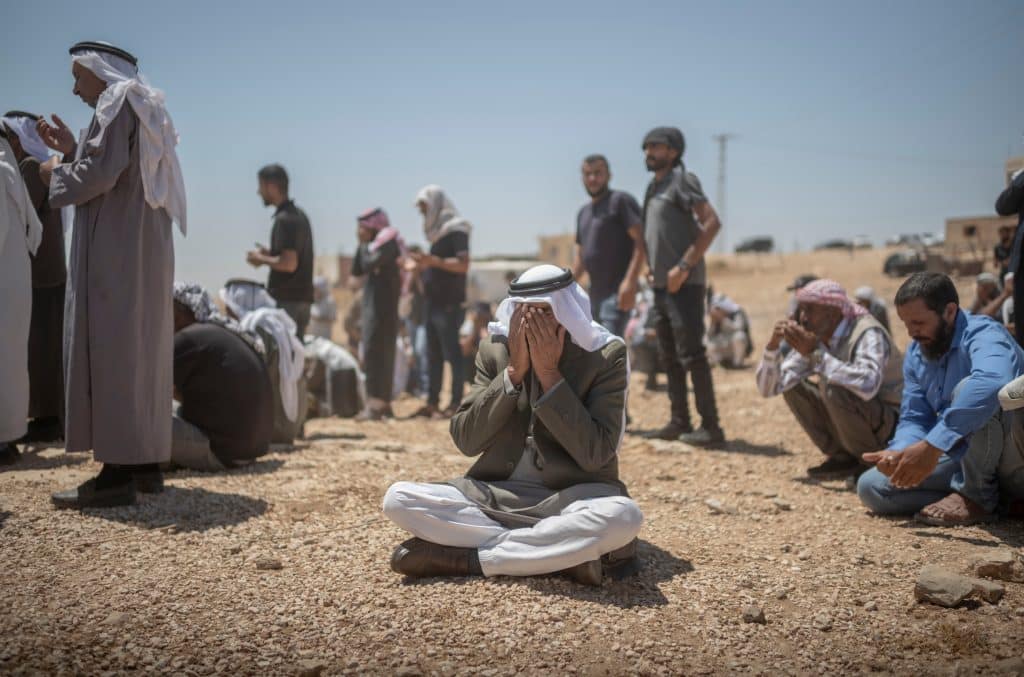
Six days later — ten days after his death — his body was returned. Awdah Hathaleen was buried in Umm al-Khair on August 7. Hundreds of people marched, despite the army erecting three checkpoints to block access to visitors.
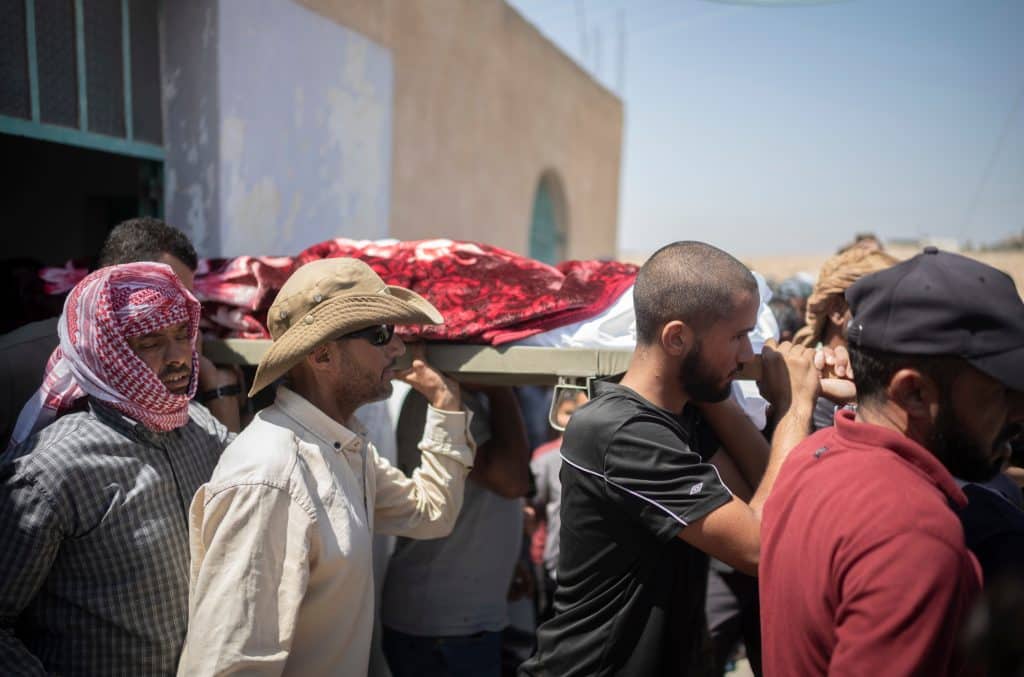
The village lost an organizer, a beloved companion, and three kids lost their father. The oldest was five years old, the youngest still a baby. “I’m in the worst situation ever,” says Hanady Hathaleen, Awdah’s widow. “Every day, it’s harder and harder. It’s like all our lives are just gone. All our dreams, the safety we once had. If we once had safety, it was Awdah. If we had good things in life, it was Awdah.”
The children ask for their father every day. “They remember their dad very well. They wish to die like he did,” she says. “Two nights ago, [the older one] told me: ‘I want to trick the gods, pretend that I am dead, so they will take me to my dad, and this will be the best thing that ever happened.’”

As we sit in the community center, the settlers remain just meters away, outside the fence. They sing, dance, and pray progressively louder, as if to drown out the conversation. “They have a very big synagogue inside Carmel, but these acts of prayer are to provoke the people,” Ahmad claims. “Their clear goal is kicking the people from here, stealing the land.”
We ask him why he decided to stay.
“My grandparents were refugees from 1948, and they moved here. If I leave from here, where am I going to go?” he replies. “Even if I moved to another place, that doesn’t mean that there’s going to be a future in that place. Then, there is the respect for the people who died and sacrificed their life for this land. We have to be resilient.”
For Ahmad, to leave Umm al-Khair after the sacrifice of the martyrs, who died so their families could stay, would be a betrayal. “This is my country,” he adds. “This is my land. This is where I belong. Why should there even be a question of leaving or staying? The settler, the illegal settler who came here, is the one who must leave.”
Ali Awad
Ali Awad is an activist and journalist from the village of Tuba in Masafer Yatta.
Rafaela Cortez
Rafaela Cortez is a journalist based in northern Portugal focusing on inequality, discrimination, and the broader structures of violence shaping daily life in both Portugal and Palestine.
Ricardo Esteves Ribeiro
Ricardo Esteves Ribeiro is a journalist based on the border between Northern Portugal and Galicia. He reports on the occupation of Palestine and the people resisting it since 2017. He’s a co-founder of Fumaça, a Portuguese investigative journalism podcast.