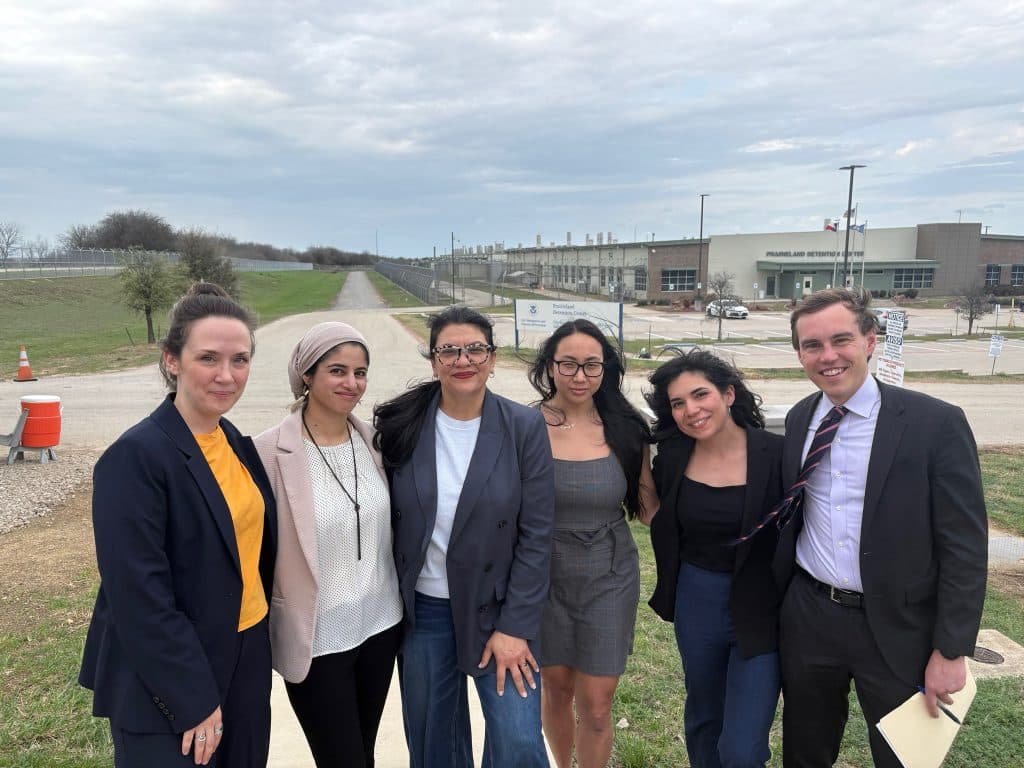
On Friday, March 6, U.S. Representative Rashida Tlaib, the first and only Palestinian in Congress, visited Leqaa Kordia at Prairieland Detention Center in Alvarado, Texas.
Kordia, who is the last remaining Columbia protester in detention, has seen a recent groundswell of support following a seizure she suffered in detention due to malnutrition. Arrested on March 13, 2025 by the Department of Homeland Security (DHS), she is fast approaching her first full year in detention as her health reportedly worsens.
Rep. Tlaib visited Kordia at the Prairieland Detention Center on March 6th, after which she called for her immediate release from detention. If Kordia is not released soon, Tlaib said, “I’m afraid she’s going to die in there.”
In an exclusive, one-on-one interview with Mondoweiss, Rep. Tlaib recounts her tour of the facility, her conversation with Kordia, and what she described as a system of “corruption” running through Congress that keeps immigrants detained at for-profit facilities.
Mondoweiss: What prompted you to visit Leqaa?
Rep. Rashida Tlaib: I think when I found out about the seizure. I had gotten notice from my team, but also saw some information online. And for somebody to be in her early 30s and never had a seizure before to all of the sudden have a seizure, I immediately thought that maybe there was physical harm to her. Of course, I later found out, it was because she’s malnourished and suffering from sleep deprivation. I think her seizure is what spurred her hospitalization, which was what spurred my desire to travel all the way to Texas.
What can you tell us about your meeting with Leqaa and your time inside the facility?
Rep. Tlaib: We spoke for hours.
First of all, I went there, I gave notice to ICE at the Congressional Affairs level. They never notified them. They were not expecting me. I ended up doing a tour of the facility with the warden and with the assistant field director there, as well as the supervisor for deportation and a number of other folks.
The biggest concern I had was the medical unit. It was crowded. I think it was intentionally crowded. Maybe they didn’t want me to go in, I’m not sure, but that’s where the biggest complaints we get are people with fevers, cough, suffering from other conditions.
[Leqaa] says, “What can I do? These are the things that are happening.” She asks for vitamins and things, “Because I’m malnourished, so I’m not getting it through the food, because I’ve been here for almost a year. I get the same food over and over again, oatmeal with a slice of bread, no fruit. They think the cranberry juice is fruit.”
[Leqaa] said, “Rashida, they give a pillow case with no pillow.” I said, “You’re kidding me. I saw pillows, though.” She goes, “That’s because we put our clothes in there. We put our clothes in the pillow case to make a pillow.” And I said, “What about the women who are pregnant? Six months pregnant?” She said, “They give them, like, an extra layer of a mattress.” I can’t remember what other thing they gave them, but that’s it. But it’s really hard. I said, “You’re suffering from sleep deprivation. How are you emotionally?” and she said, “It’s because they leave the lights on,” and it’s because there’s like 58 [detainees per unit.]
And she told me that day was the first day in three months that they let them go outside. And she went on about the other women, and I kept having to get back to her and her condition, and she told me, “I’m better off than most others. They are really suffering. They’re afraid to say anything.”
I’m afraid she’s going to die in there. I’m very upset that she [has to] keep filing grievances, and she’s obviously become an advocate inside that chamber, inside the ICE warehouse.
She teared up when I told her, “You can free everybody else when you get out there and it just is an overwhelming goal. But obviously,” I said, “Think of your mom. Think of everybody.” She wants everybody to be free with her, really. I mean, for somebody who’s been there that long, she just got to know everybody. She knows everybody’s life story.
Did she mention response time or more on issues with medical?
Rep. Tlaib: Well, she said, “I didn’t want to call the medical units.” She said, “It’s just a hassle.” And she said, in front of her, the guard fought with the medical unit and said that she didn’t look right. She had a fever. And they told the guard to tell Leqaa to make an appointment.
MW: What have you seen consistently across ICE facilities? Is it usually like this?
Rep. Tlaib: I mean, this is probably the worst one I’ve seen. Primarily because, again, they weren’t prepared for me to come through. But what I can see from the LaSalle corrections facility (Prairieland) is that it was very chaotic back and forth. I told them there are complaints about the food. There are complaints about the medical unit…
The response was, “Well, you know, Congresswoman, even the staff likes the food. The staff eats the food.” I said, “I was in your lobby for an hour waiting for you guys to let me in,” because I wasn’t going to leave until they let me in. “And I watched DoorDasher after DoorDasher come through. So don’t tell me that your staff is eating the food. Your staff is eating the food in front of the folks. So they’re eating chicken wings and all kinds of food in front of them while they’re at their desk in front of the detainees and the immigrants.”
But the point is, this facility seemed, to me, crowded. It also seemed very chaotic in the medical unit. When I walked back, the same amount of people were standing; there was nowhere to sit in the medical unit lobby. And it wasn’t even a lot. It was just like a kind of an L-shaped room.
Do you think Congress will talk about the obstructive measures DHS has taken legally?
Rep. Tlaib: I don’t think so.
What I’m concerned about is the fact that I have three people alone in Michigan – and I understand there was, according to Leqaa, a number of them at the Prairieland facility – that have said, “I want to self-deport,” that are saying, “deport me.” And they’re not deporting them because I think they make money off of not deporting them and just keeping them in the ICE warehouse.
I don’t think it’s about conditions. It’s about the fact that there are people in there who could be waiting and be out on bond with their families, and be less costly on the taxpayers. Be able to, again, wait their turn to be before a judge and figure out whatever the resolution is, instead of being there costing this money.
Because, again, it’s not just LaSalle Corrections, it’s GEO Group, CoreCivic, whatever they’re called. They’re all complaining right now that they’re not making enough money. They’re all complaining right now that the profit is not enough. I know members of Congress, myself, and others that I’ve talked to, are more concerned about the fact that they want to scale up even more.
Are you concerned that, post-Trump, even if some of ICE’s more violent actions subside, that this sort of industrial complex for detention will remain?
Rep. Tlaib:It will. It will remain if we don’t do anything about it. My colleagues take money from these people. Democrats.
Leqaa’s lawyers have also said that she’s been targeted by Trump’s DHS, both for her support for Palestine and her identity as a Palestinian. As a Palestinian in Congress supporting Palestine, I just wanted to hear your thoughts.
Rep. Tlaib: Absolutely. This is higher up. The fact that there is not one, but two court orders from the judge saying, “Release her,” and they haven’t released her… She was a student. She lives in Paterson, New Jersey, with her U.S. citizen mother. Why is she still in this facility? It doesn’t make any sense. To me, this all has the smell of Stephen Miller and these others that are anti-Palestinian, and also people who are racializing a lot of this, but also trying to suppress people’s First Amendment rights.
It is clear that this is not the first time Stephen Miller has meddled in decisions, of course. I saw him do it to another person in Minnesota, where, literally, Stephen Miller is the one who told the officials on the ground, “No, bring them back, bring them back.” I think they had transferred someone to Texas, and he told them to send them back to Texas, instead of bringing them home to Minnesota.
Can you speak more on the prevalence of private detention lobbying in Congress?
Rep. Tlaib: There’s corruption involved here. There is such a huge money scheme and corruption of many of my colleagues who have fallen into the trap of those who want to silence dissent, maybe on genocide, tomorrow it might be on ICE, maybe on the Iran war. This is something that sets a very dangerous precedent. And the fact of the matter is, none of my colleagues – none of them – should own any stock at any of these companies and be able to vote on expanding ICE and mass deportation. They should not be accepting money from the same people who benefit from us allowing this inhumane, cruel immigration system to continue. They benefit off of this broken, inhumane system.
And some of my colleagues benefit from those donations into their campaigns. And what I saw – and what I heard from Leqaa and saw personally – is how in these ICE warehouses, there are conditions where people can say, “My God, a woman in her 30s, who has never had a seizure before, had a seizure.” Imagine those who might have been sick before they got there.
Leqaa Kordia’s next immigration hearing will be at 11:30 am CT on Friday, March 13, the anniversary of her arrest.