“Where are we now?” I ask Saed, a 23-year-old Palestinian who has just led me through the narrow streets of Bethlehem’s Dheisheh refugee camp to what he calls his favorite place. For the past five minutes, we have been treading through a maze of walls carrying the names of martyrs killed in recent years, black and white stencils of AK47s, and slogans from a revolution all the way across the world: Hasta la victoria, siempre (ever onward to victory) — and Patria o muerte (homeland or death).
Houses rise atop one another, improvising a vertical city out of what was meant to be a temporary camp. But under the weight of a prolonged Zionist occupation, it was forced to endure, expanding floor by floor, generation by generation, for nearly eight decades.
Deheisheh refugee camp was initially built to serve 3,000 Palestinian refugees. Today, there are almost 20,000 registered residents. On the opposite hill, the massive settlement of Efrat looms, ever-growing, over the edge.
“We are in front of my friend’s grave,” he answers.
Before us, in a black and white photograph set into dark granite, Omar Manna looks back at us – face slightly tilted, buzz cut, piercing light eyes, and impeccably groomed eyebrows. A red-and-white keffiyeh lies neatly folded over the tombstone. Under the picture, in Arabic, an inscription: “Shrine of the Martyr in Battle, Omar, who watered the earth of his homeland with his blood.”
“He was a very kind guy,” Saed remembers. “Very beautiful, very handsome. He had a lot of hobbies. And hope. He loved his family, his work, his life. He loved the camp.”
“But someone,” he continues, “I don’t know where he is from, but he came to Israel and he killed him. For no reason, or because he defended his camp. He was a fighter.”
“Do you remember that day?” I ask.
“For sure, I can’t forget it.”
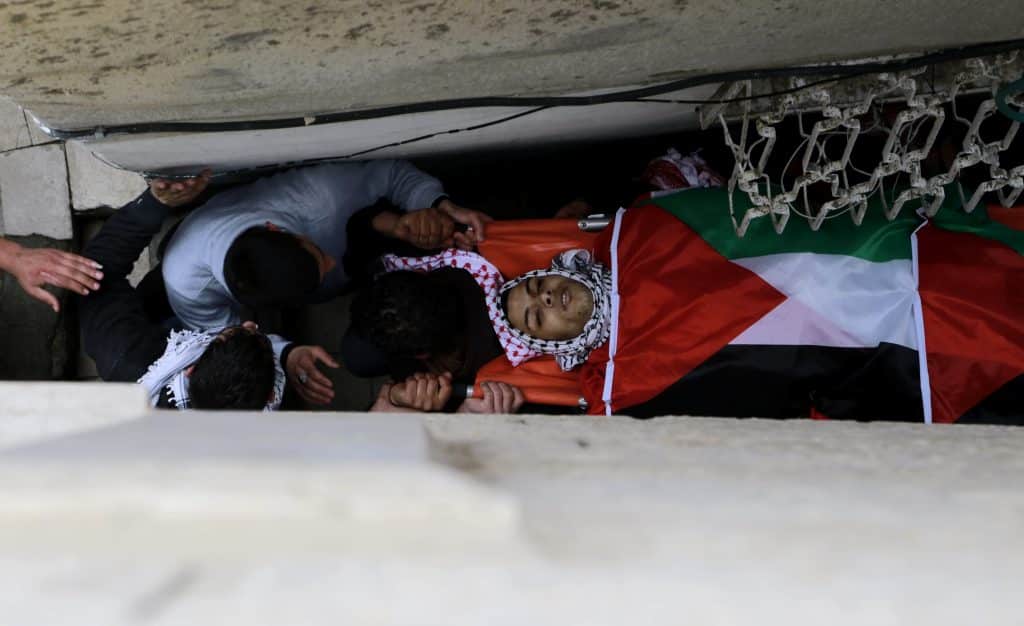
It happened in the early hours of December 5, 2022. The Zionist army barged into Dheisheh and forced its way into several homes, according to residents. Young men confronted them, defending the camp, and the soldiers opened fire.
Six were wounded. But one, Omar Manna, was killed. He was twenty-two, a year younger than Saed is now. Saed had been asleep and woke to the sound of gunfire and explosions. He overheard his parents talking in the other room: “There is a martyr. He’s from the camp, from the Manna family,” his mother said. His father asked the name. “Omar Manna,” she replied.
Saed got up, quickly put on some clothes, and rushed to a friend of Omar’s before heading to the hospital: “Then I saw my friend dead,” he said. “It is very hard to see your friend die. I saw him two days before, and, suddenly, he died, without saying goodbye.”
Two days earlier, Saed had visited Omar at the bakery where he worked, right at the edge of the camp. Saed leaned out of his car window and hugged him. Omar tapped him playfully on the head. And that was it, the last time they saw each other.

They had met a few years before and quickly became friends. Omar was two years older and, in many ways, he was like a teacher to Saed: “He was a very, very, very good man,” Saed said. “He was supporting me in everything. If I felt depressed, I’d call him without thinking. He had a magic touch, and he fixed everything with his smile and his jokes. He was so funny.”
They had volunteered together in the camp, cleaned the cemetery, and, Saed adds while laughing, even shared their tobacco. “It was wonderful. I remember everything. But yeah, it’s gone.”
That’s all he has now, memories. Saed comes to the cemetery every couple of days. He sits alone, one hour, two hours, one cigarette after another, looking at his friend: “It’s like my comfort zone, among dead people. But they are not dead. In our culture, in our tradition, they are alive. Their souls are still here, because they are martyrs, they died for their country.”
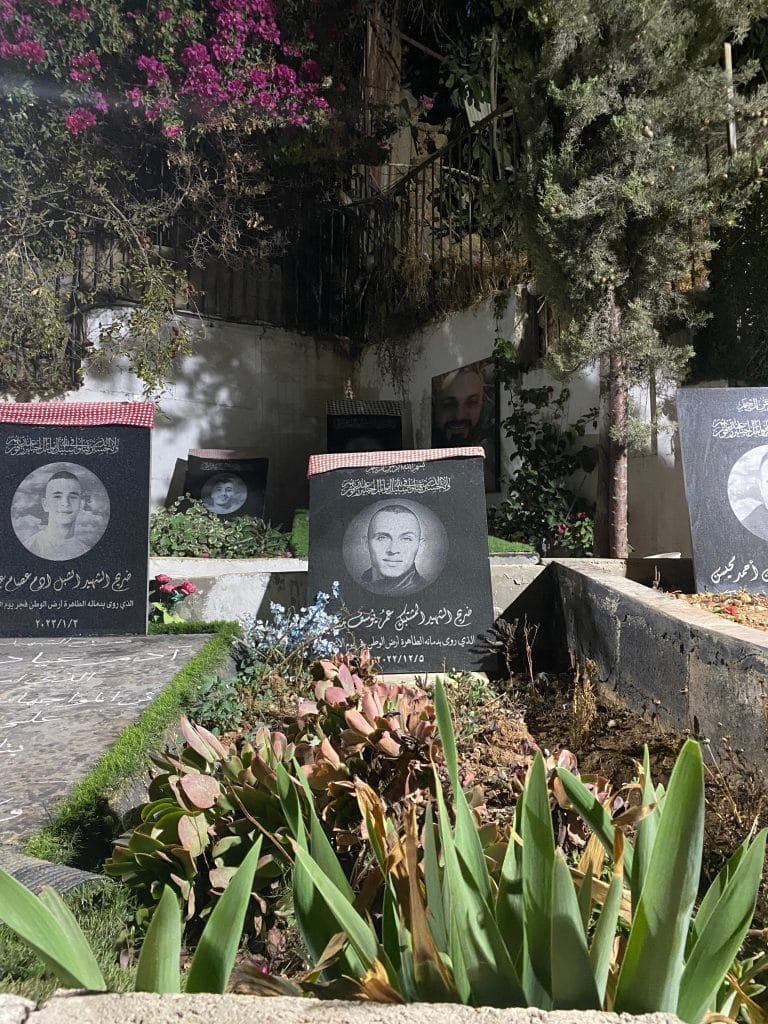
It’s as if they were sleeping, he says, and that the living — those who remain — had a duty to guard the spaces where the martyrs rest. That’s exactly what he does, he says. Every couple of days, he visits his friend’s resting place to keep him company and keep his grave clean.
Omar is not alone. Around him, black and white photographs of other martyrs, most of them younger than him, smiling at the camera. Some graves are adorned with plants and flowers; most are draped with keffiyehs. Saed points at each: 14, 15, 16, and 17 years old. There are more than a dozen in front of us, but the cemetery holds more than a hundred bodies, all from Dheisheh camp.
Omar isn’t the only friend Saed lost in 2022. Fadi Ghatas, 19, had been killed by the Israeli military three months before: “It was really shocking. And Omar picked me up when I had this shock and helped me get back to life. But when I realized I should keep going… they killed Omar.”
Saed is still very young, but he has few memories of childhood. He remembers, however, stories of children killed by settlers. Like Ali Dawabsheh, eighteen months old, burned alive in Duma in 2015, or Muhammad Abu Khdeir, 16, burned alive in 2014. “This is what I remember from my childhood.”
“When you enter a garden, you pick the most beautiful rose. This is what happens in Palestine. They take our beautiful young people.”
Also read: The martyrs speak to each other beyond the grave.
“Who is they?” I ask, knowing full well the answer.
“The fucking settler. The fucking zionist people. Israel.”
“It’s good to grow up with your family and your people,” Saed says. “But, at the same time, you don’t know when death is going to take your friend.”
I ask if this is something he felt growing up. He nods.
The killings of Omar and Fadi made Saed change the way he looks at nurturing relationships. “Now I have stopped making true, true, true friendships,” he says. “It’s like, ‘Okay, I am going to be sad if someone that I know is killed, but I’m not going to, you know, fall into a deep depression because he’s my comrade, my best friend.’”
He explains that he still meets people and even makes new friends. But since 2022, he hasn’t been able to form deep bonds. “I’m not ready for another loss. I don’t want to lose anyone close to me,” he explains. “Next time, I don’t know what I’m going to do.”
Saed lets out a nervous laugh. “I don’t know if you feel like me or…”
There’s a brief silence. “No, I don’t,” I answer. “I don’t know what it is. It’s quite sad, no? Not to have deep friendships.”
“Yeah, but you also need distance,” he responds. “Distance between the shocks. You’re going to be sad even if you don’t know who’s died or if you saw them only one time in your life, for sure. But if he’s your friend, you are going to be very, very, very, very sad. You’re going to enter your room and, you know, think about the moments you lost, or when he called you and said ‘Where are you?’, and you said ‘I am busy’, and you were not that busy, you know? And you will want to come back to that time and say, ‘Okay, I’m coming, you know? This is what I mean. I don’t want to go through this again.”

After 23 years in Dheisheh, Saed left. At the end of 2025, he exiled himself to Spain, where he lives today. “I want to have a good life. I don’t want my children to have my life. I want to give them a better life than mine.”
He isn’t a father yet, but hopes to have a large family. And one day, he wants to return to Palestine.
“What would you like to have for your children, different from what you had?” I ask.
“Only freedom. Just freedom and safety,” he says. “I don’t need anything else, just freedom and safety.”