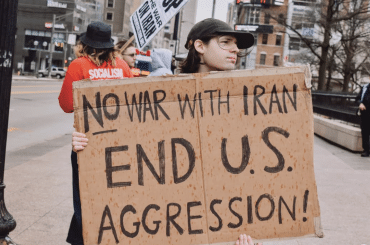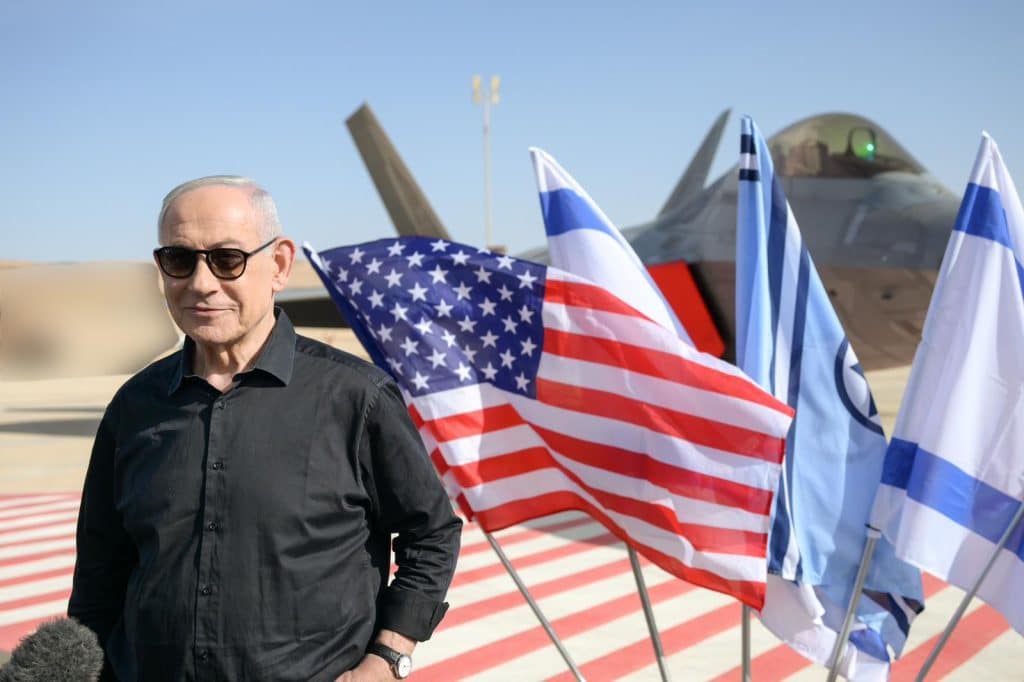
Trump and Netanyahu both believed their war on Iran would be short and easy. They were wrong about nearly everything.
Three weeks into the U.S.-Israeli assault on Iran, the Iranian government has not collapsed. Its Supreme Leader was assassinated, senior military and political figures were killed, over 1,300 civilians have died, and oil facilities were burned outside Tehran. None of it has produced the decisive outcome that Trump has claimed. Instead, Iran has responded daily, striking U.S. military and diplomatic sites across the region, forcing Israel and the Gulf states to burn through expensive defensive munitions at a rate that is not sustainable, and demonstrating a degree of internal cohesion that the architects (if they can be called that) of this war clearly did not anticipate. As Bassam Haddad writes this week, the campaign meant to reassert U.S. and Israeli supremacy may instead be marking a turning point in its decline.
The miscalculation was structural. Mitchell Plitnick’s essential analysis this week cuts through the “no daylight” mythology that has long governed how Washington talks about its relationship with Israel. The U.S. and Israel entered this war with overlapping but genuinely different objectives. The U.S. wanted a quick assertion of dominance: regime change on the cheap, a stable Iran that could be rebuilt under Western-friendly leadership, and oil markets that didn’t spike. Israel wanted something else entirely: the destruction of the one state in the region capable of backing Palestinian resistance and challenging its project of regional hegemony. Netanyahu does not want a “good leader” in Tehran. His defense minister made that plain: any successor would be marked for assassination. A failed Iranian state serves Israel’s interests far better than a stable one. These are not the same war, even when they are fought with the same bombs.
The economic consequences are already here. Oil is over $100 a barrel and rising. Energy markets are flailing. Gulf states that host U.S. bases are discovering that they do not offer security, but rather make those states targets in a war that is not theirs. Iran understands that prolonging this conflict inflicts cascading pain on its adversaries, and it has every incentive to do so. Meanwhile, Trump’s decision to relax restrictions on Russian oil sales to try to soften the global price shock is feeding Russian military capacity at the precise moment U.S. munitions stocks are being drained by the Iran campaign. The war on Iran may be the single most damaging thing that has happened to Ukraine’s prospects in years, and there is no evidence that anyone in Washington thought seriously about that before the bombs dropped.
Lebanon is where the Gaza doctrine is being implemented next. Mayssoun Sukarieh’s devastating analysis this week makes clear that Israel’s war in Lebanon has nothing to do with Hezbollah’s weapons anymore. Israel is pursuing what people in Lebanon are calling “de-Hezbollahification”, the attempt to erase Hezbollah not just as a military force but as a political and social reality, to rip it out of Lebanese Shi’a life the way Israel has sought to rip Hamas out of Gaza. Smotrich has said Beirut’s Dahiya district will soon resemble Khan Younis in Gaza. Israel is targeting cement factories and herbiciding farmland to prevent return. A ground invasion of southern Lebanon is being planned.
And the war on Palestinian life continues. While the world watches oil prices and missile exchanges, Israel has used the cover of the regional war to tighten the siege, revoke Ramadan permits in the West Bank, and accelerate settler violence. Israeli settlers killed five Palestinians in West Bank pogroms in a single week. The Gaza genocide did not pause for the regional war. The assault on Iran, the destruction of Lebanon, the strangulation of the West Bank, and the ongoing killing in Gaza are not separate events. They are the same colonial project, moving simultaneously on multiple fronts, using the chaos of each new theater to advance under the cover of the last.
Netanyahu has spent decades trying to build the conditions for exactly this moment. He finally has it. The question now is whether the military, economic, political, and moral costs become so severe that the United States cannot absorb them. The American public has already moved. Support for Israel is at a historic low. Protests are spreading. Establishment politicians have called Israel an apartheid state and floated conditioning aid. The people who launched this war are counting on the opposition being too slow and too disorganized to matter. That calculation, too, can be wrong.
🌍 The U.S.-Israel regional war
Three weeks in, the war on Iran is not going as its architects promised. Our coverage this week examines the widening gap between what Trump and Netanyahu expected and what they are getting, and what Israel’s real objectives in the region have always been.
READ MORE → How might the U.S.-Israeli war on Iran fail?, Bassam Haddad
READ MORE → How aligned are the U.S. and Israel’s goals in Iran?, Mitchell Plitnick
READ MORE → Israel’s goal in Iran is not just regime change, but complete collapse, Kate McMahon
READ MORE → The Shift: Lindsey Graham helped push Trump to war, Michael Arria
READ MORE → Lebanon’s existential war with Israel is being fought from within, Mayssoun Sukarieh
🇵🇸 Palestine
Israel is using the cover of the war on Iran to accelerate its project of dispossession across the West Bank. This week also brings a tribute to Walid Khalidi, the historian of the Nakba, and a photographic remembrance of Gaza before the genocide.
READ MORE → Why is Israel trying to cause an ‘explosion’ in the West Bank?, Qassam Muaddi
READ MORE → Mowed down with firearms: settler terror in West Bank leaves Palestinians ‘humiliated’ after killing 3 men in village, Qassam Muaddi
READ MORE → In fond memory of Walid Khalidi, the historian of Palestine, Raja Khalidi
READ MORE → In Photos: A love letter to Gaza, Mahmoud Nasser
🇺🇸 United States
The Trump administration continues to use detention as a weapon against Palestinian activists, while public support for Israel falls to historic lows.
READ MORE → Exclusive: Congresswoman Rashida Tlaib demands Leqaa Kordia’s release, says ‘I’m afraid she’s going to die in there’, Sam Judy
READ MORE → One year after her arrest, a judge has ordered Leqaa Kordia to be released from ICE detention for the third time, Sam Judy
READ MORE → U.S. support for Israel continues to plummet, despite media’s best efforts, Michael Arria
🚨 Resistance and solidarity
The Palestine solidarity movement has expanded its frame to oppose the war on Iran, and international religious institutions are demanding governments move from condemnation to consequences.
READ MORE → Power & Pushback: Palestine activists protest the war on Iran, Michael Arria
READ MORE → World Council of Churches calls on governments to hold Israel accountable for violations of international law, Jeff Wright