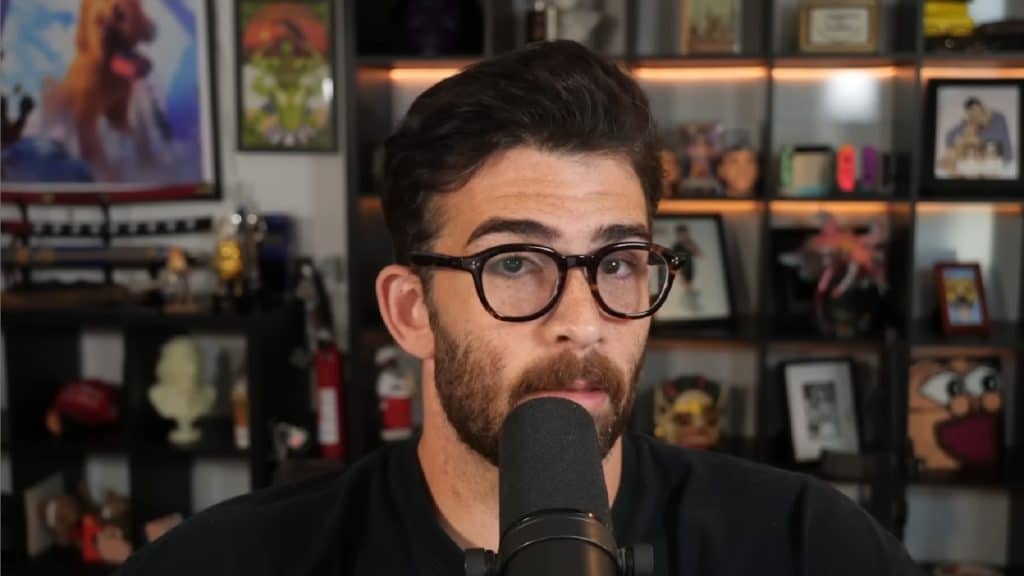
The last few weeks have seen a “debate” in the upper regions of the Democratic Party and liberal media about the emerging role of anti-Zionist streamer Hasan Piker as a force within progressive politics. Even on center-right platforms like the Bulwark, we have seen controversy over whether Democratic candidates should appear on Piker’s streams, attend campaign events with him, or engage with him in good faith on social media. At bottom, the point in question seems to be whether Piker should be accepted within the “big tent” progressive coalition or subjected to a cordon sanitaire to prevent his purportedly extreme views from gaining greater legitimacy in the public sphere.
Where Piker’s political positions and worldview are not the focus, the anti-Piker argument shifts to the offensive or overheated rhetoric he uses and his willingness to break long-accepted taboos on the Left, especially in regard to Israel, Zionism, and Palestine. Thus, the case against Piker in outlets like the Wall Street Journal attacks his speech both on the level of content and form and casts aspersions on his character based on his refusal to play by a certain set of rules. One side argues that due to the size of Piker’s audience and his immense influence with key demographics that the Democrats couldn’t rally in the 2024 election, it is foolish to push him out of the tent, and progressive politicians have no choice but to engage with him in some way, whether or not they share his beliefs. The other argues that any gain in the polls or visibility that might be accomplished by associating with Piker is outweighed by the damage one would do to the terms of public discourse by “elevating” Piker. Lurking beneath what appears to be a major controversy is the by now decade-long search for “the Left’s Joe Rogan”, the upcoming midterm elections, and the beginnings of the possibly historic 2028 general election.
The real content of the discussion is much bigger than Piker himself. While Piker is surely a powerful personality, in this discussion, he functions rhetorically as a personification of the Palestine solidarity movement in America and the Palestinian cause in general. Piker is, in effect, a proxy for Palestine. And in turn, attacks on his support for Palestine reinforce his anti-Zionist credentials in the public eye.
The liberal establishment’s insistence that Democrats disassociate from Piker confirms two things: The debate about Palestine in progressive politics is over, and the ascendant left-populist consensus places Palestine at the center of its politics.
At first glance, the question of Hasan Piker appears to be one of immense stakes for the progressive wing of the Democratic Party and even the possibility of a stable progressive politics in the United States at all. In reality, there is no real controversy at play. The insistence that no Democrat associate with Hasan Piker on the part of the liberal political and media establishment is, in fact, a tacit acknowledgment of two basic facts: First, the debate about Palestine in progressive politics is over. Second, figures like Piker in fact derive their moral authority from their willingness to break the taboos imposed by a political elite that has lost its credibility in the face of genocide in Gaza. Piker, in the end, is merely a symbol of the ascendant left populist consensus which places Palestine at the center of its politics as a global beacon for social justice and resistance to oppression. Indeed, these currents may very well reshape American democracy in the decades to come. The question of whether to resist Piker and the currents he represents, then, is mere posturing. If it were possible to push Piker out of the tent, this would have happened quite a while ago.
Indeed, there is no real debate about Piker’s role in the 2026 and 2028 elections. Given the long list of politicians and candidates who have appeared on his stream in the last year or so and his role in boosting their campaigns, at some point, it becomes self-evident that there is essentially no downside to associating with Piker, even in an austere political calculus. During Zohran Mamdani’s mayoral campaign, a series of attack ads highlighted his connection to Piker in the context of Piker’s inflammatory rhetoric, which not only had no effect on Mamdani’s historic victory but may in fact have lent to his populist credentials. The same can be said of Senate hopeful Abdul El-Sayed from Michigan, whose refusal to condemn or disassociate from Piker has had a similar effect, bolstering his credibility and lending his campaign an air of authenticity. That there is even an ongoing political engagement with Piker for centrist commentators to criticize is evidence that the criticism is essentially pro forma. The political math is clearly in his favor.
And again, this is because what can be said of Piker’s place in the Democratic Party firmament can also be said of the Palestinian cause. As recently as Summer 2023, it was imaginable in the left-wing media to defend or excuse Jamaal Bowman’s contravention of BDS principles or Alexandria Ocasio-Cortez’s “present” vote on the Iron Dome from the position of political realism. As the argument would go, while these moves were inexcusable on their face, they ought to be evaluated in terms of the political tradeoffs involved. Just a couple of years later, the Democratic Party’s leaders and those of liberal institutions are regularly attacked from the right for their failure to contain or discipline Palestine support within their ranks, the accusation being that they fail to defend Israel from their own constituents for the same reason: value-neutral political calculus. Indeed, just last week, Alexandria Ocasio-Cortez agreed to a set of conditions for re-endorsement by New York DSA, which would have previously been unimaginable. The implications of this historic shift may not have been fully understood within the Palestine solidarity movement, the broader Left, or the media ecosystem. Ironically, they appear crystal clear to campaign strategists and commentators in the centrist media ecosystem.
The question of elevating or exiling Piker is, in fact, no question at all, it is a recognition that the Left has escaped containment.
The creation of discursive taboos around the topic of Palestine has also created an unintended blowback where an audience like Piker’s associates the violation of liberal rhetorical norms as a gesture of moral credibility. It is not at all the case that Piker’s viewers regard his comments on Israel’s actions in Gaza and elsewhere as morally correct in spite of their bombast: Piker in fact derives a certain moral and ethical legitimacy because of the controversy he generates. This, in effect, is the essence of populist rhetoric: the speaker derives their ethos from the rage they extract from an elite that has lost its mandate. The more Piker is attacked, the more credible he appears to his growing audience. Thus, Piker, and the broader pro-Palestine grassroots left, have managed to get the steering wheel of the anti-establishment position from the populist right following Trump’s prosecution of war on Iran, gratuitous violence from his ICE deployments, and a possibly impending cost of living and energy crisis caused by the escalating violence in the Middle East. The question of elevating or exiling Piker is, in fact, no question at all, it is a recognition that the Left has escaped containment. Of course, a great deal remains to be seen in terms of whether this momentum can be operationalized into genuine political change in the United States or real progress for Palestinians.
What is clear, however, is that the Palestine exception has become the Palestine litmus test on a bigger scale than ever before. Political elites who attempt to resist the tide of history sacrifice both moral standing and democratic legitimacy.