
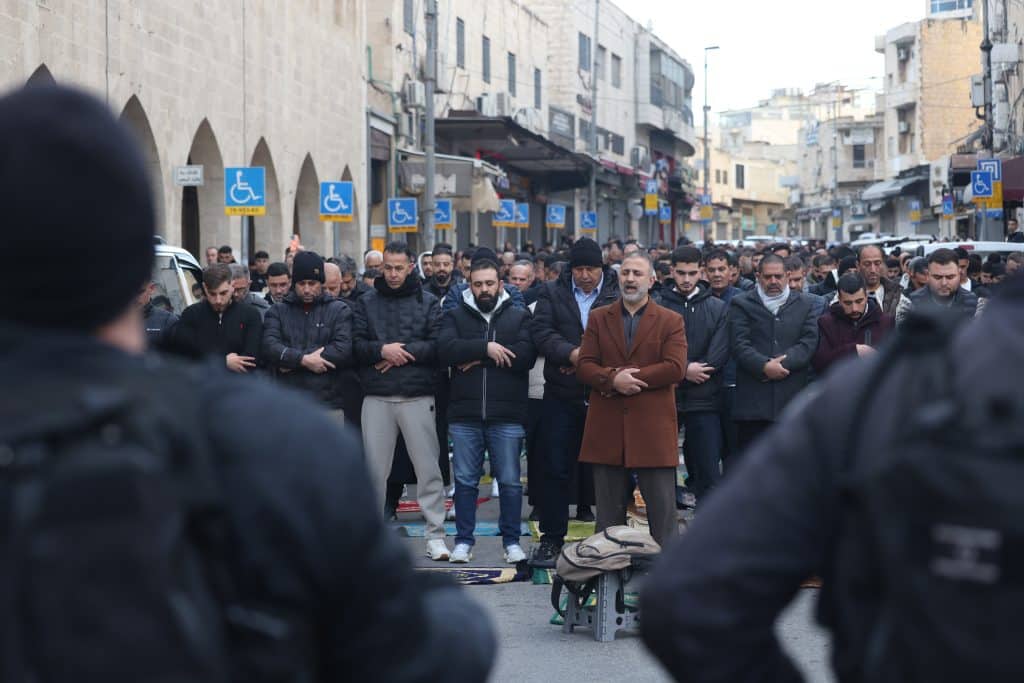
Last week, I wrote about how the Israeli far-right is not on the fringes of Israeli society; it is the center of it. As if to prove my point, the Israeli Knesset on Monday passed a new death penalty law targeting Palestinians, and National Security Minister Itamar Ben-Gvir celebrated on the Knesset floor with a bottle of champagne. In practice, it applies exclusively to Palestinians. The UN’s human rights chief said its application to Palestinians would constitute a war crime and was “deeply discriminatory.” Ben-Gvir and the other promoters of the law were gleeful.
Abdaljawad Omar explores the colonial history of racist applications of the death penalty to “pacify” Palestine. The British Mandate courts established military tribunals in 1937, designed to deliver quick death sentences. Shaykh Farhan al-Sa’di, a leader of the 1936 uprising, was “captured on a Monday, tried on a Wednesday, and hanged on a Saturday.” The death penalty was applied to Palestinians for minor crimes, and Jewish defendants were given lighter sentences for more serious offenses. The current Israeli government is returning to “the darkest of these practices.”
The disaster of the Iran war grinds on, and the disruptions to the global economy and the international system continue to spread. Trump appears to have no path out of the war, as Mitchell Plitnick lays out this week. The American people don’t want it. Trump is proposing cutting basic services to pour more money into the military. What else is there to say about this debacle?
📺 New on The Shift podcast
Mondoweiss’s Adam Horowitz and Michael Arria break down how this assassination attempt on activist Nerdeen Kiswani connects to a network of Zionist organizations with ties to the Israeli far right and even the Trump White House.
🇮🇷 The Iran war
Trump has no exit from the war he started, and the costs to the global economy, U.S. credibility, and the people of Iran keep mounting.
READ MORE → Trump has no good options to resolve the disaster he created in Iran — Mitchell Plitnick
READ MORE → A brief history of the Israeli nuclear program, the open secret at the heart of the Iran war — Anna Illing
READ MORE → Gaming the Iran war and the Gaza Genocide Syndrome — Robin Andersen.
🇮🇱 Israel’s colonial project
The Zionist project of Israel’s expansion is on full violent display across Palestine and the broader region.
READ MORE → ‘The rope is for Arabs only’: Israel’s new death penalty law for Palestinians recycles a colonial playbook — Abdaljawad Omar
READ MORE → ‘War crime’: Global condemnation as Israeli ministers celebrate death penalty law targeting Palestinian prisoners — Qassam Muaddi
READ MORE → Israeli policies pose an existential threat to Palestinians in the West Bank. Why isn’t there more resistance? — Qassam Muaddi
READ MORE → Barring Jerusalem Patriarch from Church of the Holy Sepulchre marks Israel’s latest move to control Christian and Muslim sites — Jeff Wright
READ MORE → Israel is implementing its Gaza strategy in Lebanon: turning ‘buffer zones’ into permanent borders — Qassam Muaddi
READ MORE → When they come for the homes — Palestine-Global Mental Health Network
🚨 Repression and resistance
Support for anti-Palestinian violence shows up in American Jewish institutions and in the Democratic Party’s ongoing deference to AIPAC, but resistance is pushing back and growing.
READ MORE → Plot to assassinate Palestinian activist follows harassment campaign promoted by Zionist groups and elected officials — Michael Arria
READ MORE → What is the JDL? Inside the Jewish extremist group inspiring anti-Palestinian terror in NYC. — Michael Arria
READ MORE → Prominent New York synagogue hosts presentation on why U.S. Jews should support the ethnic cleansing of Gaza — Philip Weiss
READ MORE → The Shift: The Democratic Party battle over AIPAC heats up — Michael Arria
READ MORE → Psychoanalysts are resigning from the International Psychoanalytical Association over its anti-Palestinian double standard — Palestine Mental Health Networks
READ MORE → ‘Kuffiyehs in Buchenwald’ campaign challenges Germany’s anti-Palestinian culture of remembrance — Leon Wystrychowski
🇵🇸 Palestinian life under genocide
Palestinians in Gaza continue to endure the horrible conditions Israel created there. Salman Abu Sitta celebrates Palestinian resilience.
READ MORE → ‘The rat gnawed my baby’s cheek’: Gaza tent encampments face rodent infestation — Tareq S. Hajjaj
READ MORE → Israel may dominate through violence, but Palestinians hold a force more powerful — Salman Abu Sitta

If I may, I’d like to pose a question to my fellow Jews this Passover: according to one of the foundational mythologies of Judaism, God, as part of a long running campaign to convince the Pharoah to free the Jews, killed all the firstborn in Egypt. Isn’t that, like, a war crime?
And according to another foundational mythology of Judaism, didn’t the Jews ethnically cleanse the promised land of Caananites** – another war crime?
Seriously, ethnic cleansing is part of our DNA:
Why the Passover story is a colonialist myth…..[ Passover is ] the tale of an oppressed, subjugated people that stands tall and liberates itself from bondage….The Palestinian intellectual Edward Said was less enthusiastic about the Exodus. In an article he published in 1986, a response to Michael Walzer’s book “Exodus and Revolution,” he offered a reading of the story from the viewpoint of the people living in the Land of Canaan. The exodus episode manifests solidarity with the oppressed, he acknowledged, but it also contains a dark side. If the exodus from Egypt is a revolution, it also harbors a violent element of oppression: the oppression of those who worship the golden calf, and no less, of “the unfortunate native inhabitants [of the Promised Land] who by definition are not members of the Chosen People.” In Said’s view, “The text of Exodus does categorically enjoin victorious Jews to deal unforgivingly with their enemies, the prior native inhabitants of the Promised Land.” The basic approach is: “get rid of the natives.”.. the independence of one people comes at the expense of victims among other peoples. From the vantage point of the original occupants of the land, the exodus from Egypt is a chronicle of conquest and annihilation….Future historians might look at Israel in the same way. They will see in the Zionist movement a singular success story of a persecuted people that rose from the ashes. But at the same time, it is a story of dispossession and occupation that has no end. Heroism and oppression are not separate stories, they are one story. That stems from the necessary structure of every “exodus”: when you leave one country, you enter another country. And people lived in that country, too.
Why the Passover story is a colonialist myth
**
Book of Joshua – Wikipedia
This OpinioJuris article days before the passage explained the draft legislation had lost its legal basis. See the full article here: Legitimacy Foreclosed? The De-Hybridization of the October 7 Special Court and Lessons of the Iraqi High Tribunal
The synopsis: “The legislation’s earliest iterations presented the October 7 Court as a hybrid tribunal in all but name. What was proposed was a special judicial body, separate from both civilian and military courts, engaging international experts to help prosecute alleged acts of genocide. Legislative revisions, however, have systematically stripped away these “internationalising” features. What began as a sui generis court of mixed domestic and international composition has been reshaped into a military tribunal embedded within existing, and controversial, state structures.
The October 7 Court’s legislative trajectory closely mirrors that of the Iraqi High Tribunal (IHT) which likewise began as a partially internationalized experiment in post-conflict justice before retreating into a domestically controlled (and deeply contested) forum. In both cases, hybridization initially bolstered credibility and signaled adherence to international standards; in both, these safeguards were progressively eroded, diminishing the tribunals’ overall legitimacy.”