
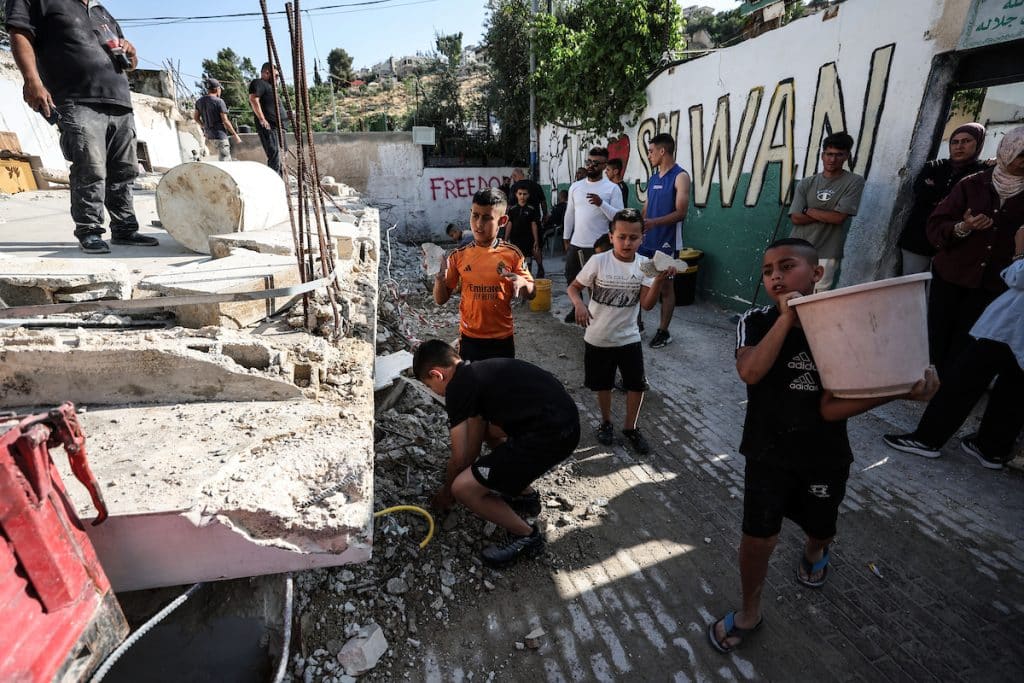
On the morning of March 25, 2026, forces of the settler Zionist entity stormed the Batn al-Hawa neighborhood of Silwan and forcibly emptied eleven Palestinian homes. Mattresses, clothing, and children’s toys were thrown out of windows onto the road. Approximately sixty-five people were made homeless in a single morning. They have sought shelter in the homes of relatives and friends, homes that are themselves, in many cases, under demolition orders.
Forces of the settler Zionist entity also seized two apartments belonging to the Basbous family. Rafat Basbous was abducted during the operation. That same dawn in Jabal al-Mukaber, 21-year-old Qassem Amjad Shuqairat was shot by special units during a raid on his home, sustaining fatal injuries. His family stated that their son was shot in cold blood inside his home and in front of his family. Palestinian prisoner rights organizations described what happened as an execution carried out during detention. His body was seized, adding to the 776 Palestinian bodies already detained by the occupiers.
This was one day. One day in Jerusalem, amid an ongoing genocide in Gaza, strikes on Lebanon and Iran, and accelerating settler violence across the West Bank. And the news of it, the evictions, the killing, the arrest of Anas Basbous, the confiscation of a body, scrolled past, absorbed into the feed, swallowed up by the volume of catastrophe. This is not accidental.
Palestinian feminist scholar and criminologist Nadera Shalhoub-Kevorkian has theorized what she calls ihaala, a deliberate swarming, an overwhelming of the senses engineered to produce paralysis. The architecture of colonial violence is not only physical. It is epistemic and psychological. It works by exceeding the human capacity to process loss, so that each new atrocity renders the last one invisible. So that grief has no time to settle. So that resistance is swamped before it can gather form. The evictions in Silwan are happening within this design, and that design extends to those of us witnessing from outside. Attacks on other countries, such as Iran and Lebanon, provide a distracting cover for a massive escalation of violent pogroms and forcible displacement and for ongoing genocide in Gaza.
The eviction orders in Batn al-Hawa are based on a 1970 law that allows Jews who lost property in East Jerusalem before 1948 to reclaim it. No parallel right exists for Palestinians who lost property in West Jerusalem in the same year. This is not a legal dispute. It is a system of dispossession formalized as law. The lawsuits are filed by settlers affiliated with the Ateret Cohanim organization. The law is the weapon. The courts are the mechanism of transfer. And B’Tselem has stated plainly that these evictions embody a policy aimed at engineering the demographic balance and Judaizing the neighborhood through the exploitation of discriminatory laws.
B’Tselem warns that the evictions of March 25 mark the beginning of a large wave of displacement threatening around 2,200 people in Silwan, including 90 families, approximately 700 individuals, in Batn al-Hawa alone.
Batn al-Hawa is only part of the picture. In al-Bustan, the threat takes an even more totalizing form. Today, approximately 1,500 Palestinian residents live in around 120 homes, with roughly 80 percent under threat of demolition. The plan driving this is called the “King’s Garden,” a settler-operated tourist park for visitors to the City of David site, run by the settler organization Elad, which would raze the neighborhood entirely. The biblical identification underpinning the plan lacks archaeological or historical evidence. But evidence has never been the point. The point is displacement. The point is the creation of territorial continuity between settler enclaves while Palestinian space is converted into a park that Palestinians will not be permitted to inhabit.
The municipality’s plan does not guarantee alternative housing for the families set to be displaced. It suggests that residents rebuild on land belonging to other residents whose homes are also slated for demolition. This is what settler colonialism looks like when its eliminatory intent lurks, ill concealed, behind bureaucratic language. bureaucratized: displacement offered as its own solution.
We write as mental health practitioners from twenty-three countries who work daily with the psychic consequences of exactly this kind of violence. We write because our clinical and political knowledge have become, in the face of Silwan, inseparable. What is happening to these families is not a housing crisis. It is not a planning dispute. It is a coordinated assault on the conditions that make psychological life possible: home, continuity, the right to remain, the right to be found where you left yourself. When a family’s belongings are thrown from a window onto the road, when the children’s toys are dumped in the street, something is being communicated that exceeds eviction. It is a statement about whose grief is legible, whose presence is real, who is permitted to exist in place.
Earlier this week, we visited one of the families who had been evicted from their home. They have since moved to a second home, which is also under a demolition order. We sat with them in their second house, itself under a demolition order, and there are no words in English for what that visit held. The Arabic word qahr comes closest: a crushing, a humiliation, a grief with no exit. Qahr bi-qahr. One layer of devastation compounded on another.
We write because we felt paralysis too, an effect the the ihaala is exactly designed to produce. The solidarity movement constantly has to respond to an ever escalating series of atrocities so that remaining effectively focused on one is invariably put in jeopardy by the next one. We can only combat the impact of ihaala by our own “counter-swarming” – mobilizing together in our thousands to challenge each and every atrocity. One effect of ihaala and its overwhelming and undermining of physical and psychological responses is that it debases language itself as atrocities constantly outstrip the confines of language and we struggle to find words adequate to the task of bearing witness.
Thus the importance of speaking drawing attention through writing, through speaking out and calls to action The alternatives of silence, scrolling past, numbness, despair, disassociation, and normalization, themselves become a form of complicity. We refuse this and insist on action.
The settler Zionist entity is counting on our paralysis. On the ihaala. On the volume of catastrophe being so great that each individual life – Qassem Shuqairat shot in his own home at dawn, Anas Basbous arrested as his family’s home was taken, the children of the Rajabi family watching their toys thrown into the street – disappears into the aggregate.
We refuse that disappearance. Silwan is Jerusalem. Jerusalem is Palestine. And the families of Batn al-Hawa and al-Bustan are not statistics. They are people whose names we know, whose homes we have visited, whose grief we carry alongside our own.
Join us. Act now. There is still time. Join our call. Sign our Petition
If you are a US resident: Write to your Congressional representative today.


On Friday, April 2, the PBS Newshour aired a 10 minute segment titled “Palestinians in occupied West Bank face growing violence from Israeli settlers”:
Palestinians in occupied West Bank face growing violence from Israeli settlers | PBS News
This has now become a topic in the mainstream media.
From a Guardian report today:
https://www.theguardian.com/world/2026/apr/05/israeli-settlers-driving-christians-out-west-bank