

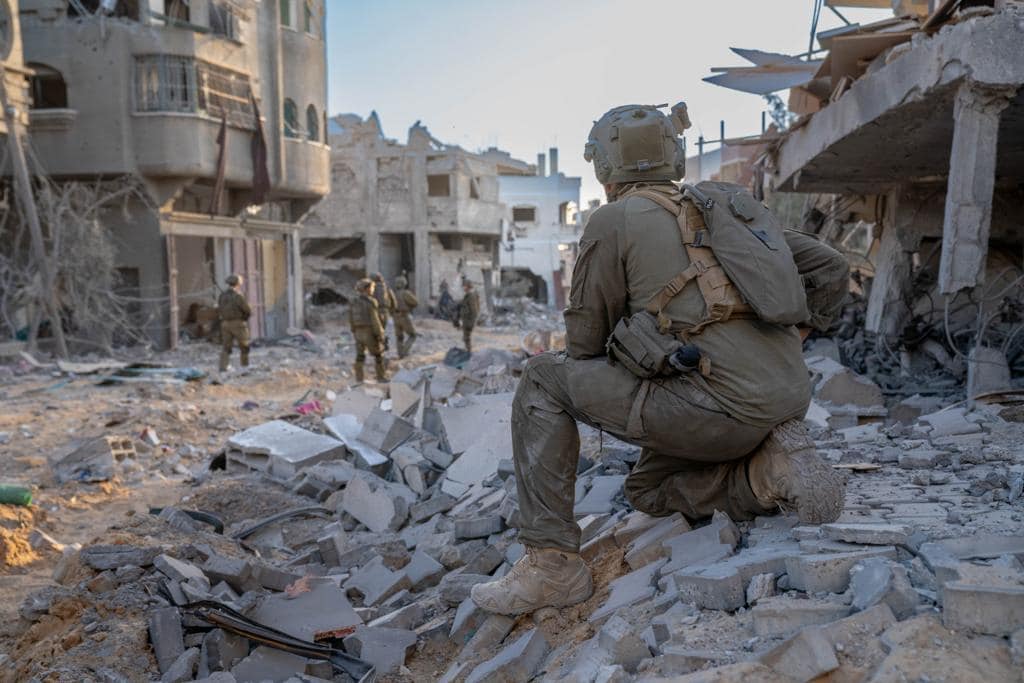
The U.S.-Israeli war on Iran has for the moment turned international attention away from Gaza as Israel moves from high- to low-intensity genocide. The genocide may be the horrific culmination of 75-plus years of Zionist settler colonialism, occupation, and apartheid, but in order to make sense of it we must analyze the radical transformations that have taken place in the Middle Eastern and global political economy in recent decades.
The impulse to genocide has always been built into the Zionist project. But that impulse has been activated by the epochal crisis of global capitalism. The Al Aqsa Flood attack of October 2023 furnished Israel with the historic opportunity for which they had been waiting for decades. If the Zionists are still in pursuit of their elusive Eretz Israel, the United States has been heading up a much more expansive project, one that places Gaza in the very center of global capitalism and its epochal crisis. In the game plan of the Washington-Tel Aviv axis, Gaza is now to become an experimental field for a new and deadlier phase of global capitalism. It is this larger picture that we want to lay out in this article.
The contemporary crisis of global capitalism is multidimensional. Structurally it is a crisis of overaccumulation, which refers to a situation in which enormous amounts of capital (profits) are built up but this capital cannot find productive outlets for reinvestment. This overaccumulation crisis generates intense pressure for expansion as transnational capitalists undertake a predatory search for where to unload massive amounts of surplus capital and open up new spaces for profit-making. This violent expansion involves the seizure of markets and resources around the world through war, displacement, and repression. The U.S. state and beyond it, what we will call Global Trumpism, is its out-of-control instrument in this expansionary wave. At the core of Global Trumpism is the Washington-Tel Aviv axis.
The larger backdrop to the Israeli genocide is the transnational integration of capital over the past half century and the radical restructuring of global class relations and power blocs that capitalist globalization has brought about. Globalization in West Asia region began in the 1980s and accelerated with the 2003 U.S. invasion and occupation of Iraq that followed the establishment in 1997 of the Middle East Free Trade Area (MEFTA) and a host of related bilateral and multilateral regional and extra-regional free trade agreements, structural adjustment programs and IMF-supervised austerity.
This integration unleashed a cascade of transnational corporate and financial investment in finance, energy, high-tech, construction, infrastructure, luxury consumption, tourism and other services. It brought Gulf capital, including trillions of dollars in sovereign wealth funds, together with capital from all around the world, involving the EU, North and Latin America, and Asia, inextricably enmeshing them all in emerging global circuits of accumulation. In this way, nationally-oriented Arab bourgeoisies transmorphed into transnationally-oriented bourgeoisies as the entire region became incorporated into the globally-integrated production, financial, and service system that came into being over the past half century.
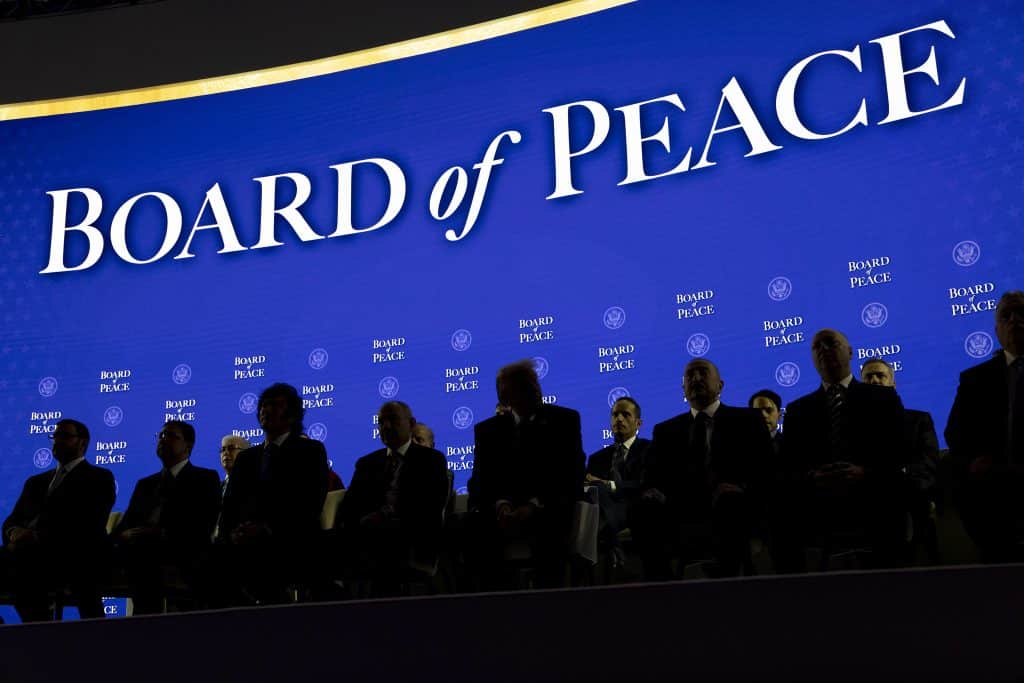
Israel, far from remaining excluded, integrated into these expanding regional and transnational capitalist networks on the heels of the Oslo “peace” accords, signed in 1993, as the Israeli and Arab bourgeoisies began to develop common class interests. In 2020 the UAE and Bahrain, along with Morocco and Sudan, signed the Abraham Accords, joining Egypt and Jordan in normalizing relations with Israeli, an opening that allowed Gulf investment groups to pour billions of dollars into the Israeli economy. The October 2023 Al Aqsa attack and the subsequent Israeli siege placed further normalization on hold. The new U.S.-Israeli strategy revolving around the “Board of Peace” (henceforth, Board of Genocide) seeks to bring the Arab and other states in the region back into the Abraham architecture.
Palestinians become surplus humanity
Up until globalization took off in the late twentieth century, the relationship of Israel to the Palestinians reflected classical colonialism, in which the colonial power had usurped the land and resources of the colonized and then exploited their labor. But Middle Eastern integration into the global economy helped spark the spread of mass worker and social movements and grassroots democratization pressures, reflected in the Palestinian intifadas, the labor movement across North Africa, mounting social unrest, and in the 2011 Arab Spring uprisings.
The Palestinian intifadas aggravated the historic tension that Israel faced between the drive to ethnically cleans the Jewish state and the need it had for cheap, ethnically demarcated labor. But globalization starting in the 1990s gave Israel a way out of this tension between dispossession/super-exploitation and dispossession/expulsion in favor of the latter. Capitalist globalization has involved ongoing waves of displacement in the Global South that have generated a vast army of internal and transnational migrants, giving rise to a new system of transnational labor mobility and recruitment and making it possible for dominant groups around the world to reorganize labor markets in an effort to weaken labor and maximize the extraction of surplus value.
While this transient migrant labor system is a worldwide phenomenon it became a particularly attractive option for Israel because it does away with the need for politically troublesome Palestinian labor. By the 2010s, hundreds of thousands of migrant workers – by some estimates up to 600,000 – from Thailand, China, Nepal, Sri Lanka, India, Eastern Europe, the Philippines, Kenya and elsewhere came to form the predominant labor force in Israeli agribusiness, and increasingly in other sectors of the economy, under the same precarious conditions of super-exploitation and discrimination that migrant workers face around the world.
In the wake of the 2023 Hamas attack Israel deported the remaining 10,000 Gazan Palestinian workers back to Gaza. In early 2024, even in the midst of war, thousands of Indian and other foreign workers were pouring into Israel to replace them. The Palestinian proletariat has thus become an ever-more marginalized surplus population. In 1993, the very year that the Oslo Accords were signed, Israel imposed its policy of “closure” – sealing off Palestinians in the occupied territories, ethnic cleansing, and a sharp escalation of settler colonialism.
As the Palestinian proletariat went from cheap labor to surplus humanity, it stood in the way not just of seizure of their land and the resources beneath their soil, but of a new round of global capitalist expansion throughout the Middle East. In this way, genocidal pressures began to build up. Genocide became more and more of an attractive option for the Zionist state and also for the most violent and predatory sectors of the transnational capitalist class, for whom the siege of Gaza and the West Bank constitutes a form of primitive accumulation.
Pax Silica and the Board of Genocide
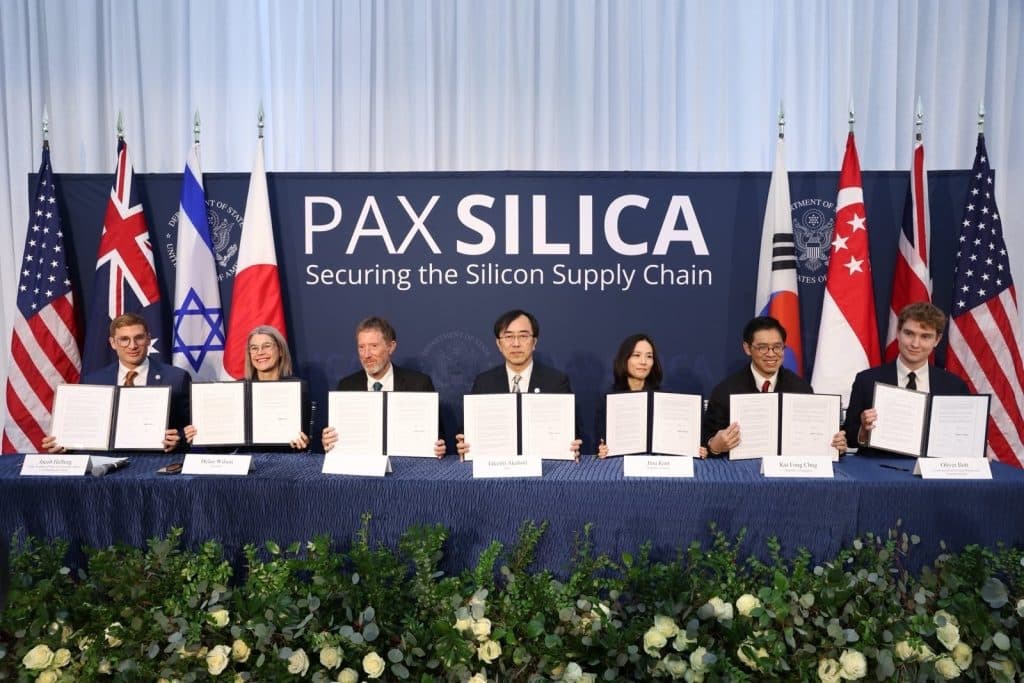
The larger meaning of the Board of Genocide now comes into focus, shining a spotlight on the emergent hegemonic complex of transnational capital that is at the center of the current worldwide maelstrom. The triangulated bloc brings together the giant tech companies, transnational finance capital, and the military-industrial-repression complex. Big Tech controls the entire ecosystem of digitalized capitalism, converting its enormous structural power into direct political control through the fascist state. To advance its agenda the bloc has turned to ‘Global Trumpism’ – one of several morbid political symptoms emerging as the post-World War II international order crumbles.
The new digital technologies and the billionaires that control them are driving a radical new round of restructuring and transformation of the global political economy. The leading tech corporations, most of them headquartered in the United States and China, draw investors from all over the world as they suck in immense amounts of surplus capital. The top 20 tech firms worldwide had a combined market capitalization exceeding $20 trillion in 2025, some one-fifth of the total global stock market valuation.
Big tech and the transnational industrial and commercial capitals it brings together are in turn enmeshed with the giant global financial conglomerates that own more than half of the leading tech firms. In 2022 there were 33 trillion and multitrillion-dollar capital investment management companies worldwide, up from just 17 in 2017. These titans of capital controlled more than $83 trillion in combined assets, over four-fifths the value that year of the entire global GDP. Silicon Valley and its financial backers are pivoting towards digital technologies for war and repression as they fuse with the military-industrial repression complex, completing the capital power axis, which in turn is moving into alignment with authoritarian, dictatorial and fascist states – an alignment most chillingly declared in Palantir’s 22-point manifesto posted on X in April.
This new capital complex is deeply invested in transnational systems of warfare, social control, repression and surveillance that are becoming digitalized, automated, and embedded in the global economy and society. These systems provide a major outlet for unloading accumulated surplus capital while also opening access to markets and resources. The capital bloc is heavily invested in Israel – in its tech industry, in its war machine, and in its genocide. The July 2025 report by the UN special rapporteur on human rights in the occupied Palestinian territories, Francesca Albanese, From the Economy of Occupation to the Economy of Genocide referenced 1,650 transnational corporations that partner with Israel’s war and occupation machine. The list of 60 companies singled out in the report reads like a Who’s Who of the hegemonic bloc of capital.
Herein lies the key role that Israel plays in the new capital power axis. Israel is the world’s third largest tech hub. It globalized based on a high-tech-military-security-surveillance complex, integrated in turn into the webs of transnational finance capital. Like the larger global economy of which it is a part, it feeds off of permanent local, regional, and global violence, conflict, and inequalities. Endless rounds of destruction followed by reconstruction fuel profit-making not just for the arms industry, but for engineering, construction, and related supply firms, high-tech, energy, and numerous other sectors.
The Israeli genocide, to be followed now by the Board of Genocide are grisly laboratories for the new modality of transnational capital accumulation. The U.S. State Department has referred to the new global dispensation driven by the hegemonic capital bloc as Pax Silica. The Middle East has emerged as a regional corridor for Pax Silica predicated on an Israeli-Gulf state alliance that was to be cemented through the Board of Genocide inaugurated by Trump at the January 2026 World Economic Forum conclave.
Israel is a powerhouse for both digital and military technologies, having combined both in its repression of Palestinians. The 20-point “peace” plan for Gaza unveiled in October 2025 involved the “redevelopment” of Gaza, including “modern and efficient governance conducive to attracting investment” and the establishment of a “special economic zone” – boiler plate language for opening up the Strip to transnational capitalist plunder and control. This anticipated new cascade of investment, not just in Gaza but throughout the Middle East, hinged on first “resolving” the Gaza conflict through the ceasefire and then expanding the Abraham Accords which, in the words of U.S. vice president J.D. Vance, would pave the way “for broader alliances for Israel in the Middle East even as it renders second the Palestine question.
As Israel moves from high-intensity to low-intensity genocide in Gaza, the Board is intended to open up the Strip to its gas and oil, its beachfront real estate, and its tourist potential. But its core mission is to convert Gaza into a hub for the public-private power axis around which tech and finance will have free reign to develop a sovereign corporate fiefdom. Razing the Strip to the ground has been wildly profitable. Two years of destruction is now to be followed by the bonanza – “reconstruction” led by the hegemonic capital complex.
The true magnitude of the global capitalist plan for Gaza was revealed not in the 20-point plan but in the Gaza Reconstruction, Economic Acceleration and Transformation (GREAT), a U.S. government proposal that was leaked to the press prior to the ceasefire agreement. It is in this document that the macabre vision of a high-tech Pax Silica hub is laid out.
The GREAT plan called for a “voluntary” departure of Palestinians to another country, a string of AI-powered high-tech megacities, and some rump, unspecified Palestinian authority that would join the Abraham Accord. Those Palestinians allowed to stay would serve as civil servants, professional and manual laborers tightly controlled through Israeli biometric surveillance, checkpoints, monitoring of purchases, and Zionist education programs promoting normalization with Israel, thus making official Israel’s occupation and its administration of the concentration camp. In the GREAT vision, the Strip is to be converted into the staging point and gateway for what it termed a “New Abrahamic Architecture”
Gaza was the first AI war of the twenty-first century, an algorithmic genocide. If Global Trumpism gets its way, Gaza will now become the testing ground for the ruling classes to rule through technocratic authoritarianism, blood and capital. Among the 60 countries that Trump invited at the January 2026 Davos conclave, some 25 countries initially signed on to the Board, among them Indonesia, Saudi Arabia, Egypt, Jordan, Turkey, Pakistan, Qatar, and the UAE. Neither Russia nor China vetoed the resolution in the UN Security Council to approve the establishment of the Board. The inclusion of Israel and Netanyahu on the Board could not be a more cynical expose of the charade.
At this time the fragile cease fire between Washington and Tehran remains shaky with no progress in negotiations. Meanwhile, in 2025 alone, under the pretext of “security,” Israel attacked six countries, including Palestine, Iran, Lebanon, Qatar, Syria, and Yemen. It also launched assaults on humanitarian aid flotillas heading to Gaza in the territorial waters of Tunisia, Malta, and Greece. As it now enters the third month of its war against Iran – waged together with the United States – it is turning southern Lebanon into a second Gaza.
There has also been no letup of low-intensity genocide – to the contrary, Israel is threatening to return high-intensity. Attacks on Gaza have in fact increased by 35 percent since the Iran ceasefire. There is no way to predict the outcome of the current regional conflict but without any doubt the whole regional and global landscape is already being radically reshaped as the global capitalist system continues to crack under the weight of its explosive contradictions. The war on Iran and the Israeli assault on Lebanon expands the political objectives and the dynamics of the Gaza genocide to the region as a whole. Meanwhile, Palestinians will continue to resist as they have done so over a century.
William I. Robinson
William I. Robinson is Distinguished Professor of Sociology, Global Studies, and Latin American Studies at the University of California at Santa Barbara. He is co-editor of We Will Not Be Silenced: The Academic Repression of Israel’s Critics (2018). His most recent book is Epochal Crisis: The Exhaustion of Global Capitalism (2025).
M. Gürsan Şenalp
M. Gürsan Şenalp, an associate professor of economics at Atılım University in Türkiye, studies and teaches on global political economy. He is a member of the editorial board of Praksis, a Marxist social sciences journal.

And then there’s the issue of Naomi Klein’s disaster capitalism – using the shock of war and displacement to favor the wealthy and powerful. This article appeared in the blog of the Carnegie Endowment for International Peace last July but it’s no less relevant –
Israel’s Gaza 2035 plan operationalizes accumulation by dispossession through direct resource appropriation and territorial restructuring. The plan explicitly targets Gaza’s substantial energy reserves—an estimated 122 trillion cubic feet of gas and 1.7 billion barrels of oil in the Mediterranean Levant Basin—as evidenced by the placement of oil rigs in the plan’s presentation materials. While these resources should be shared because oil and natural gas exist in common pools, Israel has been exploiting these fields for its sole benefit. This resource extraction is coupled with massive land appropriation through the planned construction of a 141-square-mile Gaza-Arish-Sderot Free Trade Zone along with rail corridors, which would bisect Gaza’s main highway and convert Palestinian public assets into sources of private profit for external investors.…Crucially, both plans imply that the demographic displacement of the Palestinian population is a precondition.
Destruction, Disempowerment, and Dispossession: Disaster Capitalism and the Postwar Plans for Gaza | Carnegie Endowment for International Peace
The Zionist project is an ethnonationalist project. It is expressed versus Palestinians as colonialism. It seeks alliances with imperialism and capitalism, … …. but if communism would rule the world it would certainly seek an alliance with it