

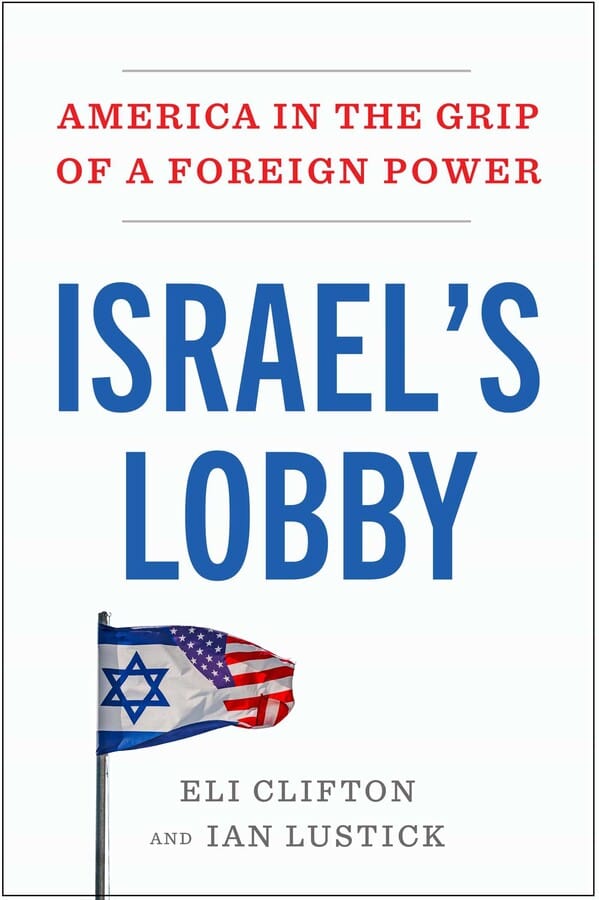
ISRAEL’S LOBBY
American in the Grip of a Foreign Power
By Eli Clifton and Ian Lustick
304 pps. Simon & Schuster, $29.00
Book-length treatments of the Israel Lobby’s deleterious impact on US foreign policy have a long pedigree, stretching back at least to the first Palestinian intifada during the 1980s.
Journalists, former Members of Congress, former high-ranking State Department officials, political scientists, and diplomatic historians have all produced valuable contributions to this body of literature that explains the mechanics through which the Israel Lobby leverages pressure to produce what–up until this historical point–has been a virtually unconditional US policy supporting Israel’s nearly 80-year apartheid rule over the Palestinian people.
Some of the books in this first-generation of literature include journalist Edward Tivnan’s The Lobby: Jewish Political Power and American Foreign Policy (1987); former Republican Congressman Paul Findley’s They Dare to Speak Out: People and Institutions Confront Israel’s Lobby (1985), who was famously defeated for re-election by challenger Dick Durbin in large measure due to his engagement with the Palestine Liberation Organization, drawing the ire of AIPAC; and former Kennedy and Johnson administration Under Secretary of State George Ball and Douglas Ball’s The Passionate Attachment: America’s Involvement with Israel, 1947 to the Present (1992).
Newer additions to this body of literature from a more academic perspective include John Mearsheimer and Stephen Walt’s The Israel Lobby and U.S. Foreign Policy (2007), an important contribution from two of the leading theoreticians of realism in international relations, and Walter Hixson’s Israel’s Armor: The Israel Lobby and the First Generation of the Palestine Conflict (2019), a diplomatic historian’s look into the rise of the Israel Lobby from the establishment of Israel to the 1967 war.
Eli Clifton and Ian Lustick provide an important addition to this body of literature in Israel’s Lobby: America in the Grip of a Foreign Power.
Clifton and Lustick are exceptionally well-positioned to articulate this updated, devastating critique of how the Israel Lobby subverts democracy at home while ensuring US support for Israeli aggression, apartheid, and genocide abroad.
Clifton, a long-time investigative journalist who specializes on reporting on the nexus between money in politics and US foreign policy, and Lustick, a prolific professor of political science whose previous books have focused attention on the inequality faced by Palestinian citizens of Israel, the Israeli settler movement, and the impracticability of the two-state resolution, combine the best of journalistic scoops with rigorous historical analysis in a powerful one-two punch.
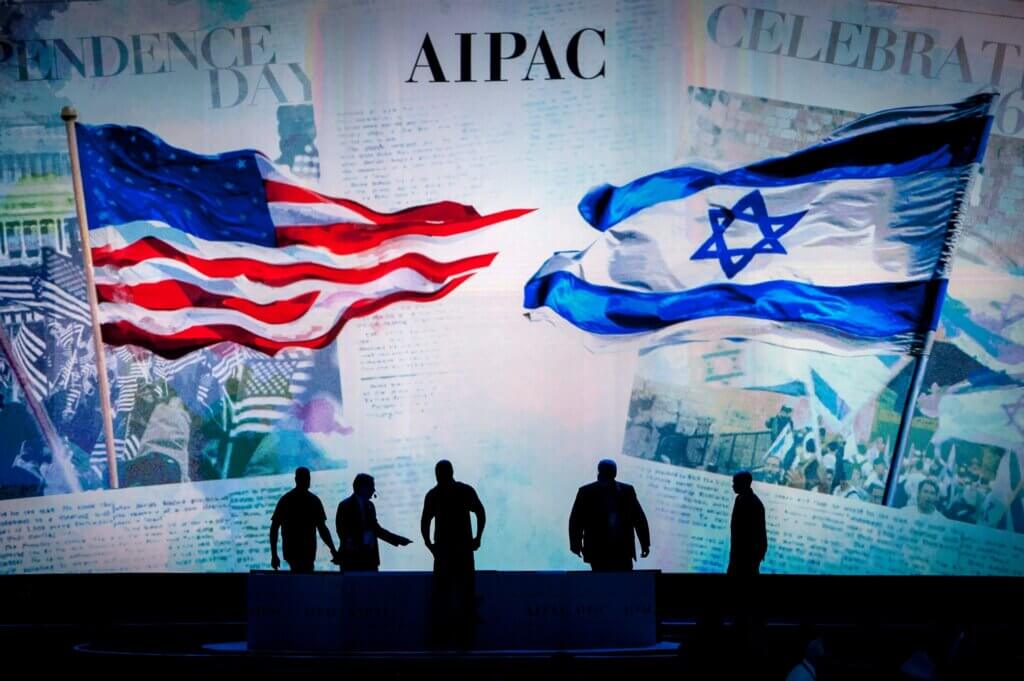
Clifton and Lustick do not mince their words: “Israel’s Lobby has become an out-of-control foreign influence operation, largely unrecognized as such, that channels some of the most extreme impulses of contemporary Israeli politics into the offices, corridors, and counsels of American leaders, imperiling both the lives and interests of their constituents and of the United States as whole.”
| Join Josh Ruebner for an IMEU Policy Project Book Club conversation with authors Eli Clifton and Ian Lustick on Thursday, August 27 at 7:00PM. Register for the webinar. |
Yet Israel’s Lobby is no jeremiad. It is a meticulously researched and documented investigation into how AIPAC and others fund blatantly racist and Islamophobic pundits and sketchy think tanks to spew virulently anti-Palestinian rhetoric; how pro-Israel megadonors exploit openings in recent Supreme Court decisions on campaign financing to funnel hard-to-trace “dark money” to impact electoral races; and how, in the face of unprecedented American public opinion support for Palestinian rights, the ADL and others have manufactured a largely faux “antisemitism” scare (where most of the incidents recorded can be chalked up to legitimate political discourse criticizing Israeli governmental policies) to work hand-in-glove with the Trump administration to dismantle freedom of speech on college campuses.
Clifton and Lustick–by transcribing videos of Israel Lobby events, unearthing misfiled tax returns inadvertently exposing pro-Israel donor connections, and by digging deep into the ADL’s methodology–have done the hard work so you don’t have to to understand what the Israel Lobby aims to achieve and the methods through which they seek to achieve it.
Among some of the many eye-popping anecdotes and statistics that make Israel’s Lobby a compelling read are the ways in which the Israel Lobby discusses its power so blatantly, and, in at least one case, unselfconsciously leans heavily on antisemitic and conspiratorial tropes.
“The masters of the universe are Jews!” former Republican Senator and current chair of the Republican Jewish Coalition (RJC) Norm Coleman exuberantly told a gathering of the Jewish News Syndicate (JNS) in Jerusalem in 2025. Citing the prominence of four Jewish individuals in the tech world–Sam Altman, CEO of Open AI; Mark Zuckerberg, CEO of Meta; Sergey Brin, co-founder of Google; and Jan Koum, co-founder of WhatsApp–Coleman argued that “we have to figure out a way to win the digital battle…And when we do that the future of Israel will be stronger because a majority of all Americans will support Israel. We’ll make that happen.”
What exquisite hypocrisy! If Tucker Carlson or Candace Owens said Jews control social media for the purpose of convincing Americans to support Israel, holy hell would break loose and Coleman would be likely to be in the front ranks of the pitchfork-wielding mob.
But perhaps this braggadocio is not misplaced. Clifton and Lustick also meticulously document how just nine pro-Israel megadonors have funneled an astronomical $1.7 billion in political donations disclosed to the Federal Elections Commission (FEC) since 2012. Yes, you read that right. “B” as in billion. And that amount doesn’t even include undoubtedly substantial “dark money” contributions made anonymously by these same donors to 501(c)(4) and other types of organizations influencing elections.
The numbers are staggering: $700 million from Sheldon and Miriam Adelson; $400 million from Michael Bloomberg; $100 million each from Jeff Yass and Paul Singer; and between $30-$70 million each from Bernie Marcus, Reid Hoffman, Larry Ellison, Haim and Cheryl Saban, and the aforementioned Jan Koum.
“These donors form the backbone of an Israel-first movement that crosses party lines and shares a uniform goal of supporting politicians, outside organizations, and think tanks that provide research and analysis for members of Congress and the president,” Clifton and Lustick write.
This dynamic produces a closed loop effect, they persuasively argue. These megadonors “are funding both the election of politicans as well as the research institutions shaping the worldview of these same elected officials, creating an echo chamber of pro-Israel talking points and policy recommendations for politicians already indebted to pro-Israel donors.”
As Clifton and Lustick make clear throughout the book, this is not your father’s AIPAC, to borrow a line from a GM commercial. Gone are the days when AIPAC attempted to cultivate a bipartisan consensus for Israel on Capitol Hill, eschewing overt interference in electoral contests while quietly and unofficially bundling money behind the scenes.
Instead, today’s AIPAC is a super-charged juggernaut, a leviathan dumping seemingly endless reserves of largely GOP megadonor cash into Democratic primaries to stymie increasingly bold Congressional voices advocating for Palestinian rights. Clifton and Lustick are correct to point out the outsized role played by the more than $23 million that AIPAC’s affiliated Super PAC United Democracy Project (UDP) plowed in to help defeat Reps. Jamaal Bowman and Cori Bush–two of the most outspoken Congressional voices against Israel’s genocide–in the 2024 elections.
And yet…after finishing Clifton and Lustick’s book as the primary season for the 2026 midterm election nears its conclusion, one is left wondering whether the AIPAC of the past, as analyzed in Israel’s Lobby, can ensure its continued dominance into the future?
I don’t think that it can. The ever-increasing amounts of electoral money dumped into campaigns by AIPAC are not translating into victories and, in some respects, can be seen as markers of desperation–a retrograde lobby swimming against what seems to be an inexorable tide of public opinion away from sympathy for Israel and in support of Palestinian rights.
A July 2026 Data for Progress poll found that 58 percent of all Americans support ending taxpayer-funded weapons to Israel–the continued provision of which is AIPAC’s reason for existence–while only 35 want to keep the weapons flowing. While poll after poll over the previous three years of Israeli genocide of Palestinians in Gaza has repeatedly shown that a majority of Democrats support this position, this poll was notable as the first time a majority of all Republicans also agreed.
While Republicans–with the lone exception of Rep. Thomas Massie–continue to support giving US taxpayer-funded weapons to Israel, revealing the growing gaps between the base of the GOP and its elected officials, Democrats are belatedly catching up with and responding to their base.
This newfound Democratic willingness to challenge pro-Israel orthodoxy has been revealed through several important developments in the current Congress. For example, 85 percent of Democratic Senators voted to block the delivery of bombs and bulldozers to Israel in April, and more than 100 Democratic Representatives voted for Rep. Massie’s amendment to slash $3.3 billion in weapons to Israel in July.
These are once unthinkable developments and may suggest the power of Israel lobby has wielded in the past, as expertly explicated by Clifton and Lustick, will be much less effective even in the near future.
Josh Ruebner
Dr. Josh Ruebner is Policy Director of the IMEU Policy Project and a Faculty Fellow at Georgetown University’s Center for Social Justice. He is the author of the upcoming book The United States and the Palestinian Nakba: A Transnational History, 1947-1950.


Clifton and Lustick have this editorial in the Guardian:
The pro-Israel lobby has swayed US presidents since Truman. It must end with Trump…To fast forward: Donald Trump’s decision to go to war on Iran earlier this year came after a sustained campaign by Israel to convince the US to join the disastrous operation. It also came in defiance of several of his top advisers, as well as the 45% of Republicans who hold an unfavorable view of Israel. That decision may be most quickly explained as yet another example of the erratic policymaking that define Trump’s two terms as president. But a closer examination of the experience of several of his predecessors reveals that this presidential decision is more the rule than the exception….
The pro-Israel lobby has swayed US presidents since Truman. It must end with Trump | US political lobbying | The Guardian
“Clifton and Lustick are exceptionally well-positioned to articulate this updated, devastating critique of how the Israel Lobby subverts democracy at home while ensuring US support for Israeli aggression, apartheid, and genocide abroad.” says the essay above.
We might add that the Israel Lobby coarsens Judaism.
Off topic: Foreign Policy has a review of “Ungrounding: The Architecture of Genocide” ( a book I’m currently reading ). I can only get the first few paragraphs, here it is:
A new book by the British Israeli architect and political activist Eyal Weizman tries to fill that void by telling the story of Israel’s systematic destruction of Gaza street by street, farm by farm, and hospital by hospital. What sets Ungrounding: The Architecture of Genocide apart from this polarized discourse is its determined focus on the physical and its analytical tone. The evidence, collected by Weizman and his team from audios, videos, and interviews and subjected to rigorous analysis, is overwhelming. Their efforts produced the “Cartography of Genocide,” an interactive and constantly evolving digital map that details “an organized and designed campaign to destroy Palestinian life in Gaza.”
A New Book Details Israel’s Destruction of Palestinian Life in Gaza