Author

Nada Elia

Browsing

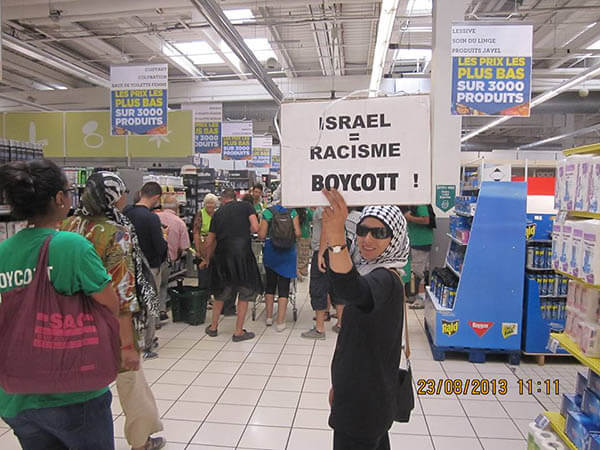
Palestinian writer and activist Nada Elia responds to claims that an economic boycott of Israel is bound to fail: “BDS will never bankrupt Israel, and that is not necessary for it to achieve its goals: showing that the emperor has no clothes, and empowering justice-minded people everywhere to disengage from a hyper-militarized, violent rogue state, until it stops violating international law and the human rights of an oppressed people.”
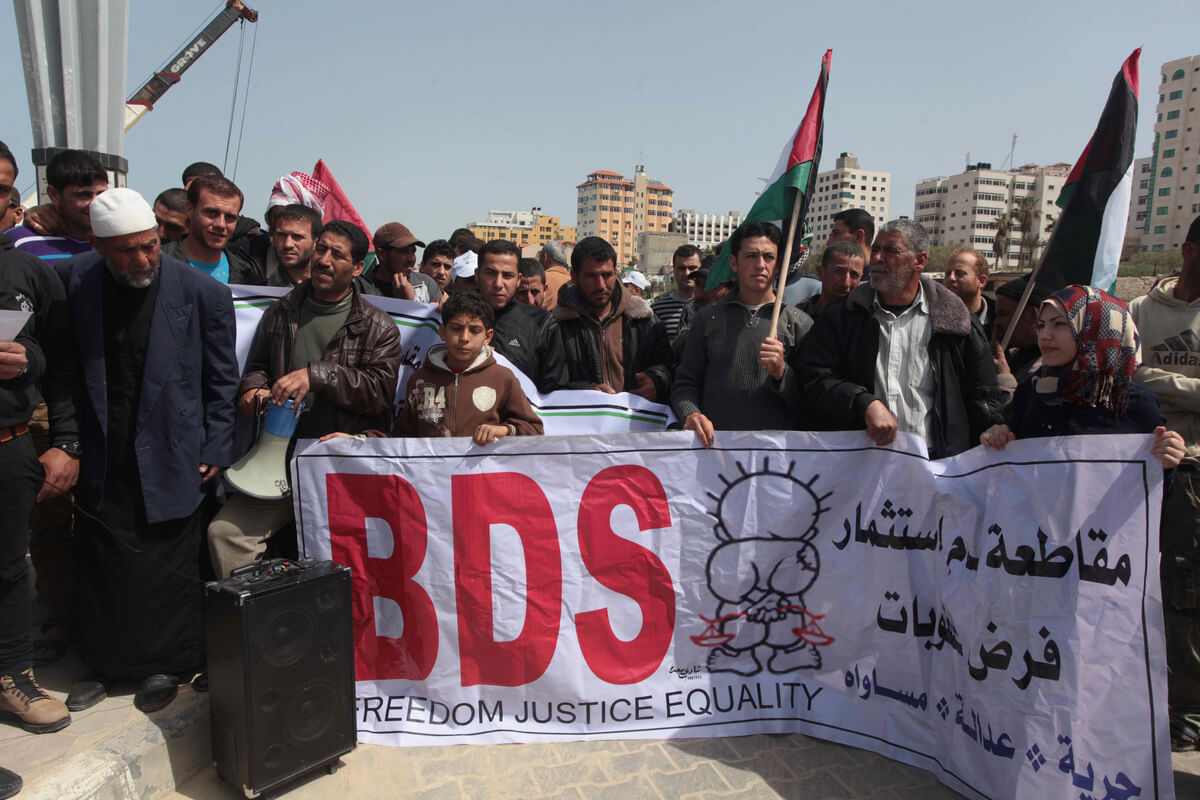
Last month, Palestinians everywhere commemorated Al Nakba, and Nada Elia says that Palestine solidarity circles are right to celebrate the discursive change that has finally shattered the Zionist stranglehold on the mainstream narrative around the question of Palestine. But, she writes, solidarity must be reciprocal, “Diaspora Palestinians living in the US must also seek to redress the consequences of the catastrophe that befell the indigenous people of the land we now inhabit. Many of us do recognize this injustice, and frequently begin our talks and lectures with an acknowledgement that we are speaking on stolen Indigenous land. But we can and should do more.”

Nada Elia writes, “This year, as we commemorate al Nakba yet one more time, as we remind the world that our catastrophe is ongoing, let us also act upon the belief that merely speaking out against injustice is not enough. ‘Demonstrations’ are not enough. BDS is a means to an end: liberation, the abolition of apartheid, the return of the refugees. We are approaching this end, and must look beyond it.”

Pulitzer Prize laureate Michael Chabon’s recent interview in which he describes the horrors he witnessed while on a tour of Hebron has been circulated amongst Palestinian-rights activists like brush fire, often prefaced with an explanation that he is a “Jewish-American writer.” Nada Elia says, “Israel does not now, and indeed never did, speak for all Jews. It is time we put an end to that myth by putting an end to the celebration of Jewish voices denouncing Zionism as ‘exceptional,’ or ‘heroic.’ They belong with all other such voices, and must magnify, rather than occupy, the Palestinian narrative.”

Nada Elia says she keeps hearing that if BDS accomplishes its goals and Palestinians achieve their rights then Israel will disappear. But in the same way she cannot fathom how someone would claim that “there is no South Africa” after apartheid, she says the end of a Jewish supremacist state will not be an act of destruction, but a global victory for justice.

Palestinians have given the world many terms. “Nakba,” the Palestinian catastrophe, and “Intifada,” the “shaking off” of an oppressive system are two examples. Another term is “Sumoud,” the persistence of the Palestinian people, despite close to a century of a denial of their right to exist. As attacks on BDS, and BDS organizers, are intensifying globally, Nada Elia says, “Now is the time for sumoud not just in the homeland, but in activist communities worldwide. Just as Palestinians refuse to surrender their rights to freedom, dignity, self-determination, activists will not give up our right to organize for justice.”

Palestinian schoolteacher Hanan Al Hroub was recently awarded the “Global Teacher award” for 2016, for teaching students traumatized by violence. Palestinian teachers are carrying on one of the most necessary tasks in any society, despite the everyday violence of the Israeli occupation, the relentless criticism from Zionists around the world who persist in their claims that that “Palestinians teach their children to hate,” and the extreme corruption from their employer, the Palestinian Authority. Under these circumstances, Hroub’s award becomes even more meaningful. It represents the sumoud of a people neglected by its leadership and abused by the world’s leaders. The award is an acknowledgement that, as Rafeef Ziadah put it so powerfully, even when engulfed in unfathomable violence, “We Teach Life, Sir!”

Recent endorsements of Hillary Clinton by Madeleine Albright and Gloria Steinem brought into focus a long-standing division between powerful, privileged white women’s feminism and intersectional feminism, with its focus on the necessity of analyzing overlapping and intersecting systems of oppression. Nada Elia writes that Palestine stands at the fault line between these two understandings: “Global feminist solidarity is necessarily an anti-colonial, intersectional practice, rather than a diamond-bejeweled white fist raised towards a glass ceiling which prevents privileged women from achieving the presidency of the world’s largest hypermilitarized imperial power.”

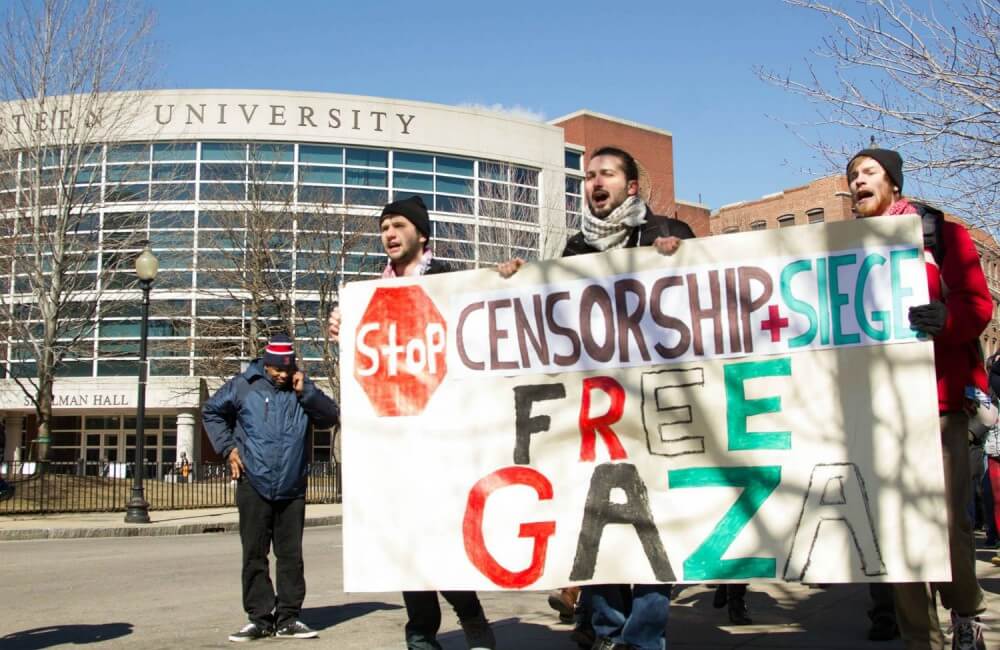
Northeastern chapter of Students for Justice in Palestine protesting censorship on campus. (Photo courtesy of Northeastern SJP)

Nada Elia says that when it comes to Palestine it is not bigots who attempt to shut down debate, but instead Israel’s liberal supporters. She believes that the impulse amongst otherwise rational people to shut down educational events and conversations stems from the fact that there is an essential dissonance at play when liberals embrace Zionism. Whichever way one looks at it, there are irreconcilable differences between the professed beliefs of liberals, and the quotidian acceptance of supremacy which Zionism hinges upon.