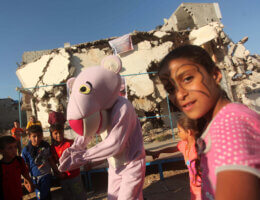
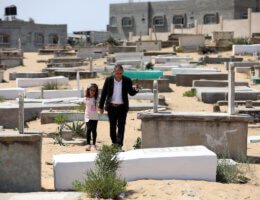
Palestinian families aren’t done crying over the 232 loved ones they lost in Israel’s last “war” in May of 2021. Hospitals haven’t finished treating many of the 1900 people who were injured in that attack, and now this latest round of aggression is piling on the cases they have to treat. Neither were the humanitarian organizations able to rebuild all the damaged sectors in time for the latest onslaught.
Mohammed Rafik Mhawesh reflects on the ongoing trauma, and resilience, of life in Gaza following the Israeli attacks in May. “While the international media celebrates the “calm” in Gaza, my family and I are still unable to sleep,” he writes.
After two and a half years of living abroad, Abdelrahman Abuabed decided it was time to visit his family. He arrived in Gaza days before the May escalation between Hamas and Israel. “A terror-stricken burden of waiting for the next massacre looms over every house in Gaza and an insane feeling of wishing it will be far away from you and from anyone you know.”
At a family gathering last May, everyone in Basma Ismail Kurd’s family was looking forward to her niece playing doctor. But after the last escalation between Israel and Hamas, and witnessing death and destruction around her, she no longer wants to become a physician. What do you tell a ten-year-old who has witnessed carnage around her, when you’re also traumatized yourself?
“Israel never misses a chance to ruin Gaza’s mornings.” Israeli drones are an ever present part of life in Gaza, and serve as a trigger for painful memories of war.
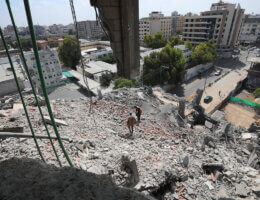
Before they were destroyed by Israeli airstrikes, Gaza’s towers were beehives of upscale boutiques, restaurants, offices, and even a music studio. Palestinians in Gaza are struggling with the loss.
Neuroscientists say memories endure when there is a strong emotion attached to it. After witnessing 264 savage hours of the carpet-bombing of Gaza, it seems impossible to break free from this brain-structured prison.
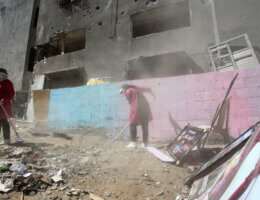
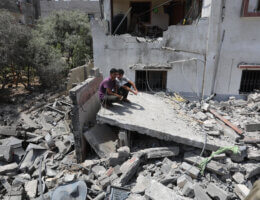
Over 16,000 housing units were damaged during the recent Israeli attacks on Gaza, and 1,800 units were completely destroyed. While that destruction is immense, what those numbers don’t capture is what else was lost in those places — the irreplaceable photos, keepsakes, and possessions and that made each a home.
Noura Selmi recounts the nightmares that have plagued her since the fighting ended in Gaza. “The ceasefire was declared and life is trying to be normal again,” Selmi writes. “Unfortunately, the rockets are still following me in my sleep.”
After every ceasefire, Rana Shubair tries to imagine leading a normal life. In Gaza, the bar is set low and means not living under raining bombs. “Mama, who broke our house?” the neighbor’s three-year-old asked. His mother ignored his question. The following day the toddler announced, pleased that he had figured it out, “The Israelis broke our house.”