Francesca Albanese’s June report to the UN Human Rights Council says Israel uses physical, bureaucratic, military, and surveillance means to “de-Palestinianize” the occupied territory, threatening “the existence of the Palestinians as a people.”
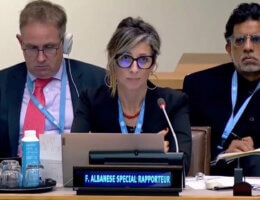

Francesca Albanese’s June report to the UN Human Rights Council says Israel uses physical, bureaucratic, military, and surveillance means to “de-Palestinianize” the occupied territory, threatening “the existence of the Palestinians as a people.”
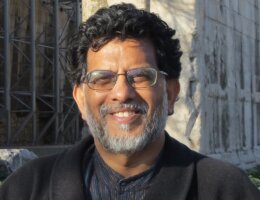
In a letter to UN Human Rights Council President Nazhat Khan, UN official Navi Pillay defends her colleague Miloon Kothari against accusations of antisemitism from pro-Israel groups, Israeli lawmakers, and U.S. officials following his interview with Mondoweiss, saying his comments “seem to have deliberately been taken out of context.”
The attacks on Kothari appear to be part of a concerted effort to undermine the UN Commission of Inquiry on the Occupied Palestinian Territory, which the United States and Israel have opposed since it was created in 2021.

United Nations Human Rights Commissioner Miloon Kothari discusses the first report of the Pillay Commission into the “underlying root causes of recurrent tensions” in Palestine.
UN Human Rights Commissioner Miloon Kothari explains why Apartheid is a useful paradigm but not enough to explain the root causes of the Palestinian crisis.
Michael Lynk reflects on his time as UN Special Rapporteur for the human rights situation in the Palestinian Territories.
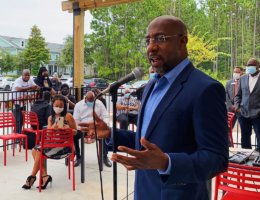
A bipartisan group of 68 Senators are calling on the Biden administration to stop the United Nations Human Rights Council from investigating Israel’s latest assault on Gaza and end the council’s “discriminatory and unwarranted treatment of Israel.” Among the signatories, Raphael Warnock.

In case you missed it, Harvard Law School’s International Human Rights Clinic lately issued a report that finds Israel’s treatment of Palestinians on the West Bank amounts to the crime of apartheid. The study came out on February 28 in the wake of five longer, wider-ranging, apartheid reports published since 2020 – and just before the UN Special Rapporteur for Palestine published yet another apartheid report on March 21. Despite its quiet rollout, the study’s high quality and association with Harvard likely mean it will play a significant role in establishing Israel’s apartheid, and represents a victory for Palestinian human rights.

New York Times Jerusalem bureau chief Patrick Kingsley used a fresh apartheid report, by U.N. special rapporteur Michael Lynk, to finally slip Amnesty International’s apartheid finding into the paper. Kingsley wrote that Lynk, a distinguished Canadian law professor appointed by the U.N.’s Human Rights Council, had “accused Israel of committing the crime of apartheid in the occupied territories.” He quickly summarized Lynk’s finding, gave Israel’s foreign ministry and other critics a chance to respond — and then, right at the end, mentioned that Amnesty, among others, had produced a “similar” report.

According to a classified cable, Israel’s government is launching a campaign to discredit a United Nations commission investigating the country’s 2021 attack on Gaza. Axios’ Barak Ravid reports that Israel’s Foreign Ministry sent a cable, to all the country’s diplomatic missions, referring to the investigation as a “top priority” and announcing that it’s launching a diplomatic effort to derail the probe. They also expressed concern that the Commission of Inquiry’s report (which is expected to be released in June) will refer to Israel as an “apartheid state.”

On May 27th the UN Human Rights Council voted to establish an ongoing commission of inquiry to report on rights violations in Israel, the occupied West Bank, East Jerusalem, and Gaza Strip. While this is very similar to the many commissions that have failed to hold Israel accountable in the past, Lori Allen says this one may be different due to the political context in which it is emerging.