

Israeli Soldiers prevent an international solidarity worker from entering Khatib’s home tonight. (Photo: Hamde Abu Rahmah)
On the day that Bil’in protest leader Mohammad Khatib was arrested for the second time in six months, the New York Times has finally caught up to the story of Israel’s ongoing campaign against Palestinian dissent. Isabel Kershner’s article, Israel Signals Tougher Line on West Bank Protests, gives an overview of the "creeping, part-time intifada" that continues to spread across the West Bank, as well Israel’s effort to quash it.
Kershner quotes Khatib in the article and notes his arrest today:
“Bilin is no longer about the struggle for Bilin,” said Mr. Khatib, who was arrested in August and has been awaiting trial on an incitement charge. “This is part of a national struggle,” he said, adding that ending the Israeli occupation was the ultimate goal. Before dawn on Thursday soldiers came to Mr. Khatib’s home in Bilin and took him away again.
It’s clear Israel is growing increasingly concerned as Kershner also quotes military spokesperson Maj. Peter Lerner, “’These are violent, illegal, dangerous riots.’ Other Palestinians are ‘jumping on the bandwagon,’ he said, and the protests ‘could slip out of control.’"
The Popular Struggle Coordination Committee released a statement following Khatib’s arrest placing it in a broader context:
The recent wave of arrests is largely an assault on the members of the Popular Committees – the leadership of the popular struggle – who are then charged with incitement when arrested. The charge of incitement, defined under Israeli military law as "an attempt, whether verbally or otherwise, to influence public opinion in the Area in a way that may disturb the public peace or public order," is a cynical attempt to punish grassroots organizing with a hefty charge and lengthy imprisonments. Such indictments are part of the army’s strategy of using legal persecution as a means to quash the popular movement.
Similar raids have also been conducted in the village of alMaasara, south of Bethlehem, and in the village of Ni’ilin – where 110 residents have been arrested over the last year and half, as well as in the cities of Nablus, Ramallah and East Jerusalem.
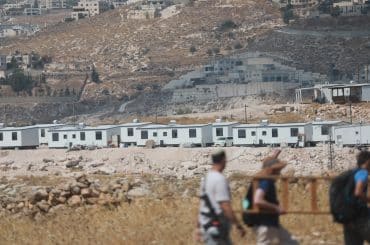
The law in Israel is Kafkaesque. The mayor of Jerusalem defies a court order to remove Jews from an illegal building in East Jerusalem, he defies a court order that rules the protests in Sheikh Jarrah are legal and has his cops bust them up. And he illegally diverts funds to haredi schools while children in E Jerusalem have no room in their classrooms.
People with any authority can do whatever they please, and no one seems to be able to stop them.
What will Israel do when the entire Palestinian population of the WB is in prison?
I have said it before, and I will probably say it again – Israel cannot continue in this vein of illegal occupation and have any institution stand, local or national, as legitimate potsherd. It is all a cruel joke, a ruse, and will continue to be until all of this stops.
Potshed,
You ask:
“What will Israel do when the entire Palestinian population of the WB is in prison?”
Israel will do all the things that are successfully trialled in Gaza.
Kick out journalists, foreigners, NGOs, and throw the key away.
Please remember, when making libellous accusations against noble Israeli institutions, such as the IDF, the most moral army in the world, that in most of the West Bank (Area C, approximately 59% of the area, and not under PA civil control) the IDF is the law, although it is itself subject to Israeli Law, of course.
There is no Israeli law that prohibits arrests by squads of goons in the early hours of the morning, nor that prohibit the rousing and terrifying of entire families, including young children, although that doesn’t seem to happen to Israelis very much.
link to guardian.co.uk
link to palestinemonitor.org
Area A comprises Palestinian towns, and some rural areas away from Israeli population centers in the north (between Jenin, Nablus, Tubas, and Tulkarm), the south (around Hebron), and one in the center south of Salfit. Area B adds other populated rural areas, many closer to the center of the West Bank. Area C contains all the Israeli settlements, roads used to access the settlements, buffer zones (near settlements, roads, strategic areas, and Israel), and almost all of the Jordan Valley and Judean Desert.
Areas A and B are themselves divided among 227 separate areas (199 of which are smaller than 2 square kilometres (1 sq mi)) that are separated from one another by Israeli-controlled Area C.
The Palestinian Authority has full civil control in area A, area B is characterized by joint-administration between the PA and Israel, while area C is under full Israeli control. Israel maintains overall control over Israeli settlements, roads, water, airspace, “external” security and borders for the entire territory.
Approximately 30% of Palestinians living in the West Bank are refugees or descendants of refugees from villages and towns located in what became Israel during the 1948 Arab-Israeli War – 754,263 in June 2008 according to UNRWA statistics.
The West Bank has 4,500 km (2,796 mi) of roads, of which 2,700 km (1,678 mi) are paved.
In response to shootings by Palestinians, some highways, especially those leading to Israeli settlements, were completely inaccessible to cars with Palestinian license plates, while many other roads were restricted only to public transportation and to Palestinians who have special permits from Israeli authorities. Due to numerous shooting assaults targeting Israeli vehicles, the IDF bars Israelis from using most of the original roads in the West Bank. At certain times, Israel maintained more than 600 checkpoints or roadblocks in the region. As such, movement restrictions were also placed on main roads traditionally used by Palestinians to travel between cities, and such restrictions are still blamed for poverty and economic depression in the West Bank. Since the beginning of 2005, there has been some amelioration of these restrictions. According to reports, “Israel has made efforts to improve transport contiguity for Palestinians travelling in the West Bank. It has done this by constructing underpasses and bridges (28 of which have been constructed and 16 of which are planned) that link Palestinian areas separated from each other by Israeli settlements and bypass roads” and by removal of checkpoints and physical obstacles, or by not reacting to Palestinian removal or natural erosion of other obstacles. “The impact (of these actions) is most felt by the easing of movement between villages and between villages and the urban centres”.
However, some obstacles encircling major Palestinian urban hubs, particularly Nablus and Hebron, have remained. In addition, the IDF prohibits Israeli citizens from entering Palestinian-controlled land (Area A).
As of August 2007, a divided highway is currently under construction that will pass through the West Bank. The highway has a concrete wall dividing the two sides, one designated for Israeli vehicles, the other for Palestinian. The wall is designed to allow Palestinians to freely pass north-south through Israeli-held land.
According to a 2007 World Bank report, the Israeli occupation of the West Bank has destroyed the Palestinian economy, in violation of the 2005 Agreement on Movement and Access. All major roads (with a total length of 700 km) are basically off-limits to Palestinians, making it impossible to do normal business. Economic recovery would reduce Palestinian dependence on international aid by one billion dollars per year.
Pro-settler opponents claim that the barrier is a sly attempt to artificially create a border that excludes the settlers, creating “facts on the ground” that justify the mass dismantlement of hundreds of settlements and displacement of over 100,000 Jews from the land they claim as their biblical homeland.
link to en.wikipedia.org
So apart from a few Jewish settler malcontents, the whole arrangement is one of sweetness and light.
Any stories that you might hear to the contrary are the concoctions of egregious lefties, who will be imprisoned if they are Palestinian, or deported if they are not.
I find it strange that many of my comments are published in full on Mondoweiss,, but bear the rubric: Your comment is awaiting moderation., while a following comment, which only makes sense by reference to the first one, passes through with flying clean colours.
Strange, that.
Maybe it’s because you post in boldface. Which is, I must say, rather impolite.
The headline is misleading. The story appears in the New York Times, not The Times.
I know that people often call their local newspapers “the Times”, but a website like this is not local.
In the US the NYT is sometimes called “The Times”. It would be better though, if he took your advice.
where are you from RoHa? i didn’t mean to sound dismissive if it came across like that. sometimes we call the nyt the Pravda on the Hudson.
it’s locally from the US. the nyt is ‘the times’ here.
I know that in the U.S. the NYT is often called “the Times”. But websites are international.
link to original.antiwar.com
Some good reporting from Cook. Hey guys, looks like I might qualify to steal Palestinian land! Indian Jews!
Looks like a way to bolster settlement numbers, as well build some facts in the ground, and drag India in w/ this entire mess.
I can see it now: Haaretz: ‘Palestinian Arab blood-thirsty hooligan, terrorist kills lost tribe innocent Indian Jewish Settler frolicking in a field of meadows while feeding the hungry hungry Haitians’