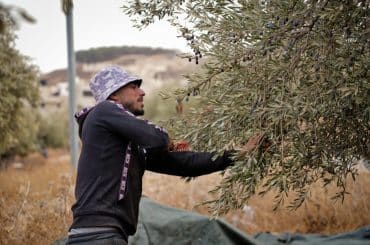
Nonviolent protests are also taking place in Gaza

Those people out there who still wonder where the Palestinian Mandela or Gandhi is should start paying attention to the numerous peaceful actions going on throughout Palestine. Non-violent resistance to the Israeli occupation, akin to the weekly protests in Bil’in and Ni’lin against the illegal wall, is now becoming a weekly occurrence in the Gaza Strip. It’s a story that deserves more attention.

The International Solidarity Movement and the activist group Local Initiative Beit Hanoun led a March 1 protest that marched to 50 meters from the Erez border with Israel.

The weekly protests in Gaza are challenging the Israeli-imposed “buffer zone” that extends 2 kilometers inside Palestinian land, though Israel says the zone reaches 300 meters into Gaza. Because of the zone, Gaza’s farmers have been denied access to their arable land near the border and only reach it at enormous risk. The zone has also severely affected Gaza’s fishermen, who are restricted to fishing only 3 nautical miles out from Gaza’s coast, a limit in complete violation of the Oslo Accords that allowed fishermen to venture out 20 miles. If the fishermen venture out further, they are harassed, shot at, and arrested.

Israeli troops shot at the demonstrators near the end of the March 1 protest, as they often do at any Palestinian who enters the “buffer zone.”

When I was in Gaza two months ago, Daragh Murrary, a legal officer for the Palestinian Center for Human Rights, explained to our delegation that, “the buffer zone is an illegal thing [under international law]. You’re not allowed to do it. There’s no military justification for it.”

Here’s more about the March 1 action from the International Solidarity Movement:


Thirty activists from the Local Initiative Beit Hannoun and the International Solidarity Movement (ISM) participated in the weekly demonstration asking for Palestinian land to be returned to its rightful owners. The activists gathered at the site of the University College for Agriculture which now lies in rubble following air attacks during operation Cast Lead.

The activists walked towards the Erez border chanting “Down with the Occupation” and “With my life and soul I will free you Palestine”. The activists reached 50 meters from the border and there Saber Zanin, Director of Beit Hannoun Local Initiative, spoke about the hardships farmers face on a daily basis as they attempt to plough and farm their land. Farmers risk being shot at either by Israeli snipers or from the automated tower machines which line the Gaza-Israel border zone. Speaking in Hebrew to the Israeli soldiers present within the watch tower, Zanin explained to them that the crowd was gathered on Palestinian land and that they had a right to be there by international law.

Zanin referred to the new regulation created by Israel upon Gaza that no person could come closer than 300 metres from the border. In reality, human rights groups within Gaza have documented that farmers have been shot at 2 km from the border.

As the demonstration came to a close and the activists started making their way back, shots were fired very close to the activists. A member of the ISM spoke to the Israeli soldiers through a microphone and asked the soldiers why they were firing upon civilians. The soldiers continued to fire as the group left. Seven shots were fired in all.

This “buffer zone” has denied access to 30% of Gaza’s farmland, as the border region includes some of Gaza’s most fertile land, according to a March 2009 report by the United Nations’ Office for the Coordination of Humanitarian Affairs. Israel is denying Palestinians the right to farm on their own land, severely affecting their livelihoods and means of sustenance. In recent weeks, according to the blog Farming Under Fire, the Israeli Defense Forces have shot and wounded a farmer and detained Gazan workers at the border.

According to a report by the Palestinian Center for Human Rights, in all of 2009, excluding the attacks of Operation Cast Lead, 69 people have been injured and 37 people killed by Israeli violence directed at people in the "buffer zone."

For more information on how the "buffer zone" has impacted the lives of Gazans, you should check out the excellent blog of Eva Bartlett, who is a Canadian human rights advocate, journalist and activist with the International Solidarity Movement inside Gaza.
 

About Alex Kane

Alex Kane is a staff reporter for Mondoweiss. Follow him on Twitter @alexbkane.
Posted in Gaza, Israel/Palestine

{ 17 comments... read them below or add one }

  1. Rehmat says:

    Nelson Mandela gave his verdict many years ago when he said: ““Our freedom (in South Africa) is incomplete without the freedom of the Palestinians”.

    So did Mahatma Gandhi, when he said: “France is for the French, England for the English and Palestine for the Arabs”.

    International Israeli Apartheid Week 2010
    link to rehmat1.wordpress.com

  2. potsherd says:

    The fence is illegal, the imprisonment of Gaza is illegal, the siege is illegal. It’s not as if the kill zone is illegal while the rest is not.

  3. Gaza is unwilling to make a separate peace with Israel. I favor negotiations to stabilize the relationship between Israel and Gaza, which would include hopefully a means to limit the “no man’s land” zone between Israel and Gaza. But I do not really see the nonviolent protest marches in Gaza playing a constructive role in the current situation. The situation on the West Bank is different, because the nature of the occupation in the West Bank is different. The role for nonviolent protests on the West Bank is certainly important.

    • WJ, sometimes I honestly think your not a troll but when you make comments like the one above I begin to question my judgement.

      Gaza is unwilling to make a separate peace with Israel

      This statement of yours is an outright lie and you know it.

      The Hamas authorities in Gaza have not only held up to their side of the truce each and every single time that they have made a truce with Israel but consistently try to extend these truces.

      I favor negotiations to stabilize the relationship between Israel and Gaza, which would include hopefully a means to limit the “no man’s land” zone between Israel and Gaza.

      So your trying to tell me that Israel is allowed to use its huge military advantage to obtain greater leverage during negotiations? The fact remains that Israel is illegally preventing Palestinian farmers from accessing their land. Basically, Israel is stealing from the Palestinians and then hoping to use what they stole as a bargaining chip during negotiations. I’m sorry but this is just outright insanity. Imagine if the Palestinians had done the same thing, what would your position be then?

      But I do not really see the nonviolent protest marches in Gaza playing a constructive role in the current situation.

      Why not? What should the Palestinians do? Fire more home made rockets that threaten the existential existence of Israel? Or how bout throw some more “existential threatening” rocks at tanks and military jeeps?

      • Citizen says:

        Neither the USA nor Israel will sit down with Hamas. De Klerk said that the first priority to resolve the situation was that you had to sit down eyeball to eyeball
        with your worst declared enemies, no conditions attached. But this won’t happen because Apartheid S Africa was insular, did not have an effective disapora (other than a tiny fringe of neo-Nazis), nor any superpower, let alone the lone superpower– at its back;rnor was De Klerk’s regime even a significant played in most world markets and finance.

        • Citizen says:

          Also, this irony: apartheid S Africa was independent; not dependent as is Israel, on endless financial gifts from the West, especially the USA’s annual unconditional direct aid (3 billion) and indirect (3 billion) aid (not to mention the 3 billion to Egypt, paid for being Israel’s pal).

    • Judy says:

      The issues is not “Hamas won’t make a separate peace, therefore they are the bad guys…” to which we respond “oh yes they will.”

      The issues is that there should NOT BE separate peace. Gaza and the West Bank would become permanently cantonized. An independent Palestine must make its peace with Israel… or become part of one bi-national body.

      • Citizen says:

        Again, the USA and Israel should sit down unconditonally with both Palestinians groups, otherwise its a nonstarter. None of the aforementioned players should be able to cherry pick who gets to sit at the table if the peache negotiation is to be taken seriously. And there should be regular unbiased news coverage of the on-going negotiations as to sticking points open or resolved, step-by-step.

  4. pabelmont says:

    The creeping restrictions have been creeping for a long time. We’ve had the blockade of Gaza for years and now, in addition, a thickening buffer zone.

    It’s like the no-trees buffer zones around the Israelis-only highways in the West Bank [ lotta tree cutting there, productive olive trees often, recalling Israel's long period of self-congratulatory tree planting]. Israel keeps making its restrictive behavior worse and worse as a technique to see how much it can get away with and to train its soldiers in accepting.

    the cutting of trees as an act of war seems contrary to Jewish law (but I’ll leave that to the experts): Deuteronomy 20, discussing the laws of war, and in particular siege, forbids the cutting down of fruit trees, adding, in an ambiguous and tantalizing phrase, “ki ha-adam etz ha-sadeh.” The words can be translated as a simple if enigmatic statement (“for man is a tree of the field”) or as a question (in the rendering of the JPS Torah,”are trees of the field human?”). The classical commentators were likewise divided. The Talmud, reading the phrase as a statement, is moved to offer a prototype of a human “tree of the field”: a virtuous sage, a worthy teacher and role model. Rashi, the great exegete of medieval Franco-Germany, understood it as a question. People make war, but why should trees suffer?

    If trees can suffer, why not people (non-combattants especially)? I guess low-intensity warfare requires a revision not only of the international laws of war but also of the Jewish laws of war. But, really, does Israel care about “Jewish law” anyhow?

  5. Pingback: Civil Engineering: Prospects, Future and Institutes in India | All … | Transport Engineering Addict

  6. Pingback: The Beauty Salon Spas – Why You Must Visit One | Skin care … | Spa Beauty Wisdom

  7. Pingback: Trading Currency Pairs « Hot and Tasty News and Buzz | Canadian Dollar Currency Herald

  8. Pingback: Land Day « Earwicga

  9. Pingback: Pickled Politics » Land Day

  10. Pingback: kashkool: Remembering Land Day يوم الأرض יוֹם הַאֲדָמָה ...

  11. Pingback: April Fools – Kind Of « بنسبة لنا

  12. Pingback: Ethan Bronner distorts history in ‘Times’ article on nonviolent resistance

Leave a Reply