

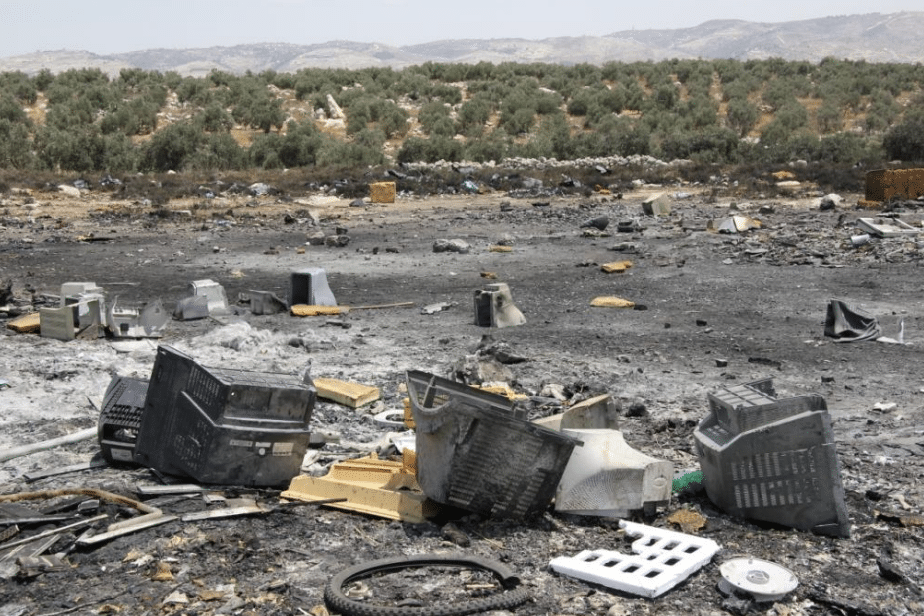
Lina Farajallah follows the dumping trucks every morning from the window of her quaint home in Idhna, a Palestinian town in Hebron in the southern West Bank. They carry waste from Israel and the nearby Jewish settlements into her neighborhood and dump it a few hundred meters from where she lives with her daughter.
The cargo in these trucks is mostly electronic waste from industrial plants outside the occupied West Bank. It does not fall within the 70,000 tonnes of e-waste that Israel officially recycles every year, but forms part of an undisclosed volume of industrial, chemical, and electronic waste openly dumped in the Palestinian territories from Israeli industrial settlements such as Barkan, Geshuri, and Kiryat Arba.
The trucks then head back to where they came from, and, like clockwork, the “sorters” of Hebron – Palestinians who have made a living re-selling electronic waste – arrive, take what they want, and burn the rest to extract the precious metals for reuse or sale.
For years now, Farajallah has suspected that the worsening, breathless coughs of her daughter, Heba, 13, come from the smoke that blankets the town and seeps into every room she and her daughter sleep in.
“At first I thought it was a passing cold, but I noticed the bouts arrived and intensified whenever the smoke returned and eased when the fire died down, or the wind changed direction,” she tells Mondoweiss.
Idhna has become a hub for dismantling discarded Israeli electronics, stripping out metals like copper to resell, and setting fire to whatever is left, often on open and farming land around the town.
Since October 2023, illegal dumps have multiplied to 92 sites across the West Bank, mostly in Israeli-controlled Area C. Palestinian authorities have struggled to regulate the industry, due to their lack of jurisdiction in Area C, and the fact that Israel has not approved a single permit for an official Palestinian waste facility in more than 20 years.
On top of that, Israel’s environment minister has pointed the finger at the Palestinians for the waste fires, blaming them for 27% of serious illnesses in Israel, and going so far as to deduct 40 million shekels from withheld Palestinian tax revenues over the waste fires last year.
Palestinian officials have been making the opposite case for years, arguing that the main source of the environment and health crises is Israel’s illegal dumping of toxic waste in the West Bank, which created the unregulated Palestinian industry of waste fires. Acting head of the General Directorate for Environmental Protection in the occupied West Bank, engineer Bahjat Jabarin, says that Israel must first bear responsibility for its illegal dumping, and the effects on Palestinian communities, before pointing fingers at the downstream Palestinian gray markets. “Israel justifies these deductions on environmental or health grounds, then it must first bear responsibility for the policies that obstruct the development of Palestinian environmental infrastructure and prevent the establishment of modern waste-management facilities, while it continues to move polluting industries and waste into Palestinian land,” Jabarin told Mondoweiss.
He describes a system in which Israel recycles most of the economically useful material inside its own territory and dumps the most dangerous waste onto open and agricultural land, most of it in Area C, the swath of territory covering about 60 percent of the West Bank and remains under full Israeli military and administrative control.
Jabarin says that Israeli waste is smuggled into the West Bank on an almost daily basis: household and industrial waste, liquid and hazardous waste, construction and demolition debris, tires, used oils and electronic waste. The shipments that are intercepted by Palestinian officials, he says, represent only a small fraction of the true scale, given the absence of Palestinian capacity to reach most of Area C.
“Protecting the environment and public health is not achieved by financially punishing Palestinians, but by ending the practices that entrench pollution and worsen the health risks to the population,” he said.
When the wall took the farmland
In Idhna, Lina Farajallah says it wasn’t always like this. The 38-year-old mother remembers when most people in her town worked the land, growing grapes, tomatoes, and cucumbers. That way of life was disrupted by the Israeli separation wall, built through the town from 2004, and the unregulated dumping of waste that followed.
As farming income dried up, many residents turned to collecting and dismantling electronic waste. Now, the electronic waste arrives in Idhna by the truckload–old refrigerators, computer screens, and mobile phones– and the town has become a graveyard for discarded devices. Between 200 and 500 tonnes now enter daily, according to a 2014 investigation by the Applied Research Institute-Jerusalem (ARIJ).
To handle the volume, the town has spun up an informal industry of workshops, 55 large ones and dozens of smaller operations wedged beside homes, where copper, nickel and lead are stripped from the devices and sold on.
Whatever has no resale value is set alight on open and farming land around Idhna, often by people who have no workshop of their own and burn the scrap on plots belonging to others to get rid of what’s left.
“One night [my daughter] woke up gasping, trying to catch her breath,” Farajallah recalls the day when the situation took a turn for the worse. “I shut every window and moved her as far from the smoke as I could and all I could think was will this happen again tomorrow?”
Over time, the family noticed Heba’s health was no longer fully recovering between the waves of smoke. Each bout seemed to last a little longer, the improvements smaller, as if her body had stopped bouncing back.
The waste Israel won’t keep
According to Bahjat Jabarin, there has been a concerted effort over the years by Israel to move the factories that produce toxic waste outside of Israel into the occupied West Bank.
“Polluting Israeli industries have been relocated to settlements built in the West Bank, among them chemical, plastic, and gas plants…stone crushers and other operations with a heavy environmental footprint, clustered in settlement industrial zones,” Jabarin told Mondoweiss.
In its 2017 report “Made in Israel,” the Israeli rights organization B’Tselem identified at least 15 Israeli waste-treatment facilities built inside the occupied West Bank, away from Israeli population centers. Six handle hazardous waste, alongside sewage sludge, infectious medical waste, oils and solvents, electronic waste, and used batteries. The group argued that siting them there lets Israel use Palestinian land to serve its own needs.
B’Tselem’s research found that plants inside Israel fall under progressive air-pollution legislation, while those in settlement industrial zones face virtually no restrictions, and are not even required to report how much waste they process or what hazards it poses. Israel also offers tax breaks and government subsidies in these zones, making it more profitable to build and run waste-treatment plants in the West Bank than inside Israel. The group counts at least 15 Israeli waste-treatment facilities in the West Bank, processing waste generated mostly within Israel.
The waste tends to follow the industry nearest each area. Hebron governorate in the south draws electronic waste, the areas west of Ramallah take demolition and landfill debris, and the northern West Bank receives chemical and other hazardous waste.
Palestinian efforts to confront this are hamstrung. Interception by the Palestinian customs police, security services, and inspectors from the Environment Quality Authority is confined to Areas A and B, the roughly 40 percent of the West Bank under some form of Palestinian jurisdiction, leaving the rest, including most of the dumping sites in Area C, beyond any Palestinian oversight.
Israeli occupation authorities have not granted the necessary approvals to establish new Palestinian waste-management facilities for decades, according to Jabarin, whether it be sanitary landfills, wastewater-treatment plants, or transfer stations, which has deepened the severity of the environmental crisis.
The Palestinian price
In Salfit, in the central West Bank, the effects of the Israeli settlement industry on farmland and water resources have plagued Palestinian farmers and residents for years. Similar complaints recur in Qalqilya, where Israeli industrial zones sit beside Palestinian communities.
A United Nations Environment Programme report found that Palestinians face interlocking pressures, including waste management, industrial pollution, and land degradation, made worse by Israeli restrictions on building environmental infrastructure, and that the political situation directly limits what Palestinian institutions can do about any of it.
The report cited research finding a strong spatial link between e-waste burn sites and childhood lymphoma in the rural West Bank. Even Israel’s Civil Administration has acknowledged that the smoke contains significant carcinogens and that runoff carries heavy metals into the soil and aquifers, harming residents on both sides of the line.
For Walid Habbas, a researcher at the Palestinian Forum for Israeli Studies (MADAR), framing this as an environmental problem misses its scale. He sees the West Bank turned into a dumping ground for activities that Israel’s own stricter laws make difficult at home, a practice he reads as “political and colonial.”
“The crisis reaches into planning, institutional capacity, and the constraints on land and infrastructure,” Habbas explains. “When there is no suitable space for treatment and sorting facilities and no reliable way to move and gather the waste, people fall back on temporary or informal fixes that are themselves a health and environmental hazard.”
He adds that the result is a gap between what is planned and what can actually be carried out, and “that gap only widens as the risks grow.”
Adala al-Atira, who once headed the Environment Quality Authority, agrees and warns of long-term damage.
“Palestinians pay a health, environmental and economic price for practices they cannot stop in the areas under Israeli control,” she tells Mondoweiss.
“Garbage that piles up or burns in the open draws insects and rodents and releases fine particles that worsen breathing problems, and it is the poorest families, those closest to the dumps and least protected at home and at work, who carry the heaviest burden while having the least means to treat or prevent the harm.”
The flows also sit uneasily with the Basel Convention, which bars moving hazardous waste across borders without the receiving party’s consent, according to Habbas.
“This impunity and disregard to international law continues because here there are no rules and no one to enforce them.”
Al-Atira agrees, adding: “People think of the environment as something distant. For us, it’s the water we drink and the air our children breathe. And we’re paying for something we have no power to stop.”
This story is produced in collaboration with Egab.
Aseel Mafarjeh
Aseel Mafarjeh is a West Bank-focused journalist, focusing on stories that speak of the challenges and creativity of youth in Palestine.

It’s impossible to understand the mentality behind this policy and Israeli behaviour. Do they think that if the Palestinians give up and move somewhere else, the land will suddenly become miraculously free of toxins, pollution and debris? Or do they believe that the settlers are immune to the diseases these toxins cause?
This is nothing new to me, my introduction coming over a year ago from Cara Marianna’s “Winter Wheat” site https://winterwheat.substack.com/p/poisoning-the-holy-land, and even further back than that with the idiotic “Plant a Tree for Israel” scheme (also scam) to bring Eastern European pine trees to the arid conditions of Palestine, and yet still further back when Herzl and Ben-Gurion sought only the educated, professional Jews to settle in Palestine, who of course were wholly inept at tending the land, and had to depend on the indigenous Palestinians how to do so in order to survive. Hospitable and helpful by nature, the Palestinians were understandably unaware of what lay ahead, had they known they could have refused assisting them and told the Zionists to go back to where they came from, and subsequent history would have been very different.