

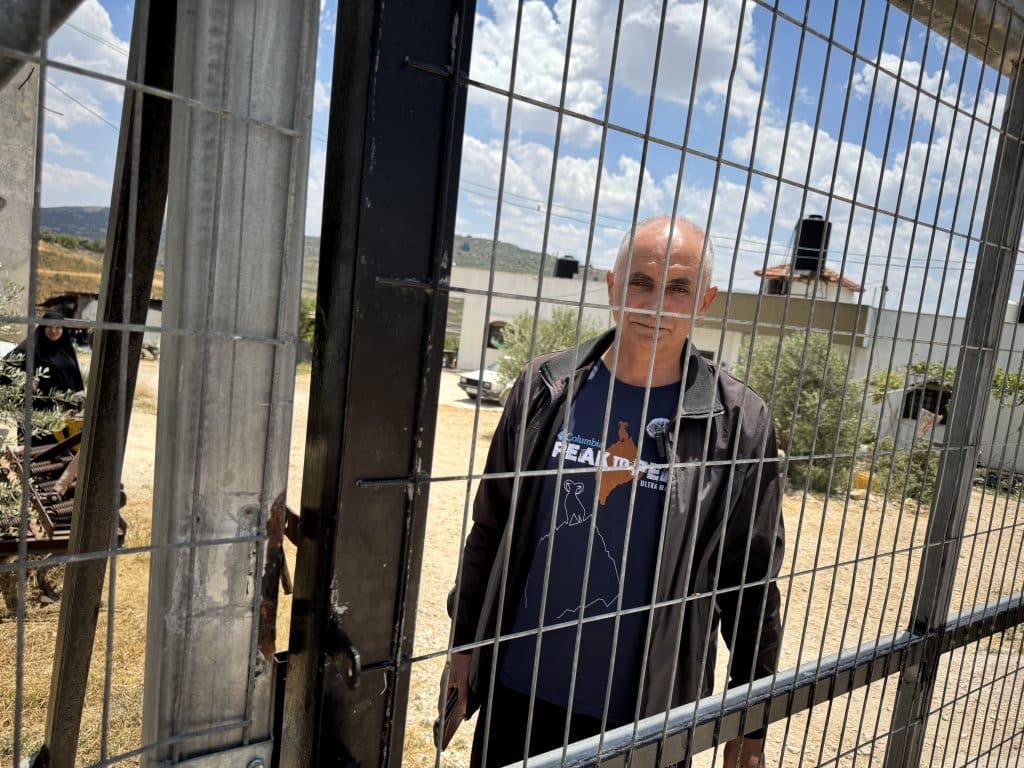
Bassam Ideis opens the large gate leading to his home’s courtyard in the Masoudiyya area of the northern West Bank to welcome his guests, staying by the entrance to shut it quickly behind him. Before walking away, he turns back after a few steps to check that it’s locked. Settler incursions from the new outpost erected on May 15 have increased of late. He checks the lock again, just to be sure.
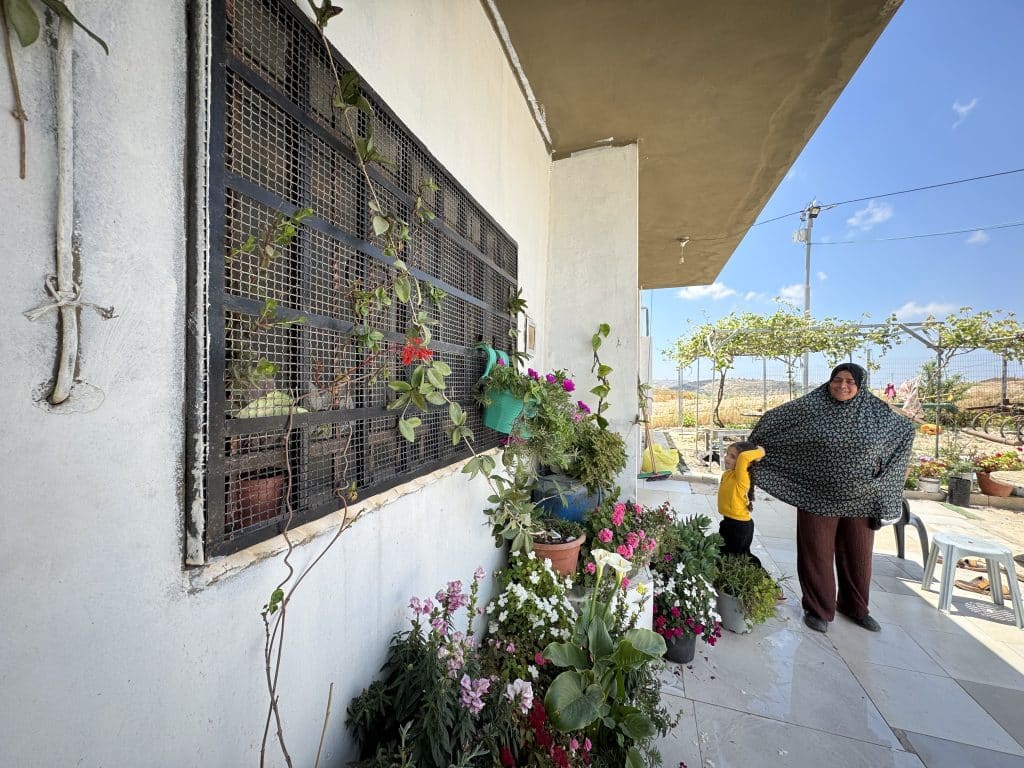
On either side of the gate, a long fence encircles the Ideis family home. Iron shutters have been placed over every window. Children rarely come out to play in the courtyard, and the entire property looks abandoned from the outside.
The neighborhood we are visiting is located on land belonging to the village of Burqa, three kilometers away northwest of Nablus. The Ideis family is one of 12 families that have turned their homes into small, semi-fortified compounds in the neighborhood, barricading themselves in their homes as a result of daily attacks from Israeli settlers. Residents of the neighborhood say these attacks have escalated since August 2023 and are aimed at displacing and expelling them from the area.
Masoudiyya sits at the choke point of settlement expansion on the main road connecting Nablus, Tulkarem, and Jenin. The outpost tent erected by settlers outside Masoudiyya is on the front lines of Israel’s effort to create a large settler presence in the heart of the northern West Bank. Israel has proposed a settler road connecting the formerly evacuated Israeli settlements around Nablus and Jenin with the rest of the West Bank’s settlement network — part of a broader “connectivity plan” put forward by the region’s Settler Council to serve 18 new prospective settlements. The road would run along the eastern edge of Masoudiyya.
Residents say the road is expected to confiscate 4,000 dunams (400 hectares) of land from Deir Sharaf, Burqa, Sebastia, Silat al-Dhaher, Bazariyya, al-Attara, and al-Funduqumiyya.
No choice but to remain
On May 20, 2026, the families of Masoudiyya survived a settler attack on their homes, which included live fire and attempted break-ins at several houses. It was the fourth time in less than a month that settlers had burned the wheat and barley crops in the Masoudiyya plain, and the message the settlers were sending was clear: the violence was not going to stop.
Life in Masoudiyya turned into a nightmare three years ago, when the Israeli Knesset ratified a decision to return to the settlement of Homesh, which Israel had built on Burqa’s lands in 1980 and later evacuated in 2007. The first attacks on Masoudiyya’s homes began in tandem with settlers streaming back into Homesh, located less than five kilometers away. “In August and September 2023, they launched violent attacks on us,” Ideis says. “They tried to burn our house and caused damage to our vehicles.”
Ideis glances at his four-year-old daughter, Yusra, who ran to him the moment he returned home. She is quiet and seems unaccustomed to visitors. “Yusra survived by a miracle,” he says, “but she had a severe panic attack, and still suffers from it to this day. Like us, she carefully watches for any settler presence around the house.”
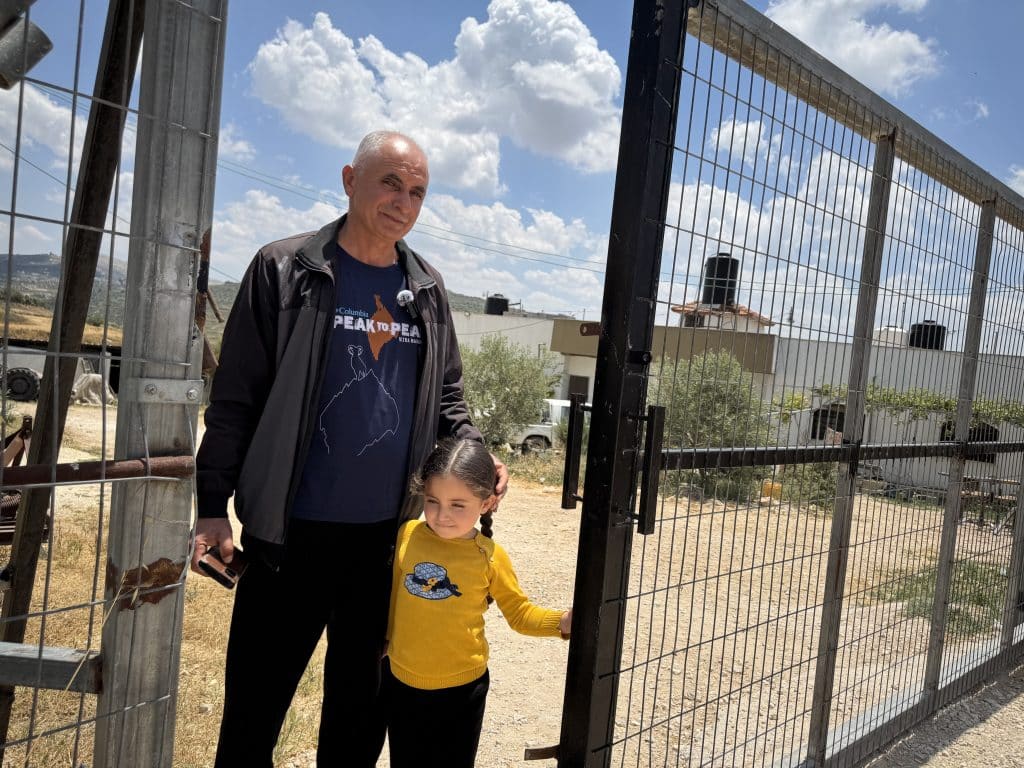
The family received us at midday. We sat drinking tea, and not much time had passed before a settlers’ drone appeared in the sky, surveilling the area and filming us. The Ideis family seemed used to it. Whenever they sit in their courtyard to receive the odd guest, the drones start hovering overhead, watching. “My family’s roots are from Hebron,” Bassam tells us. “In 1975, we moved here, bought five dunams, built our homes on the land, and farmed it.” He pauses. “We grew up here, and we will stay here on our land. Forever.”
Since Israel repealed the 2005 Disengagement Law in March 2023, legalizing the return to five settlements it had withdrawn from in the northern West Bank, Israeli settlers began setting up new outposts across the territory, including Homesh. Over the past two years, the settlers streaming back to Homesh have grown more aggressive, expanding further outward and besieging the surrounding Palestinian communities.
The Ideis family tells us they no longer distinguish between night and day and take shifts keeping watch around the clock. “We are forgotten. No one stands with us today,” Bassam Ideis tells Mondoweiss. “We face this with modest means. We call on the Palestinian Authority and its institutions to pay attention to us before it is too late. If we’re displaced from Masoudiyya, the settlers will take over.”
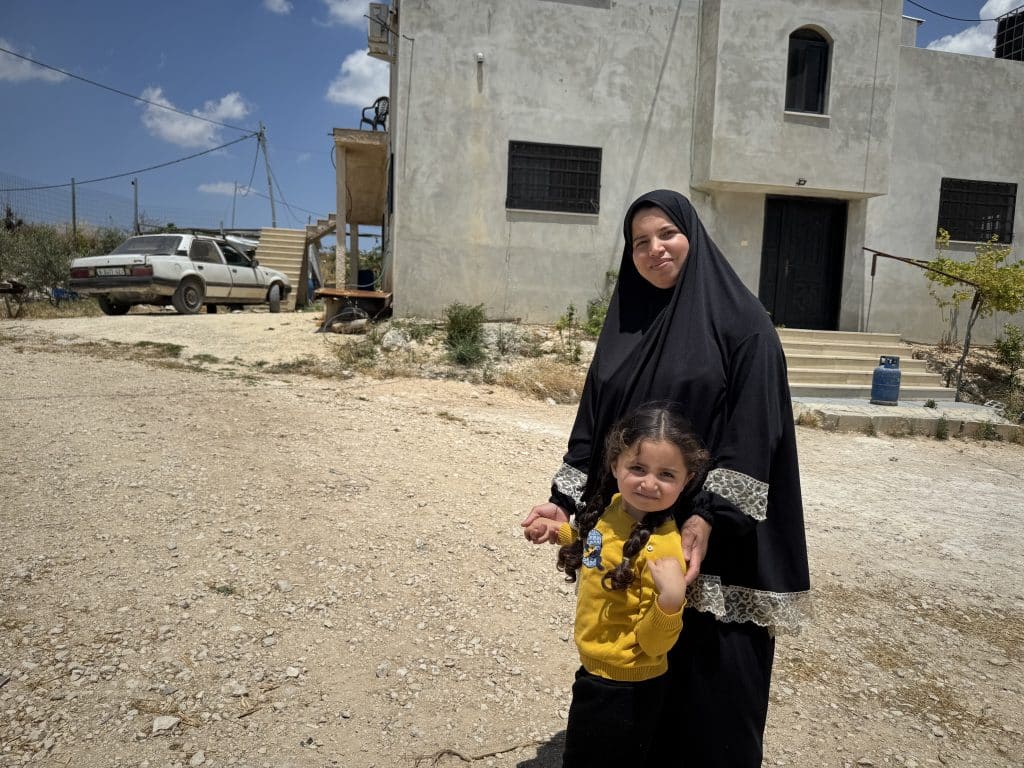
His wife, Hanan, does not hide her fear about their second child, due in a few months. She keeps Yusra in her sights at all times and thinks about what their future here might look like. “We used to live a normal life until the settlers moved closer to Masoudiyya,” she says. “Our safety and peace of mind have been taken from us ever since. We live in terror every single day.”
“But we have no choice but to remain steadfast in our homes and get used to this new life,” she adds. “The words sound noble, but really, who can actually leave their home?”
Erasing Oslo, one village at a time
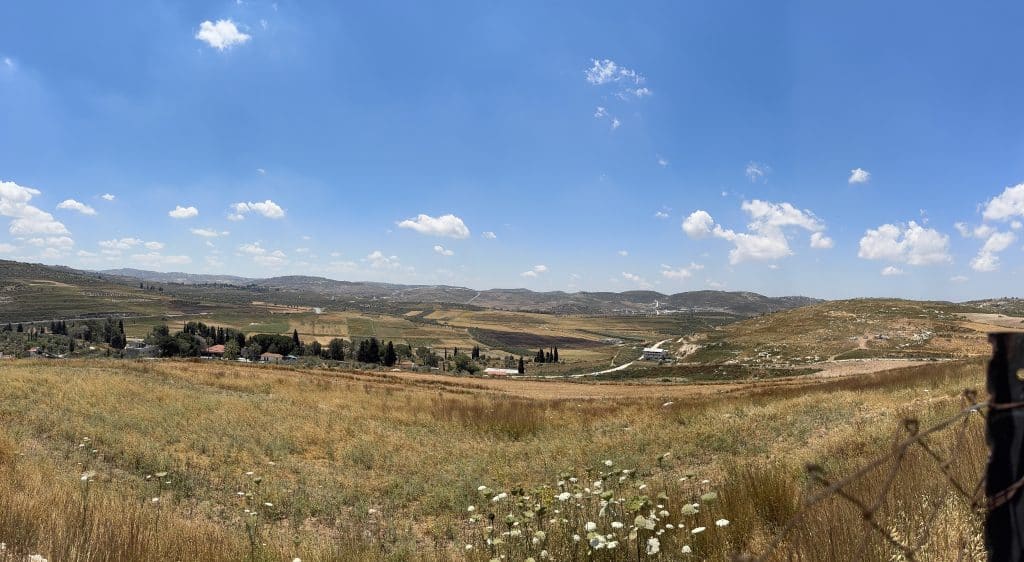
We stood on the hill of Masoudiyya, its wide plain stretching out before us, bordered by the villages of Burqa, Ramin, and Sebastia, northwest of Nablus. The plain looks like a giant chessboard divided into three colors: green fields recently planted, golden fields announcing the approaching wheat and barley harvest, and black fields where the settlers got there first, setting fire to the crops and leaving charred wastelands in their wake.
The Burqa neighborhood spans 12,000 dunams (1200 hectares), and its 75 Palestinian residents often call it “God’s paradise on earth.” It has long attracted attention for its strategic location and was historically an important hub for travel and movement.
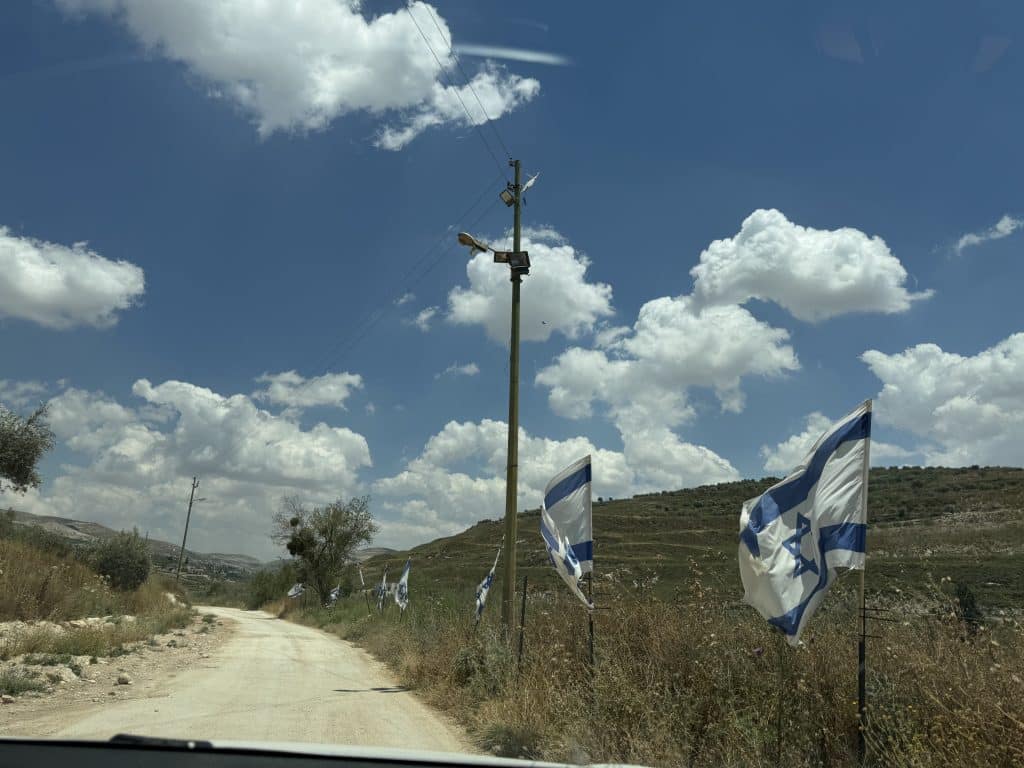
“The Ottomans built a train station here as part of the Hejaz Railway, a central hub connecting the northern and southern West Bank and transporting travelers to the Hejaz and Damascus,” Diab Hajja, a spokesperson for the residents of Masoudiyya, explains.
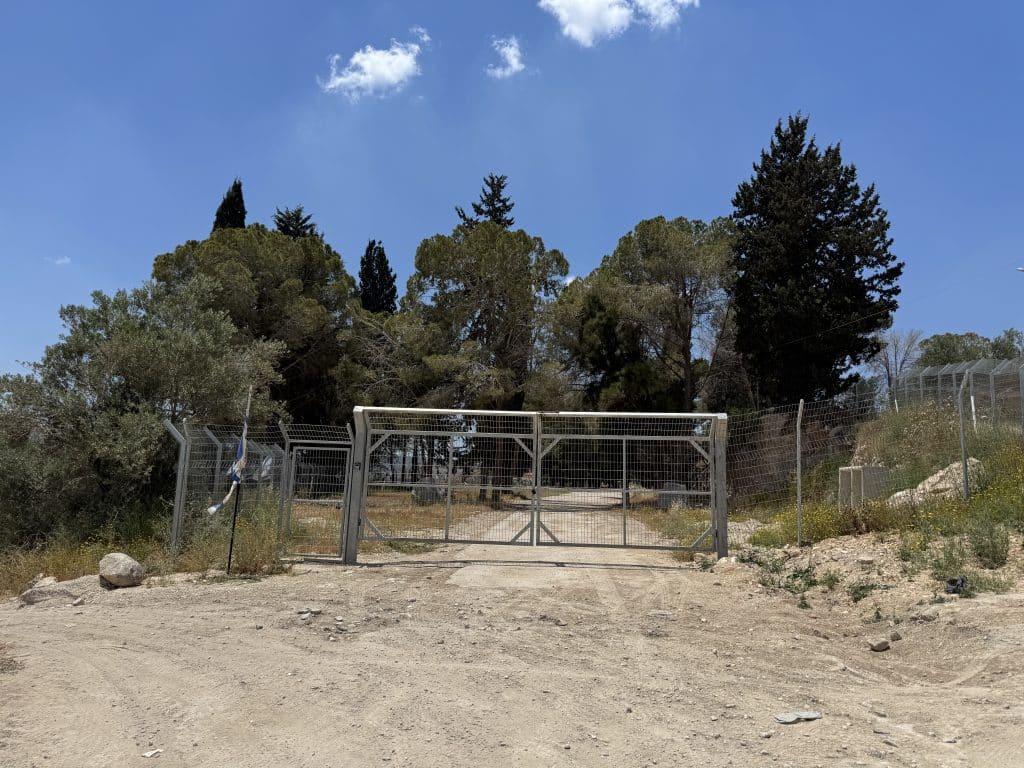
During our tour, we pass by the station’s remains. Settlers have fenced it off and planted Israeli flags along the road leading to it, barring Masoudiyya’s residents from entering, even though it sits right next to their homes and has always been a place where families congregated.
Diab explains that the Burqa municipality had begun a project to rehabilitate the archaeological site and turn it into a recreational space — replete with a children’s playground — to encourage Palestinians to assert their presence there. Today, settlers are blocking even Masoudiyya’s residents from approaching it.
The same pattern has played out at the Burqa National Park, which began construction in March 2025 on Masoudiyya’s lands. But the park faced continuous settler raids and attacks, and in April of that year, the Israeli army issued an order halting its construction.
Beneath Masoudiyya’s soil lies another resource settlers covet: the Masoudiyya Well, one of the West Bank’s most important water wells. The city of Nablus and the villages to its north have relied on it for years.
The well sits in Area B, the 22% of the West Bank under the joint control of the Palestinian Authority (PA) and the Israeli army, as per the 1993 Oslo Accords. But most of the land surrounding the well is classified as Area C, under the army’s direct administration, which accounts for about 60% of the West Bank. The remaining 18% of the territory is classified as Area A, ostensibly under the PA’s complete control, where the majority of Palestinians live in the territory’s main cities. Settlers today treat the area’s various Oslo classifications as a single territory to be absorbed by Israel and have already established an outpost on Area A lands in Masoudiyya.
Over the past several months, the Israeli government has also taken measures to abrogate these geographic demarcations and to encroach upon territories under PA control, building a military base in parts of Area A in Jenin last month and threatening properties in Area B across the West Bank. Settlers have also formed the spearhead of this effort, seeking to establish facts on the ground by seizing lands in these areas with the tacit support of the Israeli government. Masoudiyya is one of the front-line areas bearing the brunt of this assault.
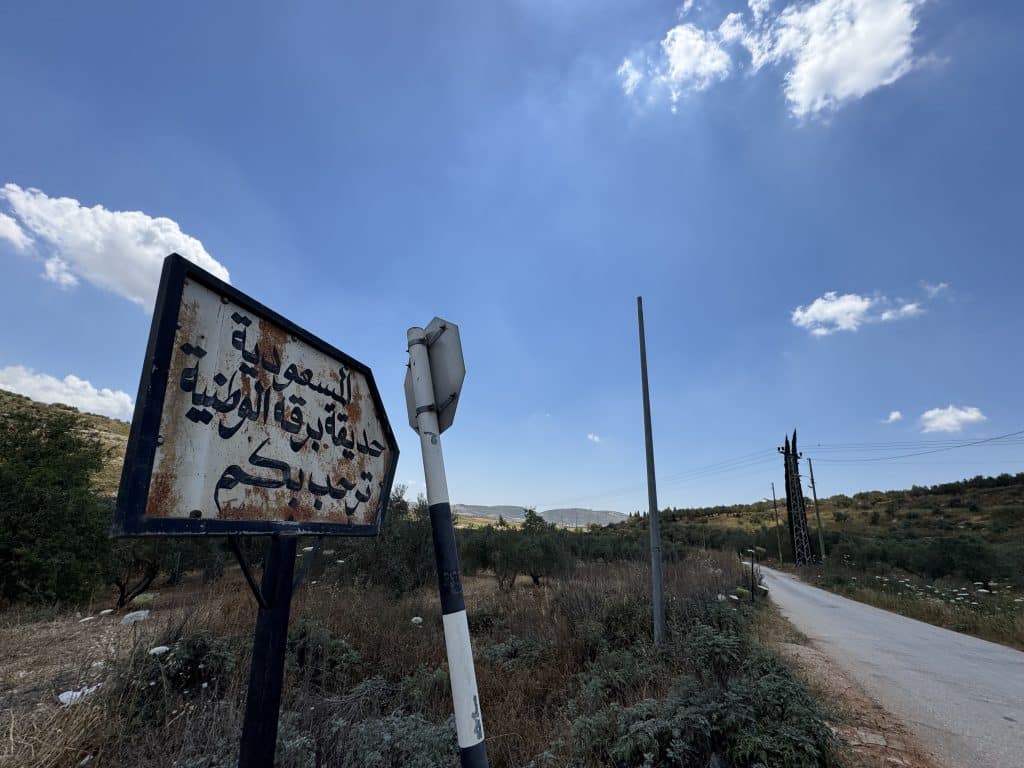
“The Masoudiyya Well is one of the largest under the Palestinian Authority’s control in terms of productive capacity,” Diab says. “It produces 400 cubic meters per hour.” The well has been targeted by settlers more than once, attempting to sabotage its infrastructure and burn the vehicle belonging to its guard.
Settler attacks have also hit the Wadi al-Shair Agricultural Association’s irrigation project, built at a cost of 13 million euros through a partnership between the Nablus municipality, the Ministry of Agriculture, and KfW, the German state-owned development and investment bank. The project serves around 300 Palestinian farmers across a 4,000-dunam (400 hectares) plain. “Settlers have attacked it more than once,” Diab says, “vandalizing the equipment and supply lines, and burning and destroying the crops.”
The guesthouse that never received a guest
We move carefully and quickly through Masoudiyya, conscious that a settler attack could come at any moment, as we arrive at Diab Hajja’s family compound. The collection of homes is fenced on all sides, with a large gate at the entrance. The fencing is how families try to slow settlers down and buy themselves a few extra seconds.
Diab stands at the gate to welcome us and begins recounting the attacks. His family’s story is the same as all the others. “For the past year and a half, every step we take outside our homes has been calculated,” he says. “We don’t leave except out of necessity. We take turns keeping watch.”
The Hajja family has lived in Masoudiyya since 2010 and has built four homes on their land in Area B, adjacent to the Ottoman-era station. “In March 2026, 25 settlers attacked our homes,” Diab continues. “They were all wearing masks and dressed in black, and they were carrying Molotov cocktails. They tried to reach our homes to set them on fire, but we came out and confronted them, stopping them from getting close.”
Like the other families here, the Hajjas have filed complaints with the Israeli police, but none of them has led anywhere. “The Israeli government sponsors and supports the settlers,” Diab explains. “The army and police always stand on their side.”
Today, the Hajja family fights to hold on to their land, and they rarely receive outside visitors — even though Diab once had a different dream. In 2024, he built a five-room guesthouse to host foreign visitors, naming it the “Sumud Hospitality House.”
“The goal was to give foreigners a chance to experience Palestinian life — to eat our food and share in our daily routines,” he says. “Because of the settler attacks and the closure of the area, I have not received a single guest yet. All I hope for is to welcome visitors one day soon.”
Shatha Hammad
Shatha Hammad is a Palestinian journalist specializing in in-depth features in the West Bank, where she has reported on the ground since 2011. She holds a BA in Journalism and Political Science and an MA in Contemporary Arab Studies from Birzeit University.
I live about two kilometres from one of the largest infrastructure projects in the UK: the point at which two major railway lines – HS2 and East-West Rail – cross. We have had old roads closed, new roads built, farms and houses compulsorily purchased (the owners receive full market value for their property) and every other sort of hassle you can think of.
BUT – we have rights, the country has laws, we have representation and consultative processes. Palestinians don’t even have the right to have rights.
More evidence of Israeli torture of Palestinian prisoners – Daily Update
July 9, 2026
“The photo “confirms what thousands of testimonies from Palestinian detainees have exposed, and what we and other organizations have been reporting for nearly three years now,” a spokesperson from PHRI said. “Israeli detention facilities are torture camps for Palestinians.”
*NOTE: Israeli torture of Palestinians has been widespread and well-documented since October 7th and long before – including torture of children. The Israeli NGO B’Tselem investigated allegations of torture in Israeli prisons and published their findings in a report called, Welcome to Hell: the Israeli Prison System as a Network of Torture Camps. Torture is a war crime.”
“The Israeli military has confirmed the authenticity of the photo, taken by an Israeli soldier, showing a Palestinian detainee bound to an iron rod. (Provided)”
https://israelpalestinenews.org/more-evidence-of-israeli-torture-of-palestinian-prisoners-daily-update/