The Palestinian refugee camps in the West Bank are at the center of the news again after the Israeli army launched a new, prolonged raid on the Qalandia refugee camp, which is located north of Jerusalem, and just outside of Ramallah. Late on Tuesday night, Israeli forces entered Qalandia after sealing it off and proceeded to arrest dozens of Palestinians and conduct field interrogations, while distributing leaflets threatening Palestinians with arrest if they take any action against Israeli forces.
In an earlier incursion at Qalandia this May, Israeli soldiers told residents to “pack your things and go to a European country,” and repeatedly invoked the name “Jenin” as they moved through the camp. Residents understood the reference to Jenin as a direct threat, given the annihilation of the Jenin refugee camp in the northern West Bank.
The current raid on Qalandia came days after Israel’s Defense Minister, Israel Katz, announced that he had instructed the army to occupy “another” refugee camp in the West Bank in a repeat of Israel’s occupation of three refugee camps in the northern West Bank in early 2025. At the time, the Israeli army displaced the entire population of Tulkarem and Nur Shams refugee camps in Tulkarem, and Jenin refugee camp in Jenin, representing at least 40,000 people. They were never allowed to return to their homes, and they still remain displaced to this day, many of them continuing to endure a humanitarian crisis.
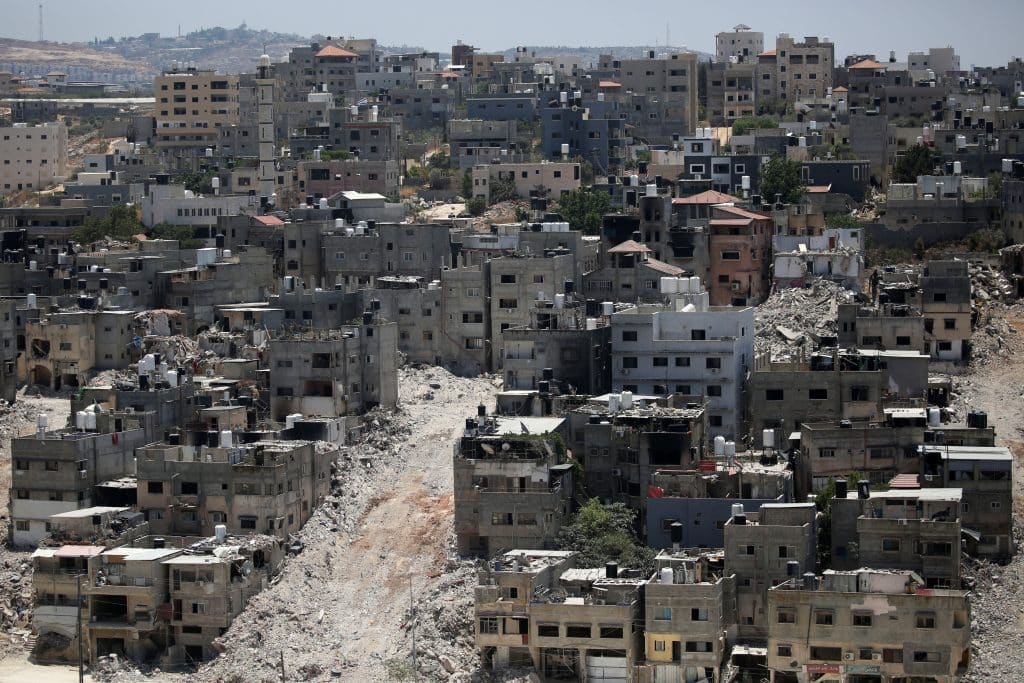
During Israel’s destruction of the camps, Israeli forces razed large portions of the residents’ homes, carving wide dirt roads into the heart of the built environment to supposedly create “safe roads” for Israeli forces to operate. In reality, it is not only part of Israel’s attempts to “re-engineer” the architecture of the camps, but to eliminate them as camps entirely, instead converting them into urban extensions of their neighboring cities and doing away with what they represent.
Since 2021, Jenin, Tulkarem, and Nur Shams refugee camps were hubs of local armed resistance groups, but a harsh Israeli crackdown on the groups culminated in the camps’ wholesale depopulation.
But the assault on these refugee camps carries implications beyond a crackdown on Palestinian resistance groups. The population that was displaced had already been refugees for seven decades, and their camps have had a major role in the history of Palestinian struggle, carrying a heavy symbolic value for Palestinians — and for Israel. It is this aspect of what the refugee camps represent that makes them an ongoing target across the entire West Bank.
Decades of resistance
All 19 Palestinian refugee camps in the West Bank were created between 1948 and 1950 to house Palestinians who had been forcibly displaced from their homes in what became Israel proper during the Nakba. The UN Relief and Works Agency (UNRWA) rented plots of land to establish the camps with 90-year contracts, making the UN the legal real estate rights holder in the camps, which were never expanded. For the masses of refugees who had lost everything, these camps became their only housing choice amid precarious living conditions, poverty, and overcrowdedness, to which the social stigma of being dispossessed was added.
At least since 2017, Israeli officials have been pushing for shutting down UNRWA, the UN agency in charge of Palestinian refugee camps. Benjamin Netanyahu has claimed that UNRWA perpetuates the Palestinian refugee problem, prolonging the conflict. In January 2025, as Israel was preparing for the invasion of the camps of Jenin, Nur Shams, and Tulkarem, its government ordered the UN agency to vacate its premises in Jerusalem, after banning it from the country by law.
In the late 1950s, the first Palestinian resistance groups began to emerge in the early refugee camps across the Middle East. In the West Bank, Palestinian armed resistance began to take shape following Israel’s occupation in 1967, centered in the refugee camps.
In the mid-1970s, the Jenin camp saw the emergence of one of the most influential groups in the West Bank: the Fatah-linked “Black Panthers,” a paramilitary group that became prominent during the First Intifada of 1987. It was in the refugee camp of Balata, outside of Nablus, where the first spark of the Intifada spread from Jabalia refugee camp in Gaza to the West Bank.
About a decade later, the Second Intifada of the early 2000s saw refugee camps becoming a stronghold for the armed wings of Palestinian factions, especially the camps of Balata and al-Ain in Nablus, the Tulkarem camp, and Jenin camp. The latter was the target of a 10-day Israeli siege and bombing campaign in 2002. One of Israel’s last raids on a Palestinian camp during the Second Intifada era was on al-Ain in 2008, which cracked down on Palestinian fighters long after the Intifada was over in most of the rest of the West Bank.
More than a militant stronghold
Over the years, resistance to Israel became a main feature of the collective identity of refugee camps, where Palestinians originating from different social backgrounds were forging new communities centered around the idea of dispossession and marginalization. Although it is the mass or armed groups’ resistance that made the West Bank refugee camps famous, it is something else that made the core of their identities, and which brewed conditions for a culture of resistance in the first place.
In March of last year, Mondoweiss interviewed Palestinian refugees who had been recently displaced from their homes in the Jenin camp. Halima, a woman in her sixties who was staying at a school-turned-shelter in Jenin city, explained the community bonds between the camp’s residents, as she described the moment when she left it.
Refugee camps formed a new brand of Palestinian community, where the cause of Palestinian dispossession was at the center of their collective identity. More specifically, it is the cause of Palestinian refugees and the memory of the 1948 Nakba.
“I couldn’t bear the sight of the destruction…It aches my heart, because everywhere in the camp is my home, and all the residents are like my family,” Halima said. “Several families of multiple generations lived in the same building, so our homes’ doors were always open to each other. If one of us lacked a certain ingredient to cook, a medicine, or anything else, they just walked into the next house and asked for what they needed. It’s just our way of life.”
“I grew up conscious of the fact that my family was displaced from Haifa, and this consciousness is a shared feature of our identity as refugees,” Halima went on. “Wherever we go, we carry it with us: being from the Jenin refugee camp means I share the fact of being born a refugee with everybody from the camp, and that binds us to one another wherever we go.”
In a way, refugee camps formed a new brand of Palestinian community, where the cause of Palestinian dispossession was at the center of their collective identity. More specifically, it is the cause of Palestinian refugees, and the memory of the 1948 Nakba.
“A refugee camp is a concentration of the unsolved aspect of the Palestinian cause,” Abdul Rahim Al-Shaikh, a professor of cultural studies at Birzeit University, told Mondoweiss. “Refugee camps were always marginalized places, always excluded from services, with high levels of poverty. This has always made refugee camps a reminder of the original dispossession of the Palestinian people, and made the camps themselves strongholds of resistance.”
This is why Israel’s offensive in the West Bank is focusing on refugee camps as it moves to “decisively” annex the territory and uproot any form of resistance in it. Not only because of the militant activity that the camps have generated for decades, but for what they represent: the living memory of Nakba, their collectivist social structures, a consciousness molded around dispossession — and the culture of resistance that they produce.
Qassam Muaddi
Qassam Muaddi is the Palestine Staff Writer for Mondoweiss. Follow him on Twitter/X at @QassaMMuaddi.