

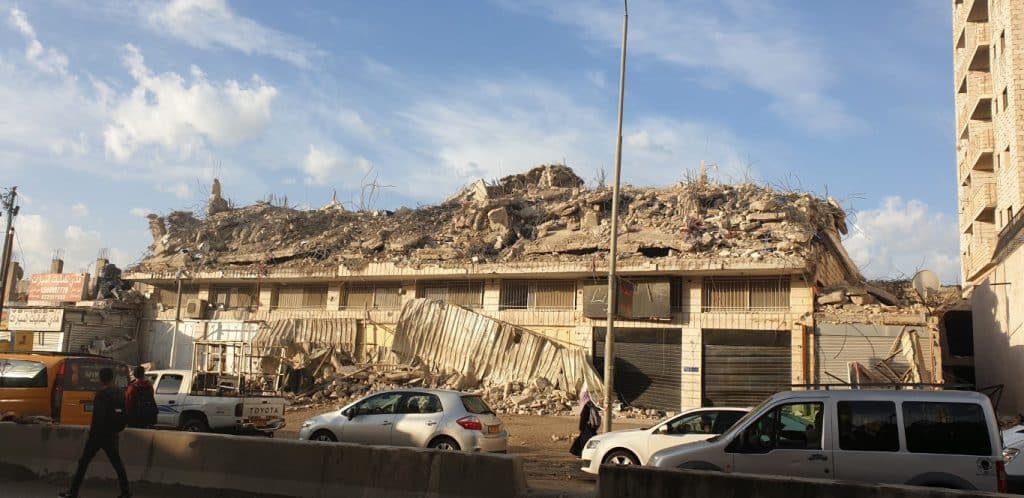
Iman Jahjouh was putting her daughters to bed when the soldiers came through the door early this week. A 33-year-old widow, Iman has been living in a house near her parents’ in the Qalandia refugee camp, close to the camp’s entrance and the airport road. She knows this makes her a target, since her husband’s family cut ties with her after his death.
Her two daughters, eight and ten years old, were still awake when the army raided the building during one of the recent incursions last Tuesday. What she remembers most is not the noise. “They came in and told my parents, word for word: ‘pack your things and go to a European country. This land is ours,’” she tells Mondoweiss.
Since that night, her older daughter asks every day whether they will have to leave the house. The younger one wakes in a panic at any sound from the street. “I started becoming afraid of the question itself,” Iman says. “Where would we even go?”
The threat her family received, alongside the practice of soldiers declaring residential houses a military command center and ordering their occupants out during incursions, has become one of the defining testimonies of a series of Israeli military incursions at Qalandia, just outside of Ramallah. Since January of this year, these invasions have escalated dramatically, and they follow a pattern that residents and analysts say cannot be separated from Israel’s expanding settlement ambitions in the area surrounding the old Qalandia airport.
The fear is not abstract. In January 2025, Israeli forces launched “Operation Iron Wall” in the northern West Bank, the longest military operation in the territory since the Second Intifada.
Beginning in Jenin, it expanded to Tulkarem, Nur Shams, and al-Fara’a refugee camps, forcibly displacing 40,000 Palestinian refugees over roughly three weeks.
The United Nations Relief and Works Agency for Palestine Refugees (UNRWA) warned at the time that repeated, destructive operations had rendered the northern camps “uninhabitable,” trapping residents in cycles of recurring displacement, and that “Jenin camp today is emptied of its residents”, a scene the agency said was “set to be repeated in other camps.”
These 40,000 former camp residents remain displaced to this day, with the prospect of returning to their homes indefinitely suspended. Meanwhile, they continue to live in squalid conditions amid what they describe as a humanitarian crisis.
This is not a distant memory, but a documented operation from months ago, that soldiers invoke when they stand in Qalandia doorways and tell families to find somewhere else to live.
Everyone knows what saying ‘Jenin’ means
Qalandia camp was established in 1949 to temporarily house Palestinians displaced during the Nakba. It sits at the geographic seam between Jerusalem and Ramallah, adjacent to the old airport and the military checkpoint, in a location that has grown in political and strategic weight. Israeli plans for development in the area surrounding the old airport, including settlement construction and infrastructure projects, have been accompanied over the past year by a wave of demolition orders and raids on homes and commercial properties in Kufr Aqab, Airport Street, and the camp’s surrounding areas.
Abu Nayel, 52, watched the last incursion from behind a window cracked by sound grenades.
“The problem isn’t just the raid,” he said. “We’ve gotten used to raids. This time, something is different. The soldiers were talking to people as if they actually wanted them to leave. They told some families that their houses have been turned into a temporary military command post. They asked them to leave immediately, and they waited in their relatives’ houses until the operation finished. But what if they didn’t leave?” He paused. “Since they started saying ‘Jenin’ every time, the fear has become greater than the bullets.”
“Just saying ‘Jenin’ is enough.”
resident of Qalandia refugee camp.
The invocation of what happened in Jenin, Tulkarem, and Nur Shams refugee camps — where Israeli operations resulted in mass displacement, extensive destruction, and months of military re-engineering in the camps — spread faster through Qalandia than any official statement.
A 24-year-old resident recalled the major incursion of Qalandia on the night of April 27. “We woke to violent pounding on doors before dawn,” he said. “We gathered the children in one room, away from the windows, and waited. Some heard mentions of Jenin. I personally didn’t hear an explicit order to leave, but just saying ‘Jenin’ is enough. Everyone knows what it means.”
“Where would we go? I was born here,” he added. “My father was born here. My grandfather arrived at this camp in 1948 after being expelled from his village. If I leave today, I would complete what they intended from the beginning. I won’t do it while I’m alive.”
The sequence of events on April 27 and then on May 11 — armored vehicles entering the camp before dawn, a complete closure of all entrances, systematic raids on dozens of homes, the conversion of some into temporary military positions, the arrest of more than 35 young men in the first wave, and warnings that residents say threatened a “fate similar to Jenin” — lasted roughly 18 hours.
On May 11, a young Palestinian man was killed by Israeli forces during a new incursion that lasted 24 hours, with ambulances prevented from reaching him. Israeli forces impose curfews during every operation.
Israeli authorities described the operations as “security activities” targeting armed groups and resistance infrastructure, following morning clashes, and have not addressed the specific claims about expulsion threats or the conversion of homes into command centers.
The Jerusalem Governorate, established by the Palestinian Authority (PA) in 1995 under the Oslo Accords as one of 16 PA governorates across the West Bank, called what is happening in Qalandia “a dangerous and unprecedented escalation.” Its governor, Adnan Ghaith, who has held the post since August 2018 and is appointed directly by the PA president, accused Israel of attempting to impose new realities through collective intimidation and warned of the forced displacement of Palestinian camps near Jerusalem. The governorate said Israeli forces had raided civilian homes, forcibly removed some families, and converted buildings into military field centers.
Imposing a new reality by force
Political analyst Imad Abu Awwad says the pattern cannot be read as a series of isolated security operations.
“Israel is no longer treating the camps only as security hotspots, but as environments that produce a coherent resistance identity that is difficult to contain,” he said.
The model applied in Jenin and Tulkarem, he argues, is about re-engineering the camp itself geographically, psychologically, and socially, “so that it becomes less capable of sustaining resistance and less attached to its nature as a political symbol of the right of return.”
In Jenin and Tulkarem, the Israeli army carried this out last year through extensive demolition operations. Residents of those camps previously told Mondoweiss that the Israeli “re-engineering” strategy is designed to “kill the idea of the refugee camp” — and the right of return attached to it.
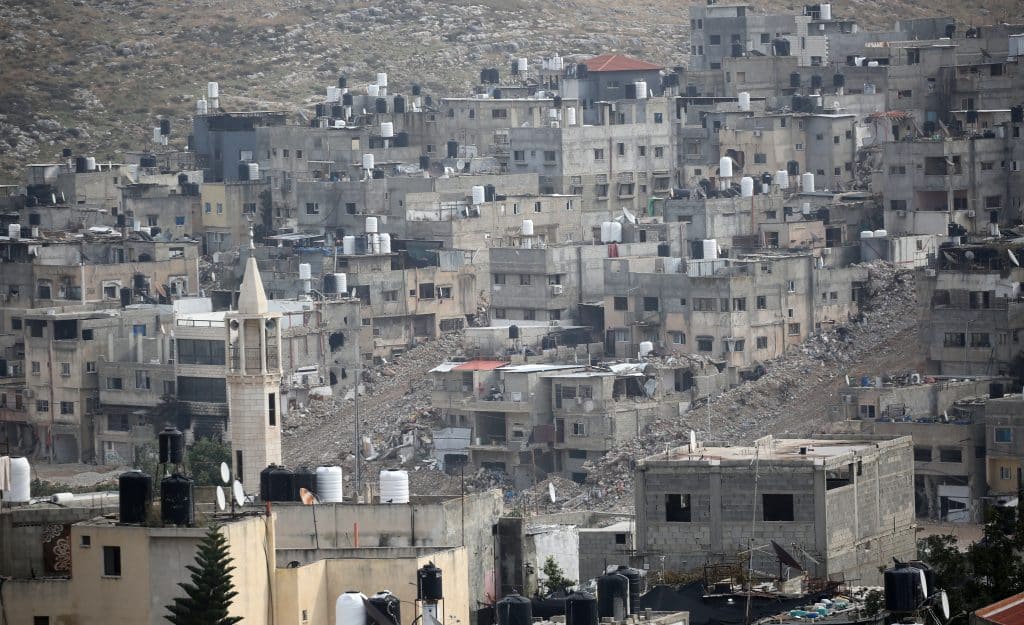
But Qalandia, Abu Awwad says, carries a doubled sensitivity: its proximity to Jerusalem, and its location adjacent to the settlement projects and strategic plans tied to the old airport.
“When we talk about Qalandia, we are not talking about a marginal camp. We are talking about an area Israel considers a key to reorganizing the geographic space north of Jerusalem.”
The sustained military and psychological pressure, he argues, may be part of a broader effort to weaken the social fabric and push people toward thinking about gradual departure, “even without an announced displacement decision.”
A member of the camp’s popular committee, who declined to be named for security reasons, put it plainly: “The occupation does not look at Qalandia only as a security file. It sees it as an area that must be reshaped demographically and geographically to serve settlement expansion around Jerusalem.”
“When homes are turned into military barracks, families are threatened with leaving, and entrances are sealed for hours, you are not just talking about pursuing fighters,” the popular committee member added. “You are talking about an attempt to impose a new reality by force.”
‘The children sleep in their clothes’
The humanitarian toll inside the camp has been accumulating in quieter ways: schools have partially shut down, shops have closed, medical teams report difficulty moving during nighttime raids due to checkpoints and closures, and residents describe repeated electricity and communications cuts and widespread property damage from violent search operations during the incursions.
A volunteer with a local organization said children are sleeping in their clothes in anticipation of nighttime raids, and some have stopped going to school since the siege began.
Ali Jahjouh,70, the head of Fatah’s popular committee in the camp and Iman’s father, whose home sits next to his daughter’s at the camp entrance, has been living under a standing demolition threat because of the building’s location.
He sat in his small house after the last raid and turned the questions over quietly: “What will we do if this continues and escalates? Where will we go? Where will we find ourselves in all of this?”
He has no money to rent elsewhere, no way to build again. His daughter, Iman, and her two girls are sleeping in the house nearby. “I just hope this day doesn’t come,” he said. “I hope I wake up and find the house is still standing. This time, they razed the Qalandiya cultural and crafts center and said they will build a military post there. We don’t know what they will do next time they come.”
For younger generations, displacement is not something that they want to live through, and a legacy they don’t want to continue after what their parents endured during the Nakba in 1948.
Muhammad Zahran, 26, married last year and built a small apartment on his father’s roof, under a hundred square meters of white brick as proof of something: that he had the right to be here, above the land his grandfather’s family was expelled from — Lyd — in 1948.
He refuses to have children yet. He says he is waiting to see what happens to Qalandia before he thinks about building a family in a place whose future feels suspended.
“The real fear,” he says, “is the fear of it actually happening. Of actually leaving”.
Iman, for her part, hides her fear from her daughters. She tells them things will be fine soon. She knows they won’t entirely believe her.
“I’m not afraid of what will happen to the house,” she says. “A house can be replaced. I’m afraid for the girls. I’m afraid they’ll grow up seeing all of this and thinking it’s normal”.
“We are already refugees,” she said. “Our families were displaced once. Today, we are afraid of being displaced again. Watching everything that happened in Jenin and Tulkarem, we know it’s not just a theory. It’s a real possibility.”
This story is produced in collaboration with Egab.
Aseel Mafarjeh
Aseel Mafarjeh is a West Bank-focused journalist, focusing on stories that speak of the challenges and creativity of youth in Palestine.
Re the attempts to erase Palestinian life from Eretz Israel this is right on topic:
https://www.newyorker.com/science/medical-dispatch/how-a-new-israeli-policy-cuts-off-humanitarian-aid-in-gaza
“How a New Israeli Policy Cuts Off Humanitarian Aid in Gaza…months into the ceasefire, Israeli officials barred thirty-seven international N.G.O’s. A Doctors Without Borders clinic is carrying on without antibiotics, or even chairs for patients.”
The New Yorker is one of the best sources of information around; they have an entire fact-checking department and every sentence of every article – literally – has to meet its standards.
Then, just before New Year’s, the Israeli government released a statement. It had previously instructed all international humanitarian organizations that operated in Gaza to submit detailed information to maintain their registration, including financial statements, the identities of all donors, and a full list of employees, with passport numbers, dates of birth, and, for Palestinians, the names of spouses and children. Organizations that refused would be expelled. “We were briefed on the issue,” Hulse said. “It was really hard to believe it was actually happening.” Thirty-seven organizations—including M.S.F., the International Rescue Committee, the Norwegian Refugee Council (N.R.C.), and Action Against Hunger—received notice that they had failed to comply and would no longer be allowed in Gaza, the West Bank, or East Jerusalem. They were given sixty days to cease operations and withdraw all international staff….Many N.G.O.s have raised concerns that lists of their employees could be used to target their Palestinian staffers. More than five hundred aid workers, including fifteen M.S.F. employees, have been killed in Gaza since October 7, 2023. (The Israeli military has said that it does not target medical personnel.) Filipe Ribeiro, a head of mission for the organization, told me that M.S.F. asked for safety assurances from a committee headed by the Ministry of Diaspora Affairs. “We asked repeatedly, ‘What will you do with this list? How can we be sure it won’t be used to harm our staff?’ ” he told me. “We never received an answer.”
Expelling the refugees that were expelled. A very rare inhuma pattern. I’m even struggling to find similar cases. Maybe commenters can help.
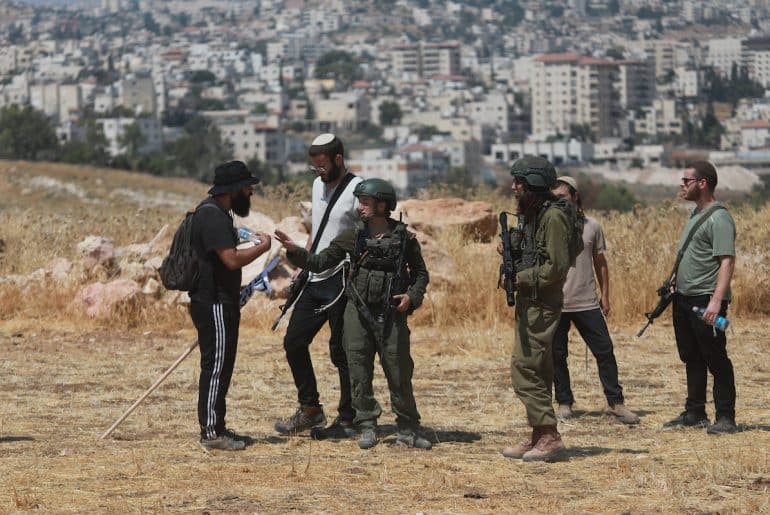
They Fled To Safety In Palestinian Territory, Then Settlers Attacked Again...Violent settlers ae not merely clearing Palestinians from land under Israeli control, they are attacking areas where Israel agreed to Palestinian self-governance…Settler violence has grown commonplace in the West Bank in recent years, part of a campaign of harassment, abuse and forced displacement. Since Israel captured the West Bank in the 1967 Middle East war, more than 700,000 Israelis have settled in the West Bank among more than three million Palestinians….Since the Hamas-led Oct. 7, 2023, attack on Israel, violent settlers, emboldened by a right-wing government, have forced thousands of Palestinians from their homes, according to the U.N. Office for the Coordination of Humanitarian Affairs. The Palestinians are forbidden from carrying weapons, while the settlers are often heavily armed….
https://www.nytimes.com/2026/05/16/world/middleeast/settler-attacks-palestinians-west-bank.html
Instead of sending billions in 2-thousand pound bombs, fighter jets, flesh-burning white phosphorus and killer drones, please send battalions of psychiatrists to Israel. What one is witnessing is abnormal. I don’t mean to be flippant or disrespectful, but what one has been seeing in thousands of videos and first-hand accounts is so deviant, so cruel. I wish I hadn’t seen the videos of Israeli cruelties that I can’t get out of my head. It is profoundly disturbing.
This genocidal, brainwashed and wholly propagandizes population—inckuding its shills in the West—need psychiatric help. Every survey shows overwhelming support by Jewish Israelis for what the IDF has done. In what universe is it normal for New York Zionists to protests in front of the NYT for Israel’s right to rape??? They know the story is factual; it’s just that they don’t consider Palestinians human and so anything goes.
Mafarjeh has been laying out the challenges MW faces.