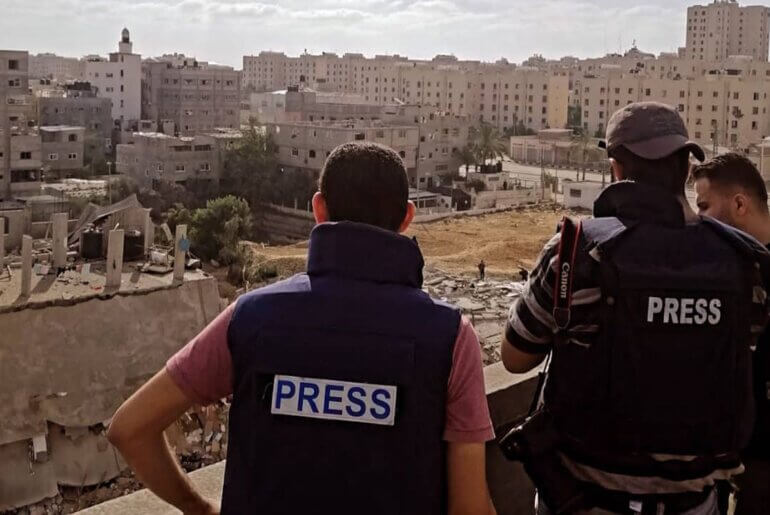
Muhammad Hussein Rahal’s home in Jenin, in the occupied West Bank, has been seized and slated for demolition by the Israeli army, along with two neighboring houses.
But the seizure of Rahal’s home is unlike other Israeli demolitions of Palestinian homes, which are commonplace across the West Bank. Rahal’s home is being destroyed to build an Israeli military base — possibly the first ever built on land under Palestinian Authority (PA) control.
Rahal’s home sits in Area A, the small portion of the West Bank that technically falls under the PA’s full control — an area that for decades has been regarded as the “safest” place in the West Bank for Palestinians to build a home. The Israeli army’s seizure of Rahal’s home marks what appears to be the first time since the signing of the Oslo Accords in 1993 that Israel has seized land in Area A for military purposes. Palestinians say the move not only proves the Oslo Accords are truly dead but also shows that Israel’s plans to annex the West Bank are moving ahead at full steam.
For the past week, Rahal, better known as Abu Faris, had been sitting on a chair in front of his door in al-Jabriyat, a neighborhood in the northern West Bank city of Jenin, waiting.
“Every time an Israeli military vehicle passed by, I thought they had come to execute the order,” he said. “There is nothing harder than being asked to hand over your home.” He was right to wait.
On Monday, June 15, the soldiers came, and he was forced to leave. When he asked whether the seizure was only until August 23, as he had earlier been told, their answer was blunt: “No return.” He has since made his way to Jenin, where his sister lives.
Until recently, Abu Faris thought his home was protected given that it sat within PA-controlled territory, which has been relatively safe from Israeli encroachment since 1993.
That assumption is now gone.
Legal documents obtained by Haaretz reveal that on May 7, 2026, Israel’s Central Command signed an order to seize land near Jenin refugee camp and build a permanent military base inside Area A. The Association for Civil Rights in Israel (ACRI), which filed a petition against the move, called it one of the most significant violations of the Oslo framework ever.
The Oslo Accords were the series of agreements signed between Israel and the Palestine Liberation Organization (PLO) that led to the creation of the PA, which served as an administrative body intended to mark the beginning of Palestinian self-governance in lieu of full statehood. The Oslo framework would, in theory, give the PA full administrative and security control over approximately 18% of the West Bank (Area A). In another 22% of the territory (known as Area B), both Israel and the PA would have joint control. The remaining 60% is classified as Area C, where Israel enjoys full administrative and security control.
Last week marked what seems to be the first time that the type of Israeli expansionism usually reserved for Area C extended to PA-controlled territory in Area A, signaling that Israel’s annexation plans in the West Bank are moving forward.
Until now, Israel’s settlement expansion and land seizures had been concentrated in Area C, which it carried out through a variety of legal and administrative measures meant to establish Israel’s de facto annexation of the territory. Moving into Area A, however, marks a shift from encirclement to penetration: no longer merely surrounding Palestinian population centers, but entering them. If it becomes a precedent, it would further the oft-repeated goal of hardline Israeli Finance Minister Bezalel Smotrich to “bury” a Palestinian state by rendering Palestinian land geographically non-contiguous and administratively incoherent. It would mean that the West Bank has been all but annexed to Israel, and that the Oslo Accords are effectively over.
UN Special Rapporteur Francesca Albanese has warned that such measures represent “deliberate, incremental steps toward permanent annexation, advanced piece by piece, in broad daylight, and with total impunity.”
Until recently, any investment in developing property in Area A was considered a safe bet. That was why Abu Faris poured all his money into building his current home, thinking his property would be beyond Israel’s reach.
His previous home was demolished in Jenin refugee camp, part of a wave of destruction that razed dozens of houses during Israel’s Operation Iron Wall, which launched in January 2025. He needed somewhere safe.
“I decided then to invest my UN retirement money in buying land and preparing the house modestly,” he said. “During the last three months, we worked day and night. During Ramadan, we would start after suhoor and continue after iftar until we finished the tiles and painting.”
It was not the first time soldiers had come to the door. A week earlier, Israeli soldiers had arrived at the house.
“They asked me if the house was mine. I said yes, and they said they would seize it under a military order,” Abu Faris said. “They said they had been watching me work on it every day.”
“The officer asked me if I was angry. I told him, ‘How can I not be angry when you’re expelling me from my new home and ordering me to evacuate in only ten minutes?’”
According to Abu Faris, the officer made a phone call and got the evacuation postponed. The soldiers said they would come back to seize the house, and then return it to him on August 23, but offered no guarantees.
“Until now, I don’t know where I’ll go,” he said at the time, in a tired voice. “My brothers suggested I stay with them, and others say to return to displacement housing,” referring to temporary housing he took up at the Arab American University after his previous home was demolished — along with hundreds of other displaced families from Jenin camp.
Recently, Israeli soldiers have been patrolling his area, putting the neighborhood on edge. “The fear has reached the point that my brothers didn’t dare visit me during Eid,” said Abu Faris.
Israeli encroachment on Area A comes amid the largest wave of forced displacement in the West Bank since 1967, according to UN data. Over 40,000 Palestinians have been displaced from Jenin, Tulkarem, and Nur Shams refugee camps, according to UNRWA and Israeli Defense Minister Israel Katz.
Issa Zboun, director of the Geographic Information Systems Department at the Applied Research Institute–Jerusalem (ARIJ), told Mondoweiss that this military order is “the culmination of the settlement policy pursued by the Israeli occupation in the West Bank against Palestinian citizens and Palestinian land.”
He added: “Several orders have been issued to confiscate land and demolish houses in areas administratively belonging to the Palestinian Authority, including in Area B.”
The goal is “to change the features of the land, impose facts on the ground, and entrench the idea of not establishing a geographically contiguous Palestinian state in the West Bank,” said Zboun.
He said that the PA “does not have sufficient tools to confront this fierce attack, because the regional situation overshadows the Palestinian issue, and the Israeli occupation exploits this opportunity.”
Zboun said that the Oslo Accords have been “practically finished on the ground for a long time,” pointing to “continued incursions inside Area A, and central cities like Ramallah, even near the Palestinian president’s residence.”
“Official Israeli statements, including those by Itamar Ben-Gvir — who declared Oslo is dead — reflect open calls to end the Palestinian Authority and cancel Oslo and the A, B, C classifications. These are blatant violations of the Oslo Accords, which appear to have expired,” he said.
Area A no longer safe
Mansour Kabha also received an order to evacuate his house, located in the Jabriyat area, adjacent to the Jenin refugee camp.
“The Israeli army came on site and notified me of a decision to confiscate the land until August 31, 2028, for military purposes, according to the order I received,” said Kabha.
“I’ve built a house at a cost of approximately 700,000 shekels (around $240,000), and if the camp is established next to it, my family’s entire life will be affected, especially my daughters, who commute daily for study and work.”
Kabha and his neighbors worry that new security procedures will make movement and transportation more difficult if the area is surrounded by a military camp.
The decision he received called for the confiscation of about 7 dunams (7,000 square meters) owned by 10 people.
Among the owners are his sister and brother. The plots are officially registered with legal ownership deeds (known as kushans), he said, and they are located within Area A under the PA. They have owned the land for about twenty years.
“We went to the Palestinian Authority, and were told that the issue is political and that the Authority would follow up, and we were asked not to take any individual actions. About a month and a half has passed since then.”
Recently, the army came to two houses in the area and told the residents they would need to evacuate for two months. The homeowners were asked to empty their personal belongings, and soldiers would come take over the houses. They were also told they must stay in the house until the army arrives to photograph it and receive the keys.
“Currently, there are approximately 5,000 people in the area, and about thirty houses, and a military camp is scheduled to be established in the middle of this residential community,” he said, “Construction of the camp is expected to begin next week.”
“This is residential land that people bought specifically because it is located within Palestinian Authority areas and has a clear legal status. All plots are licensed and officially registered. Our houses are the result of long years of work and savings, and we pay taxes to the Authority,” Kabha said.
‘The Authority asked us to wait’
Hassan Brijiyeh, a researcher with the Wall and Settlement Resistance Commission, a group that works under the PA, said, “The Oslo framework is an international agreement, and no one can cancel it.” Though in practice, the Israeli side is trying to dismantle it,” he said.
“Israeli Occupation doesn’t care about Area A, or B, or C,” he said. “It considers all Palestinian land part of Judea and Samaria,” referring to the name Israel associates with the entire West Bank, which has been occupied since 1967, but excludes East Jerusalem.
Brijiyeh stressed that international law establishes Palestinian ownership of the land, pointing to two rulings by the International Court of Justice: a 2004 ruling which found it illegal for Israel to construct a separation wall in the occupied territories, and a 2024 ruling which declared Israel’s entire occupation unlawful and its settlement construction illegal, including in East Jerusalem. A 1973 UN Security Council resolution designates the entire West Bank as Palestinian land, he added.
On the ground, the reality is different. “Step by step, Israel is fragmenting the land and establishing control with strong support from the United States,” said Brijiyeh.
Everything has happened so fast.
In May, Israeli soldiers began gathering behind his house, Abu Faris said. They came with surveyors, spending hours photographing and drawing up plans. When he told neighbors, they said nothing would happen, because it’s Area A. The visits continued, three times a week. His house was seized only one week later.
“During the soldiers’ visits, some rumors began accusing landowners of selling their land, but we know them well, and they are respectable people who have all the legal papers proving their ownership,” said Abu Faris.
The landowners considered hiring a lawyer, but the PA asked them not to. According to Abu Faris, the PA said it was a political issue and that it would follow up, since it oversees affairs in Area A.
Kabha, whose 700,000-shekel investment now sits in the shadow of a future military camp, faces an impossible choice: stay and live under military surveillance, or leave and lose everything.
“We bought this land because it was Area A,” he said. “We paid our taxes. We followed the rules. And now the Authority tells us it’s a political issue and we should wait.”
This article is published in collaboration with Egab.
Asmaa al-Masalmeh
Asmaa al-Masalmeh is a Palestinian data journalist from the West Bank with a background spanning print, radio, and television, and experience managing social media platforms. Her bylines include The New Arab and ARIJ.