

Skeptical ‘Washington Post’ report on teargassing death is written by reporter said to have served in Israeli army

Jonathan Cook shares my interest in confused-nationalities in correspondents for major American papers:

A recent predecessor of [Ethan] Bronner’s, Joel Greenberg, did reserve duty in the Israeli army while he was reporting for the paper, apparently a fact known by the editors but also not considered a conflict of interest.

Alison Weir says that this fact on Greenberg comes from the Jewish Week, and he was bureau chief for the Times at the time.

Well here's Joel Greenberg, writing for the Washington Post as a "special correspondent" on the Jawaher Abu Rahmah killing. The thrust of the piece is that the claimed cause of death is questionable. First two sentences and last one:

The Israeli army, which had questioned reports by Palestinian witnesses and doctors that tear gas led to the death of a woman after a protest against Israel's separation barrier in the West Bank on Friday, said Wednesday that it is still conducting its own inquiry into the death and will make an announcement after its completion.

Military officials, speaking on the condition of anonymity due to the sensitivity of the issue, had earlier suggested that an existing medical condition might have contributed to 36-year-old Jawaher Abu Rahma's death. ..

The army said the Palestinian medical reports "raise many questions and doubts," and it described Palestinian cooperation in investigating the incident as "poor."

About Philip Weiss

Philip Weiss is Founder and Co-Editor of Mondoweiss.net.
Posted in Israel/Palestine

{ 14 comments... read them below or add one }

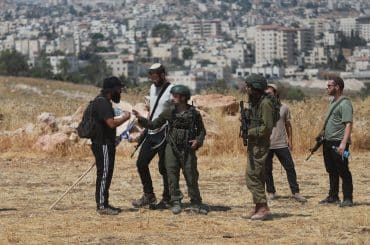
  1. Thanks Phil. Also interesting in the Greenberg story you link to in the Post is their choice of accompanying photo, which shows Palestinian protestors hurling tear gas canisters back at the soldiers in Bil’in. The photo serves simultaneously to minimize the dangers of the tear gas (“look, the protestors easily just toss the stuff back”), and exaggerate and distort the contribution of protestor “violence” in Bil’in.

    • RE: “their choice of accompanying photo, which shows Palestinian protestors hurling tear gas canisters back at the soldiers in Bil’in” – Bill in Maryland
      MY COMMENT: They might look like Palestinian protestors hurling tear gas canisters, but you never really know for certain!

      FROM HAARETZ, 09/24/10:

      (excerpt)…The IDF has admitted in court in the past that mistaravim [IDF soldiers posing as Palestinian protesters] sometimes joined the rock throwers. They say they did so in order not to blow their cover. No exposure could be greater. For who can distinguish the pretend Palestinian rock-throwers from all the actual Palestinians who wish to make their voices heard – and say who is really interested in throwing rocks. Disguises are always deceiving, dependent on context. If rock-throwing is absolutely reprehensible, then joining in is just as reprehensible..

      SOURCE – link to haaretz.com

  2. annie says:

    Military officials…. suggested that an existing medical condition might have contributed to 36-year-old Jawaher Abu Rahma’s death. .. the Palestinian medical reports “raise many questions and doubts,” and it described Palestinian cooperation in investigating the incident as “poor.”

    this is the intended effect of the ‘throw everything against the wall and see what sticks agenda’ repeatedly used by the goi. also i do recall an iof spokesperson quoted the other day (paraphrasing) “this investigation is unusual because we usually do not rely on palestinian sources”. so frankly i would like to hear the framing of the q&a “poor” quote.

    wapo has passed the highwater mark for reliable uber msm lying hasbara. after memories have faded about Jawaher’s murder these articles will be linked to in years to come to ‘prove’ ‘we really do not know what happened’.

    luckily the majority of us will remember, we’re in for the long haul.

    free palestine.

  3. clenchner says:

    Serving in the Israeli army is simply not a predictor of political or journalistic bias. If it is – then military service anywhere, for any army, would be grounds for a similar accusation. Should U.S. journalists covering the Afghan conflict be vetted to exclude vets?
    I served in the Israeli army. I’m a peace activist and former refusenik. Were I a journalist for a U.S. publication, who would come after me?
    By the same token – should we go after all the Palestinian stringers and journalists in the West Bank and Gaza who have any sort of past with one of the armed factions? Of course not.
    I wonder what Veterans for Peace members would say about this, or Combatants for Peace, or Yesh Gvul.
    (This particular journalist might be flawed because of his work; that’s a conversation with merit.)

    • Chaos4700 says:

      You don’t think it looks bad for a US newspaper to, for the most part, employ almost exclusively former IDF military personnel and in turn have those military personnel repeat falsified information as press-released by the IDF itself, insisting that a Palestinian struck by a tear gas grenade probably died of natural causes?

    • pronomad says:

      You’re an Israeli, serving in your national military, in a country with mandatory conscription. Service in the US military is voluntary, and these days American journalists generally don’t hide their service; if anything, they will slip it in if they can as a means of enhancing their credibility.

      Of course military service is not a predictor of bias; however, given that this country has been at war for over a decade now in the ME and elsewhere in the Muslim world, I for one would like to know which ME reporters have volunteered to serve in the Israeli military, why they chose the IDF over the US military, and why they think that this fact should be concealed from readers. Would WaPo/NYT editors give a similar pass to Iran correspondents downplaying Iran’s “quest” for a nuclear bomb who had served in the Revolutionary Guards?

      I would not automatically discredit someone’s ME opinion or writings because of service in the IDF, but it sure raises a red flag if they hide it from me.

    • Duscany says:

      Any American who served in the Afghan army is not a credible source for news about Afghanistan. By the same token, any American who joins the Israeli army is obviously biased toward Israel. If he wasn’t, he would have joined the US Marines instead. People who have a pro-Israel bias have no right to represent themselves as credible news sources when it comes to Israel.

    • Tuyzentfloot says:

      clenchner, I think that’s a straw man. Philip’s focus in the article is on the bias aspect but there is no cause and effect relation.

      excerpt from Cook’s piece

      But, more significantly, the NYT’s partisanship on Israel is not simply speculation; it is demonstrated in its reporting. Alison Weir of If Americans Knew, a U.S. institute for disseminating information about the Middle East, has pointed out the systematic distortions in the paper’s coverage. For example, international reports on Israel’s human right abuses are covered at a rate 19 times lower than those documenting abuses by Palestinians, and deaths of Israeli children are seven times more likely to be reported than those of Palestinian children. The Times, like other U.S. media, reports endlessly on the plight of Gilad Shalit, an Israeli soldier held in Gaza, while rarely mentioning the 7,000 or so Palestinians—including many women and children, and hundreds who have never been charged—held in Israel’s prisons.

      Keller goes on to comment about Bronner’s connections to Israel: “How those connections affect his innermost feelings about the country and its conflicts, I don’t know. I suspect they supply a measure of sophistication about Israel and its adversaries that someone with no connections would lack.” If true, why would the NYT not also want to make sure that it employed a Palestinian or an Arab-American in one of its two Jerusalem posts, or even have one of its two reporters based in the West Bank city of Ramallah? Would that not ensure that the Palestinian perspective was reported with an equal “measure of sophistication”?

      But there exist more significant reasons why the media might prefer Jewish reporters in Jerusalem. One is that Israel defines even mild criticism of its policies as anti-Semitism, a charge to which the news media are still extremely sensitive. Having a Jewish journalist, or better still one who has demonstrated a commitment to Israel through his own or his child’s army service, offers some immunity from such accusations.

      Another reason is the importance accorded by all news organizations to gaining access to the centers of power. In a self-declared Jewish state, as news editors understand, Jewish reporters, especially those conversant in Hebrew, will have an important advantage. This is what Keller is obliquely referring to when he talks of Jewish reporters covering the conflict with “sophistication” and being able to make “connections.” Keller, like other U.S. editors, is not overly concerned that such connections come at a very high price. U.S. news media are choosing to employ partisan reporters who are dependent on official Israeli sources of information for news in a system where the ultimate professional sin is to be accused of anti-Semitism.

      This is hardly an atmosphere in which fearless independence and truth-seeking are likely to flourish.

    • sherbrsi says:

      Serving in the Israeli army is simply not a predictor of political or journalistic bias.

      It definitely does pose a conflict of interest, in which case the author’s work has to be thoroughly checked for bias and then re-evaluated to see if his political and past affiliation with groups and interests he is now directly reporting on are unaffected by such connections. Theoretically, his IDF connection would raise an investigation on the bias of his reporting or at the very least be a point of concern for the newspaper, and in the interests of fairness Greenberg should inform the readers himself of this involvement. Practically, do you think that a former Hamas member would ever be allowed to report on any part of the conflict, let alone those involving Hamas?

      A snake oil salesman cannot run his business for 5 years and then assume a position as a health columnist in a newspaper and peddle his products to unsuspecting readers as the miracle cure. Obviously
      he has his own agenda to sell, which is all too frequent when we see ex-IDF staff reporting on matters involving the IDF.

      Greenberg’s biased report simply confirms the pattern, but of course nothing will be done about it as Jewish or not, IDF service or not, WaPo and other high-name newspapers are in the business of selling Zionism and Israel favorably. The spin will always be there.

  4. Chaos4700 says:

    You know, when they did this to help cover up Furkan Doğan, that technically made these self-styled “journalists” treasonous for conspiring to aid in a direct threat to the safety of American citizens abroad.

  5. naomip says:

    I’ve known Joel since he was 11 years old, we attended the same (liberal) Hebrew day school. And when I say liberal, I mean we got off school to canvass for Vietnam morotoriums. We are not personal friends, we don’t chat about the spouse and kids, but you guys have got this wrong.

    His family made aliyah when he was 14, thus his service in the army was not that of a grownup American volunteering but part and parcel of the normal Israeli life he was living. Joel has worked for both the Times and the Chicago Tribune and I’ve dealt with him as a professional journalist. He works on the Anglo model of reporting and is objective and fair, and his own politics (this is really no-one’s business, but it should be said) are left of center. The fact that his politics are invisible in his writing is the mark of an extremely professional reporter.

    Now, the editing at the WashPo gives me more than pause. And one has to remember that journalists, especially those hired as special correspondents, are assigned stories. “Go cover the Israel army’s [ridiculous/cynical/outrageous] denial of responsibility for the Bi’lin death” means report what the IDF says. It doesn’t mean believe it, it doesn’t mean there is no context, but it’s a story.

    Having dealt with the twists and turns of media coverage for 25 years, I suggest you need to be careful about how you perceive journalists’ own experiences to affect their reporting. Some bend over backwards to address what they may think is their own bias; in the days when I was a spokesperson for gun control, I met many reporters who grew up as I did, in cities and suburbs where no-one sane and civilized owned a gun. These guys were the ones most likely to listen patiently to the NRA’s arguments and write stirring little feature pieces about the joys of hunting in the wild. In our own sphere here, you get the chicken-hawk phenomenon of guys (and they’re usually guys) who would never have dreamed of serving in the American military, who romanticize the IDF. Someone who has actually served in the Israeli army at least understands what he’s writing about.

    Sorry for the long screed.

    • clenchner says:

      Exactly. I think that Alison Weir in particular does a disservice in focusing so much on the background and alleged motives and conflicts of interest that journalists may have.
      Since we can’t see into each others’ souls, it’s much better to do media analysis that focuses on editorial judgments and more clear cut cases of wrongdoing.

      • James North says:

        Thanks to both naomip and clenchner for your comments. But let me remind you that it is company policy at the New York Times and I assume the Washington Post that reporters are to avoid even the appearance of bias. They are not allowed to wear campaign buttons, attend political rallies (even when they are covering other matters), or belong to political organizations. One reporter got in some trouble for going to a pro-abortion choice demonstration. Leonard Downie, the Post’s longtime executive editor, famously said he even refused to vote so he could lower the appearance of bias.
        Using reporters to cover a conflict when they or close family members have actually served in one of the armies seems an obvious violation of their own stated policies.
        The great anarchist Emma Goldman is supposed to have said, “We have to teach them to live up to their values before we try and teach them ours.”

    • marc b. says:

      with all due respect to the importance of the greater context of joel’s ‘personal history’, it’s the political context that matters. as has been detailed ad nauseum, greenberger’s regurgitation of GOI talking points does not constitute real journalism, and is part of a multi-step process of dehumanizing victims of the IDF and police forces, and absolving israel of culpability. to reiterate: step 1. issue equivocal denial due to as-of-yet unavailability of ‘objective’ facts; step 2. publish counter-narrative explicitly or implicitly blaming victim or victim’s supporters for tragedy; step 3. issue tacit admission of culpability after event is no longer prominent news item, while simultaneously reducing victim to statistic, or placing victim in larger ‘historical context’ of greater tragedies. you could see this tactic at work on a smaller scale on this blog during the gaza massacre where the authenticity of every photograph or video of dead or injured children was questioned, some claiming that the children were coached, or that photographs of the dead were actually taken in lebanon or during earlier conflicts, as if there were a shortage of images of mayhem or a lack of photographers to record the mayhem in gaza. the point being that the discourse over authenticity robbed the victims of their humanity, and attempted to blunt any outrage directed at the goi.

      ps. thanks to annie for using the Government of Israel abbreviation in the lower case: i will now refer to the GOI as the goi, pronounced ‘goy’. has a nice ring.