Editor’s Note: On the occasion of Father’s Day on June 21, 2026, this essay is co-published with Palestine Square, the blog of the Institute for Palestine Studies.
One of my favorite childhood memories is waiting by the front door for my father to come home from work.
I would watch for him every afternoon, eager for the moment he walked through the door. He never came home empty-handed. There was always something for the house, and usually chocolate for us children. The second he arrived, I would run to bring him his slippers and sit beside him while he ate. Even if I had already eaten by the time he came home, food tasted different when Baba was there.
Fridays were our special days together. He clipped my nails, polished my school shoes, and paid attention to details that most people would have considered insignificant. He visited my school regularly, not because I was in trouble, but because he wanted to know whether anything was bothering me. He wanted to make sure I was happy. He made me feel important. He made me feel safe. As relatives often joked, he treated me like a princess.
As I grew older, our relationship evolved, but the foundation remained the same. Whenever I left the house, he called me constantly just to make sure I was safe. Every phone call ended the same way. He would ask me to bring him namoura, a semolina cake drenched in syrup.
“Ya Baba, it’s too sweet,” I would protest.
“It’s not up to you,” he would answer. “I want namoura.”
In his later years, after diabetes weakened him and a stroke paralyzed one side of his body, something beautiful happened between us. The father who had spent his life taking care of me gradually became someone I cared for in return. The man who had once seemed larger than life became, in many ways, my spoiled child. Yet his eyes never changed. Whenever he looked at me, they were filled with love and pride. He made me feel like I was the strongest girl in the world simply because I was his daughter.
This is the man I think about when I read headlines about Gaza.
As Father’s Day approaches in the U.S., social media fills with celebrations of fatherhood. I see photographs of fathers grilling meat in backyards, embracing their children, attending graduations, and receiving expressions of gratitude from their families. These images reflect something universal about fatherhood: fathers are caregivers; they are protectors, companions, and sources of love and safety.
Yet when Palestinians appear in most of the news coverage in the U.S., fatherhood disappears.
For nearly three years, Gaza’s suffering has been described through ostensibly innocuous phrases. One such phrase is “women and children.” The intention is understandable. The phrase signals civilian vulnerability and emphasizes the horrors of genocide. But it also produces a troubling consequence: Palestinian women and children become visible victims whose innocence is recognized, while Palestinian men become invisible casualties whose innocence must be proven.
Studies of Western media coverage have found that Palestinian deaths are often framed through the category of “women and children,” while adult men are more likely to disappear into aggregate casualty figures or be discussed through security-oriented frameworks. And that Palestinian deaths are often framed through the category of “women and children,” while adult men are more likely to disappear into aggregate casualty figures or be discussed through security-oriented frameworks.
Numerous scholars of gender and conflict have long documented how humanitarian narratives often present women and children as the archetypal civilian victims of war while viewing men primarily through frameworks of security, violence, or as combatants. This framing can render civilian men less visible as victims and less worthy of public empathy. In the context of Gaza, where thousands of men have been murdered, injured, displaced, or separated from their families, the consequences of this narrative are profoundly cruel.
For me, this conversation is not theoretical. It is about my father.
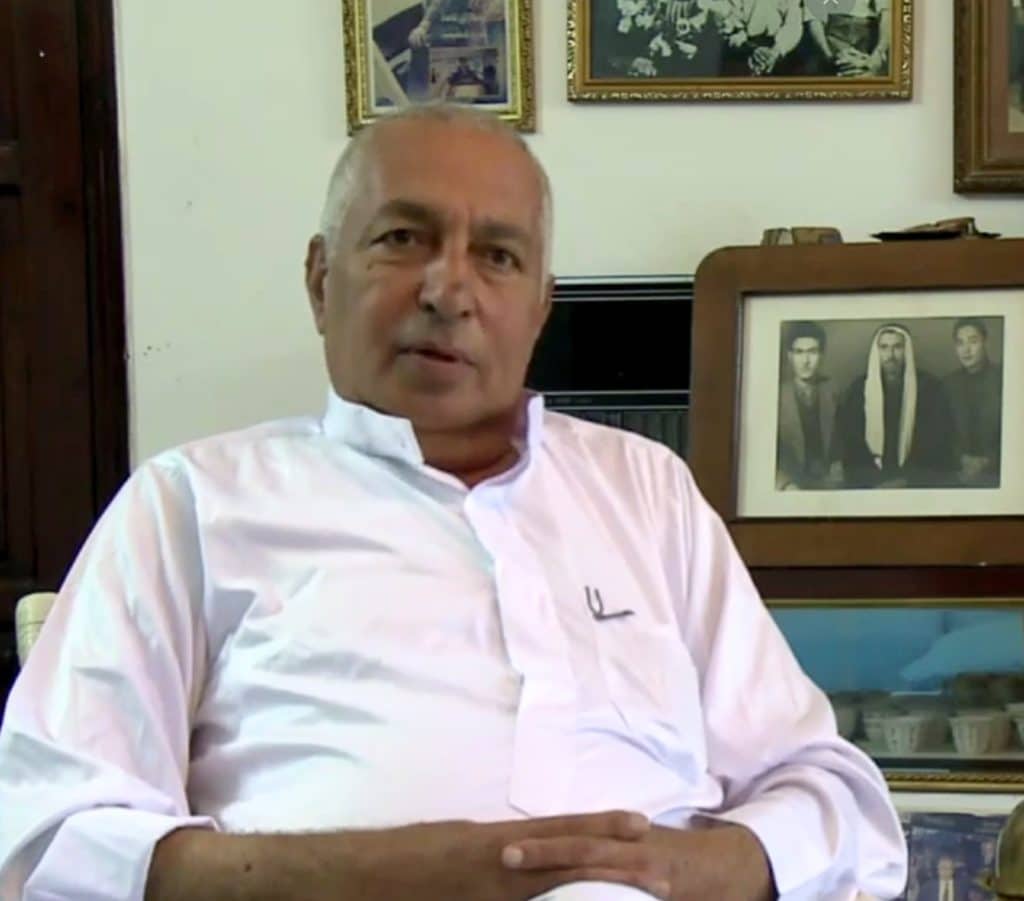
I write this to reclaim my Baba, Sameer Abusaleem, whose name now lives on through The Sameer Project, the mutual aid initiative I worked with a brilliant team of cofounders to establish in his memory to deliver lifesaving shelter, water, and medical care to the displaced families of Gaza.
In Arabic, Baba is more than a word for father. It is a word that carries affection, protection, and home. When I say “Baba,” I am not invoking an abstract figure. I am remembering a man who spent his life caring for those around him.
Before he became a statistic, before he became another casualty of Israel’s destruction of Gaza, and before the discourse rendered him yet another invisible Palestinian man, he was a father, a husband, and a pillar of our community whose violent death and lonely burial embody the cruelty of the genocide.
—
To know my father is to know the land.
My father was a respected, deeply loved local farmer. For him, the land was more than property; it was as essential to his existence as the very air he breathed. He poured his life into his orchards, cultivating citrus and olive trees with a tenderness that mirrored how he raised his nine children. Our family often joked that he treated the olive and citrus trees like his children.
Even now, when I think of him, I picture him moving through the orchards. He knew every corner of the land. He spoke about the harvest the way other people spoke about family milestones. Caring for the land was never separate from caring for people. To him, they were one and the same.
His orchards were a sanctuary for our entire neighborhood. Over the decades, he employed dozens of local workers, providing them with livelihoods and fostering a community of shared labor and deep mutual respect. In a Gaza choked by a decades-long blockade, his lands and the fruits they bore were an act of quiet, defiant resilience, a way to feed the people and tether them to their ancestral land.
The same dedication and commitment that guided him in the fields guided him at home.
When my mother lost her sight, he devoted himself to her care. Baba stepped into the darkness with her, adjusting his entire life to ensure her dignity and comfort. Even when the catastrophic stroke later left him paralyzed on one side, binding his body to a wheelchair, he continued to be the sun around which our family orbited. He could no longer walk his beloved fields, but he remained the anchor of our family. This reality rarely appears in the U.S. media narratives covering Palestinian families.
The language of “women and children” suggests a world in which vulnerability belongs to women and strength belongs to men. But Palestinian families are far more complex than that. When Baba was paralyzed because of the stroke, my mother, despite her blindness, became his hands; he was her eyes and her guiding voice. They navigated survival together.
Love and survival move in every direction. My father taught me that.
When Israel bombed our family home, my father could not run. He could not seek refuge elsewhere. He was lying in his bed. My father eventually died from the injuries he sustained.
The cruelest part of Baba’s death was the utter isolation of his last moments. None of his nine children were by his side. We were displaced, separated, and trapped by conditions beyond our control. We could not hold his hand. We could not sit beside him. We could not whisper our final goodbyes or a final prayer in his ear.
None of us could attend his funeral. There was no dignified procession through the streets he walked, through the community he cherished and supported with his charity, no gathering of the neighbors he had employed in his orchards, no tears dropped by his children onto his final resting place. He was buried hurriedly, in a landscape reshaped by violence, by strangers who gave him the mercy of a grave when his own blood and flesh could not.
The man who had spent his life caring for others was buried without the presence of the children he had raised. One of the most sacred human experiences, to be present by a loved one in death, was denied to us.
The loss continues to haunt me.
When I hear discussions of casualty figures, I think about everything those numbers fail to capture. The death of a father is never the death of only one person. It transforms entire families. It leaves empty chairs at dinner tables, unanswered phone calls, unfinished conversations, and grief that settles into everyday life.
I refused to allow my father’s story to end there.
My father’s life was defined by caring for his family, his workers, his neighbors, and his land. I wanted his legacy to inspire the work of The Sameer Project.
Through emergency shelter, clean water, medical support, transportation support, and other forms of humanitarian aid, The Sameer Project embodies the values my father lived by.
Every family we support carries a piece of his legacy forward.
The same man who spent his life caring for his family and community continues to care for others through the work done in his name. The same farmer who nurtured orchards now inspires efforts to sustain life amid devastation.
This Father’s Day, I hope readers will look beyond the catchall phrases that so often dominate conversations about Gaza. Behind every casualty count of Palestinian men is someone who worried about his children, cared for his spouse, worked for his community, and dreamed of growing old surrounded by the people he loved.
My father was one of those men.
He brought home chocolate for his children. He polished school shoes. He called to make sure I arrived safely. He loved namoura. He made me feel like the strongest girl in the world because I was his daughter.
He was my Baba. His name was Sameer Abusaleem.