

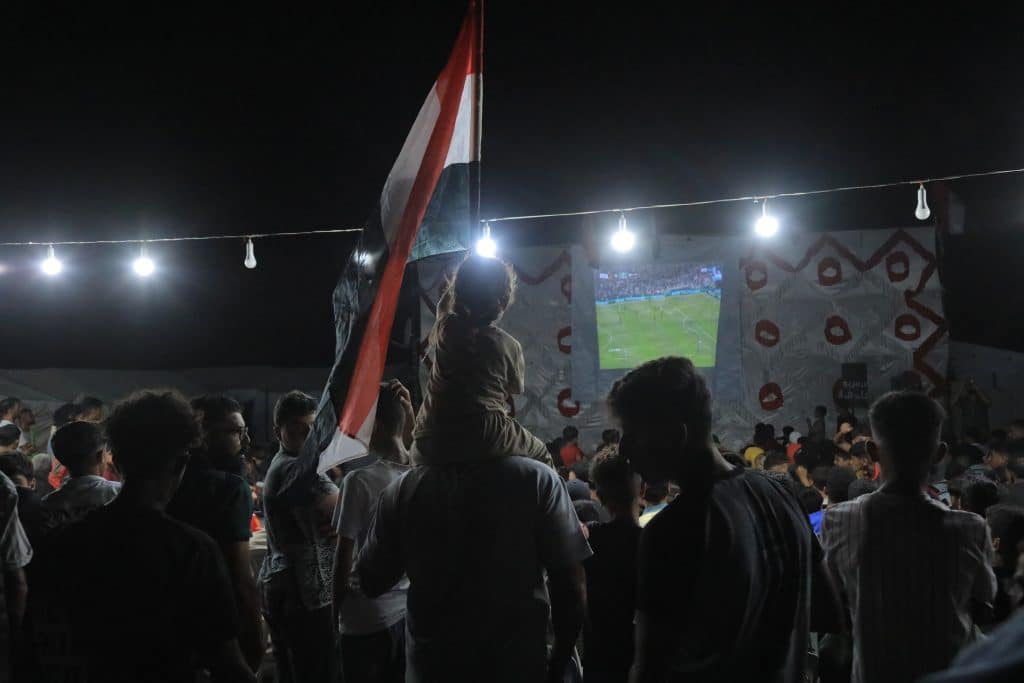
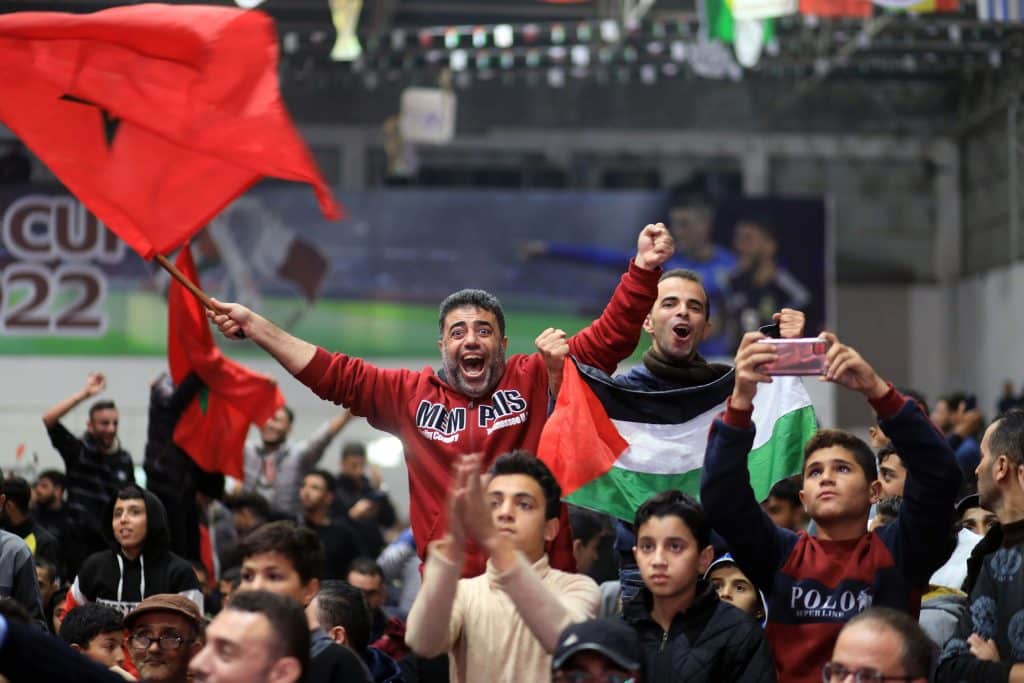
Last Monday, Palestinians in Gaza gathered across the Strip and converged on specially prepared screenings to watch the World Cup match between Egypt and Belgium. The broadcasts were supported by the Egyptian Relief Committee, a humanitarian organization set up by the Egyptian government operating in Gaza, which provided screens, electricity connections, seating, and lighting for spectators.
The match kicked off at 10 p.m. local time, an hour that is usually akin to a curfew in Gaza due to Israel’s ongoing nighttime military attacks and a continuously volatile security situation. Across Gaza, most families retreat to their tents after sundown, rarely leaving until morning.
This stands in stark contrast to what Gaza nightlife was like before the genocide. And during the World Cup, Palestinians would stay up into the late hours of the night to suppor their favorite team.
Like in much of the Global South, football occupied a central place in Gaza’s social life, and local enthusiasm for the sport would reach fever pitch when it was time for the World Cup. During the 2022 Mondiale in Qatar, families gathered around televisions, some carrying their TV sets out into the street so they can watch with their neighbors and relatives.
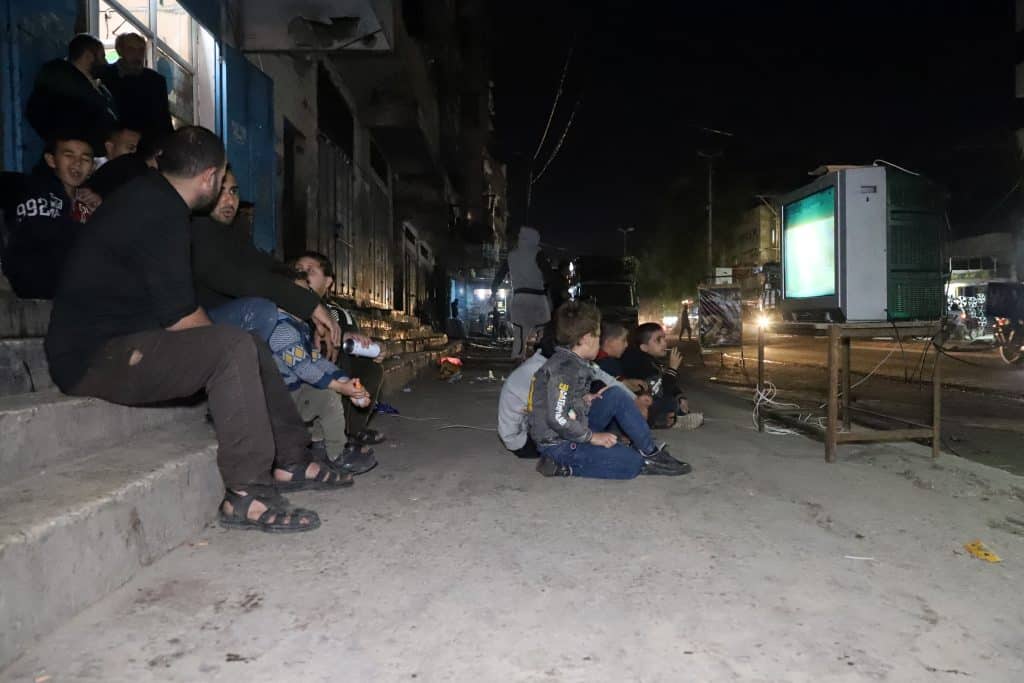
People also brought food and drinks with them, and children would always stay up late, not to be left out of the excitement. Invariably, rivalries would quickly emerge as residents aligned their loyalties with one national team or the other.
But some matches united nearly everyone in backing a single team — usually an Arab team that had managed to qualify, like with Morocco’s outstanding performance in 2022.
Monday’s match was one such occasion, with nearly the entire crowd cheering for Egypt. But outside the sponsored watch tent, hardly anyone was watching.
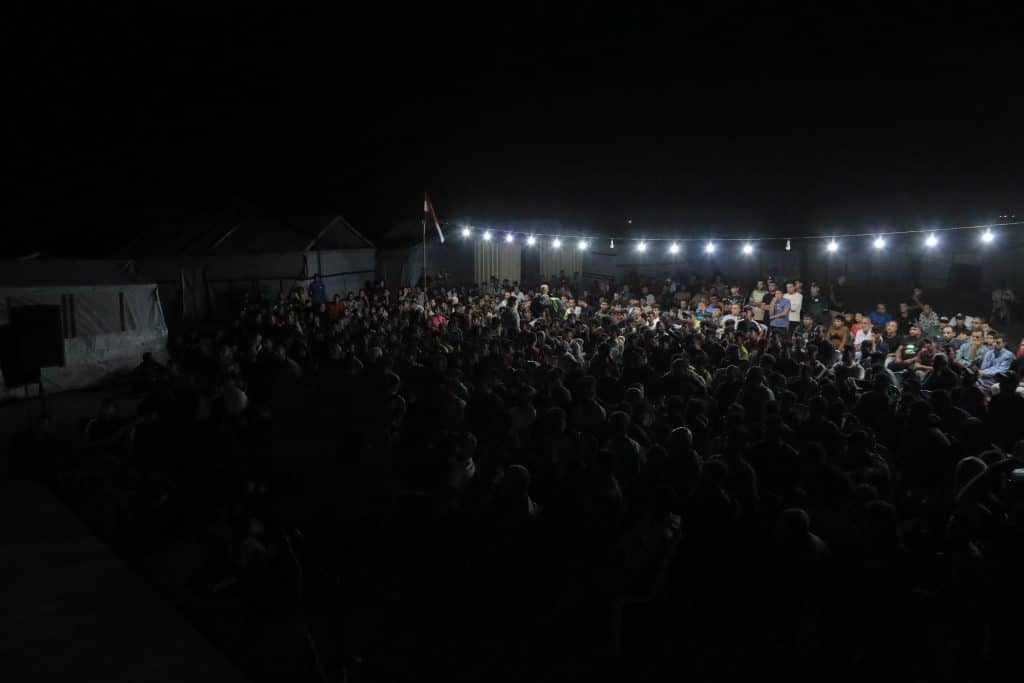
For most displaced Gazans living in tents, watching a football match is largely out of reach. Access often requires paid electricity, a screen, an internet connection, or a subscription to a sports channels. None of this is within reach for most residents of tent encampments.
Another option is visiting cafés that broadcast matches. For Monday’s match, the Egyptian Committee sponsored the game because Egypt was playing, but that was only one game. For those who were able to attend, it was like being transported back in time, according to spectators.
Raed Azoum, a displaced resident from Rafah who attended the public screening, described the atmosphere as far more than a football match. “This is a festival, not a match,” he said. “Look at the people, look at the excitement and joy on their faces. Nothing has brought us together and made us happy like this in a long time.”
For those like Azoum, the screening offered breathing room and a brief escape from a grim daily reality. “If everyone had known the match would be screened, huge crowds would have come. We love joy, and we all love Egypt, too.”
The noise coming from that one gathering place was louder than the drones and the bombings, and for a short time, residents said, the excitement of the game replaced the fear of death. “Personally, I felt as if the war had ended,” Azoum said. “With this crowd, the spirit, and the cheering, we are experiencing something that has been missing from Gaza since the war began.”
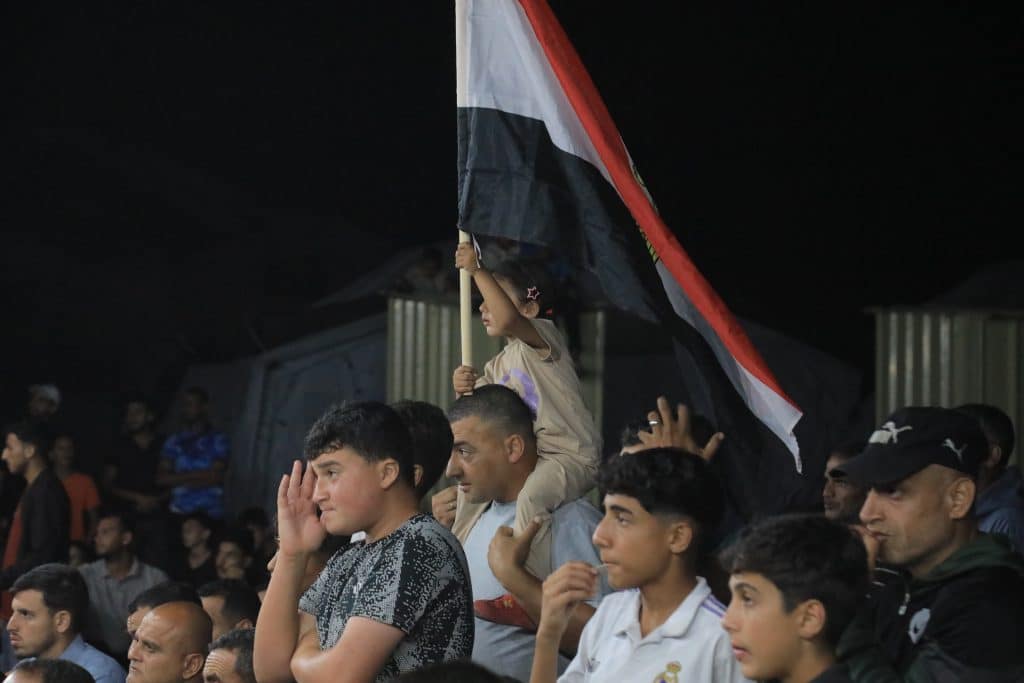
‘People are occupied with things far greater than football’
But journalists covering daily life in Gaza said events like Monday’s screening are few and far between.
Ahmad Barakat, a journalist who reports from Gaza daily, said turnout has only experienced a boost whenever an Arab teams is playing. “Compared with previous years, attendance is extremely low,” he said.
The reason, Barakat said, was preoccupation with daily survival. “People are occupied with things far greater than football,” Barakat said. “They are dealing with displacement, war, and the daily struggle to secure water and food for their families.”
“People have to choose between staying up late to watch a game and waking up early to secure water before the crowds arrive.”
Ahmad Barakat
From early morning until late at night, many spend their time searching for drinking water and other necessities, Barakat said.
Barakat also pointed to another reality created by the war: the late timing of matches. “People have to choose between staying up late to watch a game and waking up early to secure water before the crowds arrive,” he said. “Personally, I would choose waking up early rather than spending my time watching a match.”
Before the war, he said, having to make such calculations were unheard of, despite the Israeli blockade.
Cafés showing matches, even the modest ones meant for a mass customer base, attract fewer customers due to the sharp rise in prices as a result of Israel’s ongoing restriction of food and aid into Gaza. Watching a game in a café may now cost NIS 50 ($16) for two cups of tea, compared to NIS 10 ($3.3) before the war.
For many Palestinians, watching matches in public spaces is only feasible when entry is free or limited to the cost of an inexpensive drink. Once the cost rises above NIS 100 ($33), families often choose to spend that money on food and other household needs.
The result is that the only ones who can consistently follow matches are the very few remaining in Gaza who still have money. A number of upscale and expensive cafés across the Strip serve this clientele, broadcasting matches and screening every major game. They largely consist of businessmen and the rich (for Gaza’s standards).
The uneven screenings show that, despite the genocide and the evacuation of Gaza’s wealthier families from the Strip in the early months of the war, class disparities still exist in Gaza, even amid the rubble.
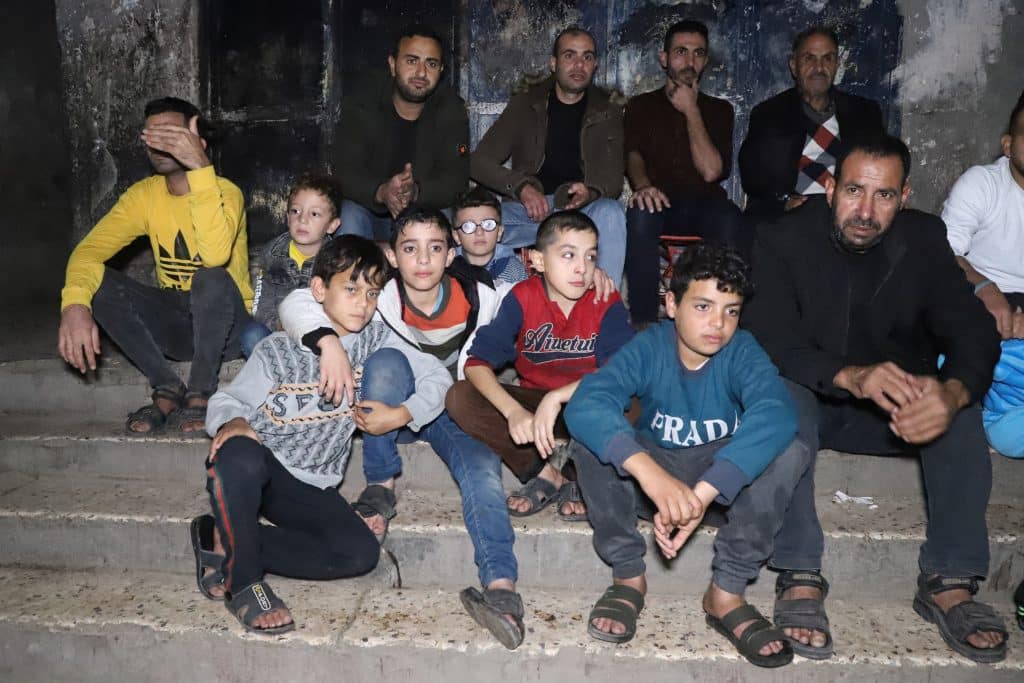
Muhammad Raafat, a displaced father of three living in Gaza City, said some cafés require customers to meet a minimum spending threshold or pay additional fees. “If the choice is between watching a match and buying fruit — if we can find any — or food for the family, then food comes first,” he said.
Raafat said such calculations were never part of his life before the war, when his family lived comfortably in their home. “But life in displacement camps imposes a different set of priorities,” he explained.
Yet the hardships faced by Gaza’s residents have not diminished their passion for the sport. A dedicated audience remains, even if smaller than before. Many still make the effort to follow matches and preserve moments of entertainment amid the hardships of daily life.
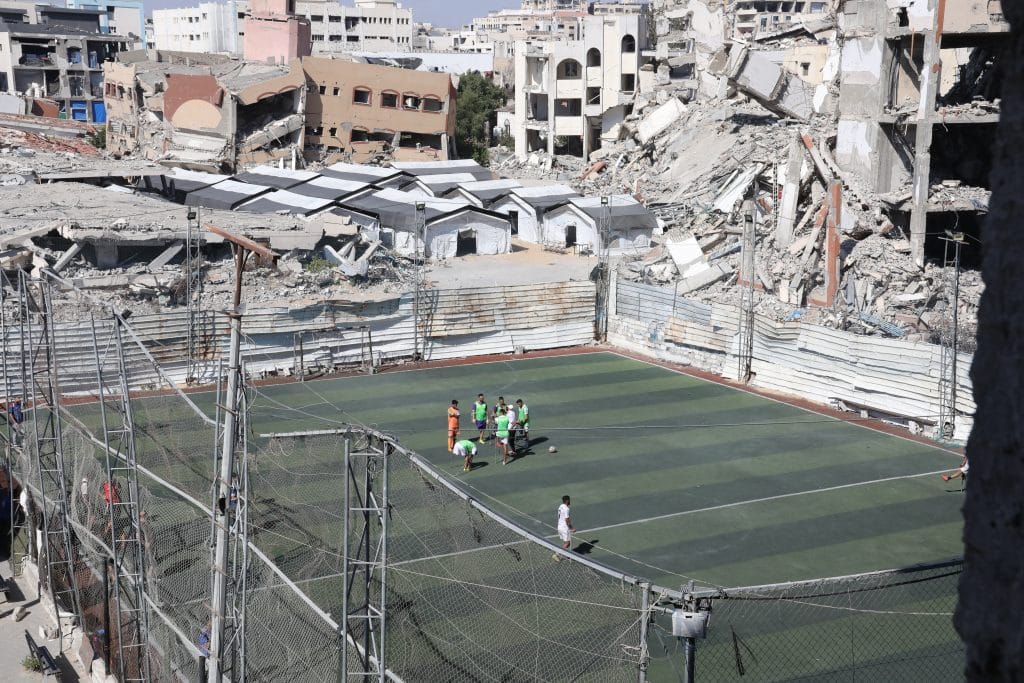
Despite the near-total collapse of organized sports in Gaza over the past three years, the destruction of most stadiums, the conversion of sports facilities into shelters, and the killing of several athletes — among them Suleiman al-Obaidi, who was shot by the Israeli army while searching for food — Palestinians have not abandoned their connection to the sport.
Hani Abu Ruzq, who traveled from Gaza to Qatar as part of a media delegation covering the 2022 World Cup, said he had hoped to report on this tournament in the same way, but was prevented from doing so by current conditions.
“Despite the late-night broadcasts and the challenges of life in Gaza, a portion of Gazans continues to follow the matches closely. For many, the participation of Arab teams provides an opportunity to cheer as though Palestine itself were competing,” Abu Ruzq said.
Their support for those teams carries a broader message, Abu Ruzq said, from a society decimated by genocide but still looking for moments of joy.
Tareq S. Hajjaj
Tareq S. Hajjaj is the Gaza Correspondent for Mondoweiss and a member of the Palestinian Writers Union. Follow him on Twitter/X at @Tareqshajjaj.

Sine the title refers to ‘genocide‘ it’s appropriate to introduce a new source of information on Gaza:
Bearing Witness Gaza
“Hundreds of testimonies, data points, and reports are scattered across the web….
Bearing Witness brings this information together in one place, organizing it within the context of time and place and connecting individual events to broader developments.…
By combining personal testimonies, data, and spatial mapping, this platform allows users to navigate between individual stories and the larger picture….The project aims to provide an accessible and reliable knowledge infrastructure enabling researchers, journalists, decision-makers, and the public to better understand events, identify emergent patterns and trends, and ground public discourse in documented, contextualized information.”
From the ‘Testimonies’ page:
“Literally every day I was there , I saw a child shot in the head…”
Dr. Feroze Sidwha
https://bearing-witness.com/
There is a ton of information here.
Off topic but important:
Re In landmark case, UK judge sentences pro-Palestine activists as terrorists – Mondoweiss , that story reported on injuries suffered by one of the police-persons. To be clear: I do not support violence, any activists who physically assault anyone deserve jail time, etc. Now a report on the trial proceedings:
https://realmedia.press/the-filton-trial-3/
Next was some medical evidence about APS Kate Evans, which turned out to be somewhat less dramatic than described by the corporate and state media last week. The first report was from the hospital admission where she walked in slowly but evenly and unaided. An X-ray scan showed no obvious acute injury, but a radiologist’s report some days later reported a small fracture to the bony projection at the side of a vertebra, not requiring surgery. Ms Evans was advised to take pain medication if necessary while it healed. In ensuing physiotherapy Ms Evans complained of pain and occasional numbness and other symptoms, she was given an MRI scan a few months later which showed no bony injury or spinal compression. In the months leading up to trial the CPS ordered a report by an orthopaedic specialist who re-examined the scans and gave an opinion that Ms Evans had sustained a fracture to the side of her vertebra typical of a medium to severe blow or a motor accident or a fall, expected to heal in 3- 6 weeks, with full recovery in 3-6 months and no long-term consequences.