

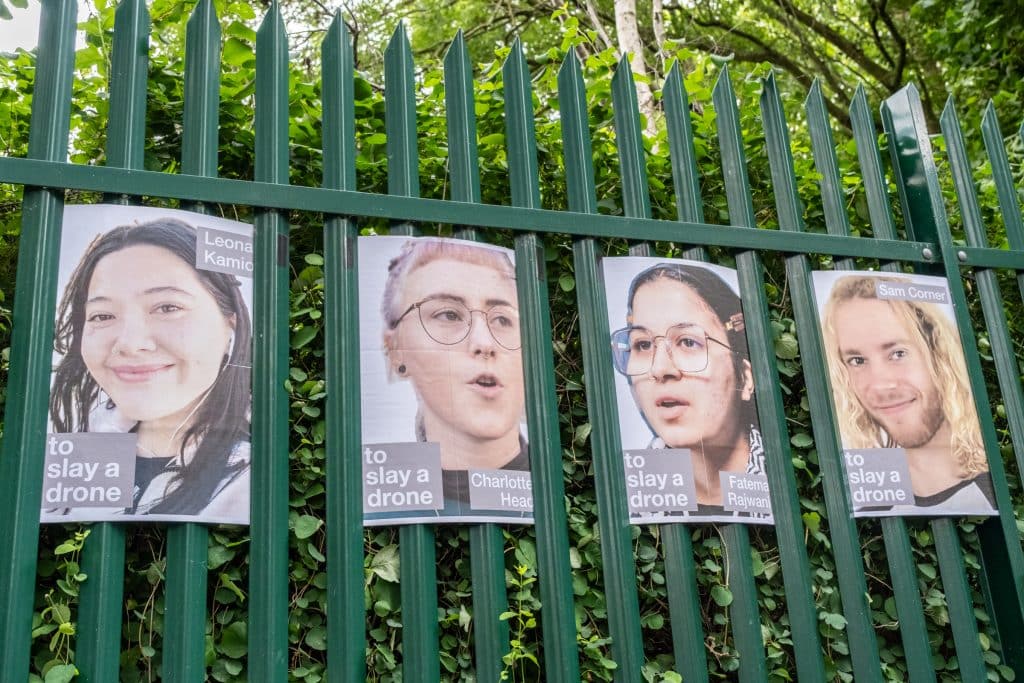
On June 12, 2026, a UK judge at Woolwich Crown Court convicted four Palestine Action activists as terrorists and sentenced them to prison for their involvement in a direct action protest at a factory operated by Elbit Systems, Israel’s largest weapons manufacturer, which reportedly caused £1.2 million in damages.
This is the first time in the UK that counter-terrorism legislation has been used against activists. There are now major concerns that this will set a dangerous precedent for other activists who oppose Israel’s genocide against Palestinians in Gaza and in ethnic cleansing in the West Bank.
Palestine Action members Charlotte Head and Leona Kamio were sentenced to 6 years, less 45 days, while Fatema Zainab Rajwani was sentenced to 5 years and 8 months, less 45 days, under a clause in terrorism legislation for causing criminal damage. Samuel Corner was also sentenced to eight years and eight months, including an additional sentence for grievous bodily harm without intent.
The raid carried out by the six activists on the Elbit factory in Filton, UK took place in August 2024, where it is reported that they destroyed 40 “military assets” including the ‘Magni X’ drone and multiple ‘Thor’ drones; both of which have been deployed extensively in Gaza by the Israeli military.
The activists were arrested on-site. An additional 18 people were arrested in connection with the raid as part of ‘Operation Recomply’ and were subsequently dubbed the ‘Filton 24.’ In May 2026, they became the ‘Filton 25’ after the Crime Prosecution Service decided to advance Lewis Chiaramello’s verdict regarding his alleged involvement in an action at RAF Brize Norton airbase.
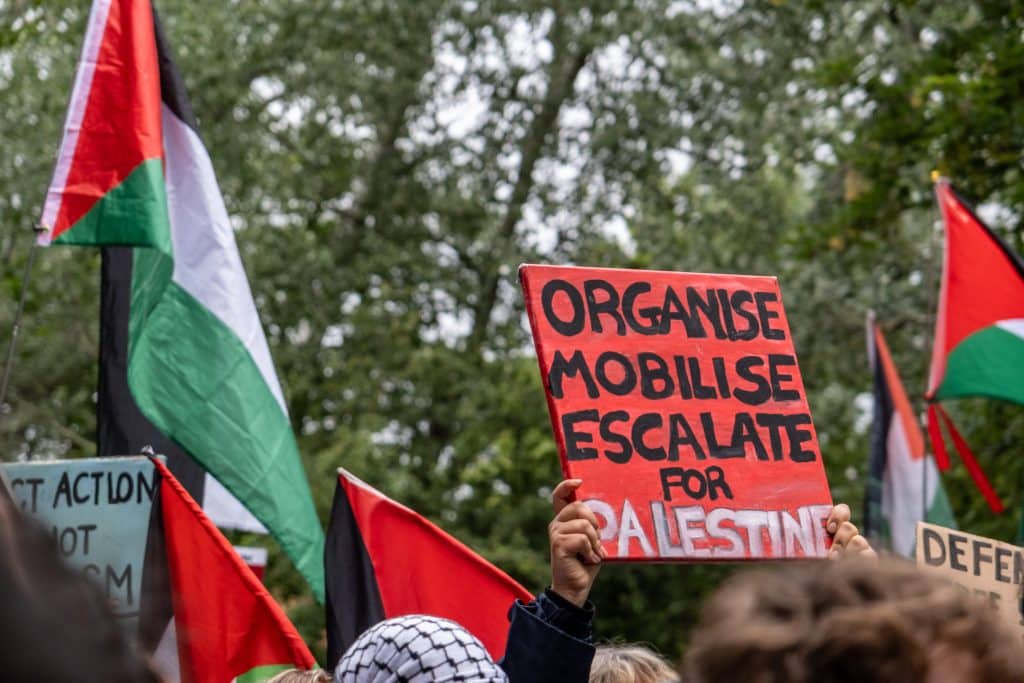
During the sentencing, more than 500 people gathered outside the court to support and show solidarity with the activists, displaying banners, performing music and poetry, and chanting. A large contingent of police officers was present and made more than 100 arrests, predominantly for displaying support for Palestine Action, which the British government proscribed as a terrorist organization in July 2025.
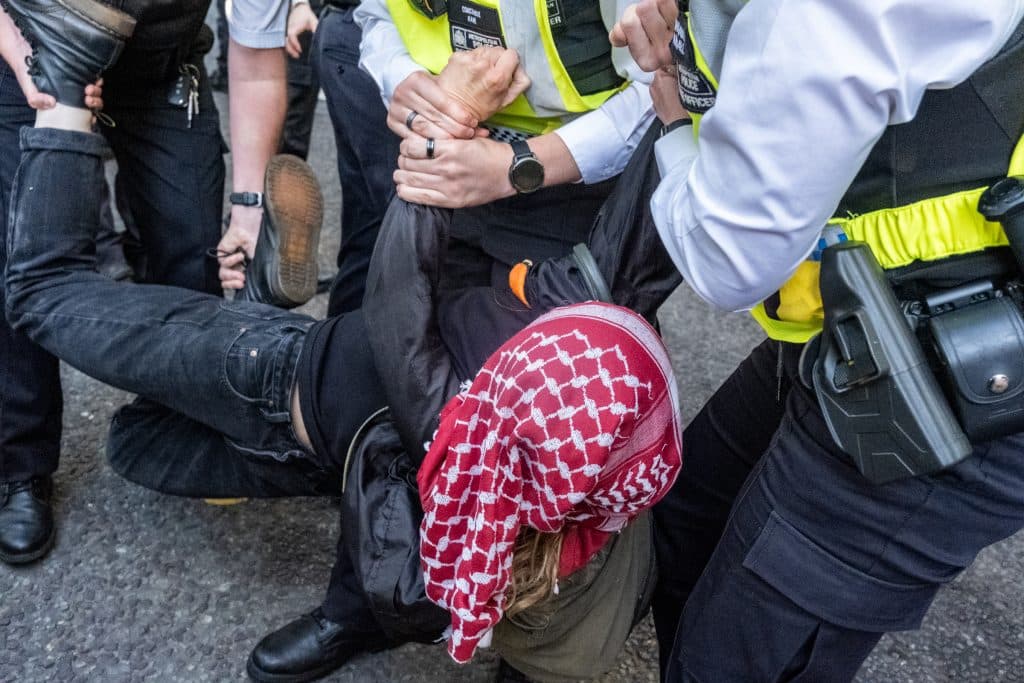
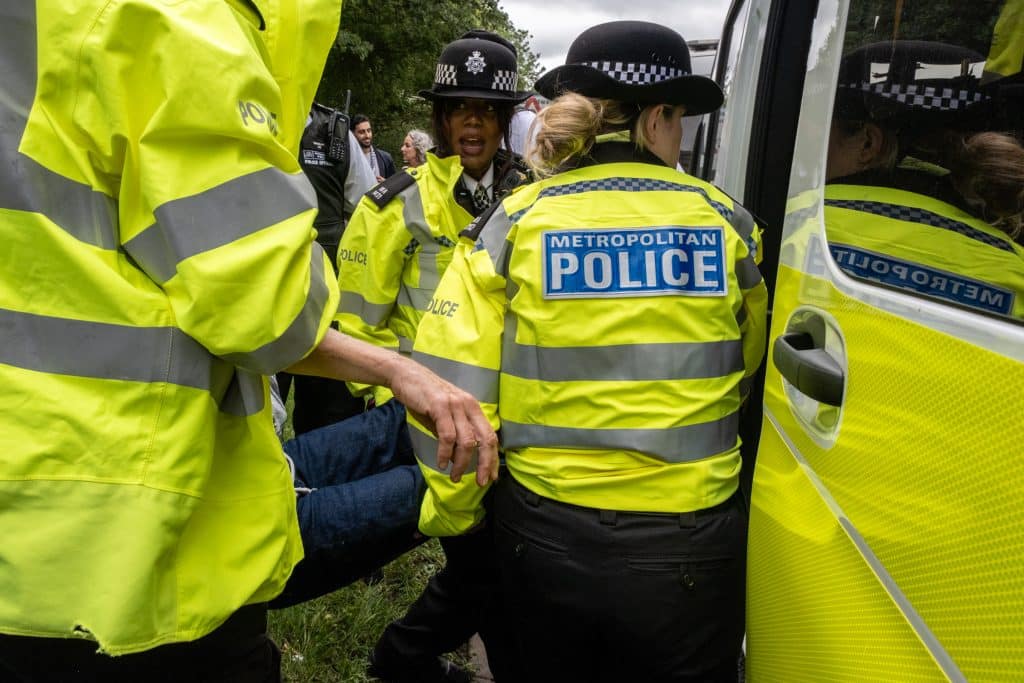
Other arrests followed later, after a blockade of a prison van carrying some of the activists as it left the court premises. The vehicle remained stationary for over an hour until protesters were removed by police, who are accused of using disproportionate force and conducting violent arrests.

An unprecedented trial
The sentences were delivered at the end of an unprecedented trial.
Following their action on the August 6, 2024, Samuel Corner, Jordan Devlin, Charlotte Head, Leona Kamio, Fatema Rajwani and Zoe Rogers were all initially charged with criminal damage and aggravated burglary. An additional charge of violent disorder was given to Corner, Head, and Kamio.
Using counter-terrorism powers, the six were denied bail and remanded in custody, despite being charged with lesser offenses. They remained in prison until their court trial was concluded in February 2026, beginning in November 2025; nearly 18 months after arrest.
None were initially convicted of any offense as the jury failed to reach verdicts on the charges of criminal damage and violent disorder, and all were acquitted of aggravated burglary. Unsatisfied with the outcome, prosecutor Deanna Heer KC confirmed that a retrial would be pursued.
The retrial concluded on May 4, 2026 and found Samuel Corner, Charlotte Head, Leona Kamio, and Fatema Zainab Rajwani guilty of criminal damage. Corner was also found guilty of inflicting grievous bodily harm without intent. Devlin and Rogers were acquitted.
Once court-imposed reporting restrictions were lifted on May 12, 2026, it was revealed that a significant factor was withheld from the jury during deliberations – that a guilty verdict could trigger a ‘terrorist connection’ clause under the Counter-Terrorism and Sentencing Act 2021 at sentencing.
Going further, the defendants’ barrister, Rajiv Menon KC, faced contempt of court proceedings for his closing speech in the 2024 trial and was accused of defying the judge’s orders, Sir Jeremy Charles Johnson KC.
The judge ruled that the defendants could not argue that they had a lawful excuse based on the actions of the Israeli military in Gaza, and also forbade lawyers from inviting the jury to disregard the court’s rulings of law or to apply the principle of jury equity, a jury’s right to acquit defendants based on its own judgment of conscience or sense of fairness.
In his closing speech, Menon told the jury about the landmark 1670 legal decision Bushel’s Case, which established the independence of juries. He also read from a plaque at the Central Criminal Court, highlighting the case’s significance and quoting it as saying, “established the right of juries to give their verdict according to their convictions.”
This was the point of contention for Johnson and is believed to be the first time in UK legal history that contempt of court proceedings have been brought against a barrister for his closing argument.
Appeal judges concluded that Johnson lacked jurisdiction to refer the case to the High Court, and the contempt of court claim against Menon was dismissed.
Soon after, Johnson was promoted to Deputy Senior Presiding Judge of England and Wales by Lady Chief Justice Sue Carr and approved by Chancellor David Lammy, a member of Labour Friends of Israel who has received more than £32,000 in funding from the pro-Israel lobby. Labour Friends of Israel is a pro-Israel lobby group that works closely “behind the scenes” with the Israeli embassy in London, as revealed in the Al Jazeera documentary series ‘The Lobby’.
In the week leading up to the sentencing, the campaign group Defend Our Juries filed a formal complaint against Johnson, alleging biased and discriminatory practices. Over 5,000 people signed, including lawyers, law professors, retired police officers, and magistrates, and called for his removal from the trial sentencing. Johnson refused to step down.

Clamping down on Palestine Action
Palestine Action has targeted Elbit Systems and other companies associated with Israeli weapons and munitions manufacturing since its formation in 2020. Over time, some members of the group have been prosecuted for their involvement, while others have been acquitted. This has become a growing concern within the UK Government, already under pressure from the Israeli government and lobbyists. Since Israel’s genocide in Gaza began in 2023, actions against facilities and offices have increased, as has government attention.
On June 20, 2025, two Palestine Action activists broke into RAF Brize Norton airbase in Oxfordshire, damaging two Voyager aircraft that they claim are part of Britain’s direct participation in genocide and other war crimes. Days later, Yvette Cooper, then Home Secretary, announced in parliament her intentions to proscribe Palestine Action under the Terrorism Act 2000.
It later emerged that the Crime Prosecution Service advised her not to proscribe the group within six months of any court hearings, citing concerns that doing so would prejudice a fair trial. Her announcement came five months before the first trial began. She also risked contempt of court for discussing case details in a published article despite reporting restrictions. Judge Johnson dismissed the defense lawyer’s application against her.
Cooper is also a member of Labour Friends of Israel and has accepted donations from the pro-Israel lobby.
Despite widespread opposition from members of the public, human rights and civil liberties groups, and the United Nations, the proscription went ahead. MPs voted in favor, 382 to 26. However, it is believed that Cooper strategically influenced the vote by including two groups in her proscription order, the neo-Nazi Maniacs Murder Cult and the ultranationalist and white supremacist Russian Imperial Movement.
Notably, Jonathon Reynolds, the previous UK Trade Secretary and current vice-chair of Labour Friends of Israel, who oversaw arms exports to Israel and is a beneficiary of the pro-Israel lobby, voted for the ban.
Outraged by the vote, silent protest vigils took place, with signs reading “I oppose genocide. I support Palestine Action.” This nationwide campaign was met with mass arrests and subsequently played a significant role in applying pressure in the run-up to a legal challenge against the ban.
Following a landmark judicial review, the UK High Court ruled that the ban was unlawful and would be overturned, citing breaches of the rights to freedom of expression and assembly under the European Convention on Human Rights. However, the ruling would not be retroactive and would take effect after the Home Office appeal against the High Court was concluded. As a result, the mass-arrest protest vigils continued; in London alone, more than 500 were arrested in a single sitting.
Prior to the day of sentencing, more than 3,300 people had been arrested, 1,200 of whom had been charged with terrorism-related offenses. However, an additional 72 were arrested outside Woolwich Crown Court for holding revised signs stating ‘Saving lives is not terrorism. I support Palestine Action,’ some of which were displayed on signs measuring less than an inch.
They currently await trial and could face up to 14 years in prison.

‘An insane escalation’
The sentencing of Samuel Corner, Charlotte Head, Leona Kamio, and Fatema Zainab Rajwani under terrorism legislation is a landmark case for the UK. Indeed, it is a first.
In a statement provided to Mondoweiss, Lisa ‘Luxx’ Minerva, coordinator of the Filton25 Defence Committee, said, “This is an insane escalation on the side of the state, the entire thing has been orchestrated.” She believes the unprecedented outcome of this trial is the result of a concerted effort, implemented by a “biased” judge who “completely overlooked the evidence,” and is part of a “strategy to oppress the movement” that has gained momentum throughout Israel’s genocide in Gaza.
Many see this as another appalling example of the UK Government’s commitment to appeasing the Israeli state and its active participation in genocide, war crimes, and military provocations in the Arab world; all of which are deemed abhorrent and disturbing.
Indeed, as Judge Johnson stated in his closing speech of the proceedings, “Elbit is not on trial.”
And it is for this reason that Luxx affirms direct action takes place: “These four people became the decision-makers they needed to see in society. When they needed the arms to stop, they went out and stopped them themselves when nothing else was working.”
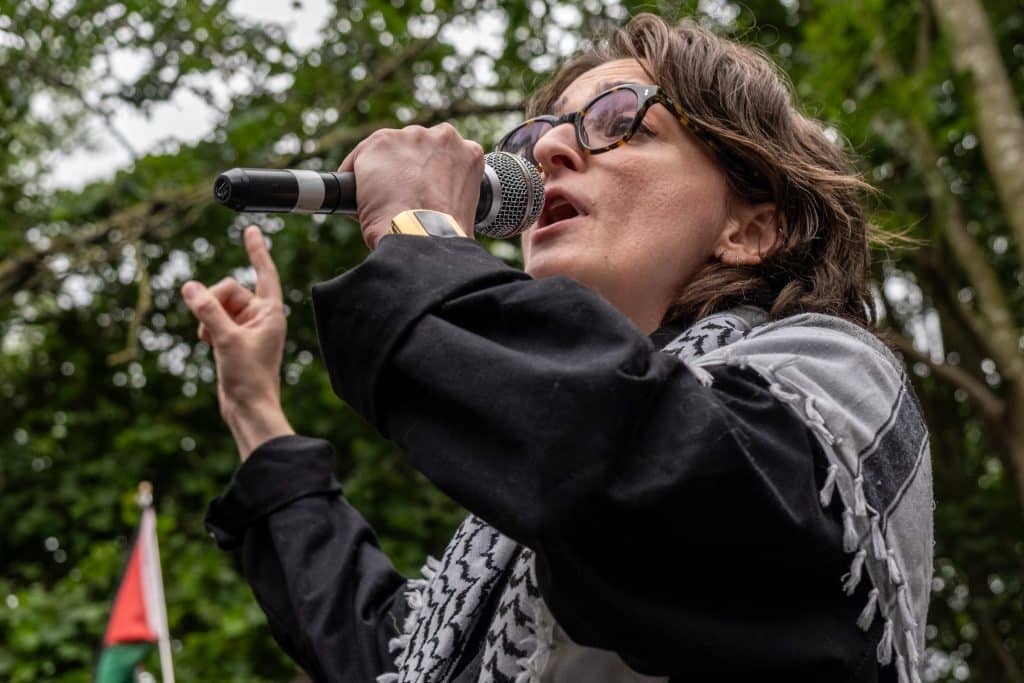
The sentences also come as many in the UK have watched as pro-Palestinian demonstrations, vigils, and marches have been subject to additional policing powers and restrictions, including limits on chanting and the use of language, symbols, and iconography. These efforts have sought to demonize anti-genocide demonstrations as “hate marches,” boycott campaigns as “discrimination,” and political discourse that challenges Israel as antisemitic.
However, Luxx views these as desperate tactics held by a nervous system: “This is meant to intimidate the movement, but actions against Elbit Systems have not stopped.”
But there are no signs that the repression will ease anytime soon. On Monday, June 15, 2026, in a surprise, the Court of Appeals ruled that the proscription of Palestine Action was lawful.
It is believed this ruling will be appealed to the Supreme Court and possibly to the European Court of Human Rights, though the proceedings are likely to take years. The fate of the remaining Filton25 remains to be seen. Likewise, the future of direct action and protest is uncertain. But one thing is certain for Luxx: “We will fight this. It isn’t the end, it’s only the beginning.”
Aidan Frere-Smith
Aidan Frere-Smith is a freelance journalist, photographer, and videographer with a primary focus on humanitarianism, environmentalism, and activism.



I hope this goes to appeal. The judge’s directions to the jury were disgraceful.
How dare these activists target an economic system that profits from genocide? That’s totally against “western civilization”.
“Once court-imposed reporting restrictions were lifted on May 12, 2026, it was revealed that a significant factor was withheld from the jury during deliberations – that a guilty verdict could trigger a ‘terrorist connection’ clause under the Counter-Terrorism and Sentencing Act 2021 at sentencing.
Going further, the defendants’ barrister, Rajiv Menon KC, faced contempt of court proceedings for his closing speech in the 2024 trial and was accused of defying the judge’s orders, Sir Jeremy Charles Johnson KC.
The judge ruled that the defendants could not argue that they had a lawful excuse based on the actions of the Israeli military in Gaza, and also forbade lawyers from inviting the jury to disregard the court’s rulings of law or to apply the principle of jury equity, a jury’s right to acquit defendants based on its own judgment of conscience or sense of fairness.
In his closing speech, Menon told the jury about the landmark 1670 legal decision Bushel’s Case, which established the independence of juries. He also read from a plaque at the Central Criminal Court, highlighting the case’s significance and quoting it as saying, “established the right of juries to give their verdict according to their convictions.”
This was the point of contention for Johnson and is believed to be the first time in UK legal history that contempt of court proceedings have been brought against a barrister for his closing argument.”
Sure reads like there is plenty of evidence to determine a mistrial. Judge Johnson bought, owned up to his eyeballs by the Israel lobby in the UK. His alleged integrity sold to the highest bidder.
At least 70,000 Palestinians including tens of thousands of children, crushed, blown to bits, starved to death, burned to death by Israel and protesters trying to stop the madness and hold weapons manufacturers a tiny bit accountable go to prison. Israel commits hundreds of thousands of barbaric, heinous war crimes and protesters go to prison. Completely fucked up!
These protesters tried to stop the genocide. Bring more attention to the defense companies. War crimes being committed.
Some how Holy Cow always misses mentioning Israel’s genocide and hundreds of thousands of war crimes.
No accountability in Israel for IDF, illegal settlers those who have committed thousands of war crimes.
Yet UK goes overboard punishing those who focused in on the Israeli weapons company complicit in Israel’s massive amount of war crimes. Absurd!
https://www.gettyimages.com/photos/children-of-gaza-gaza-massacre
Israel’s war criminals should be on trial at the Hague prosecuted and imprisoned at the very least.
https://www.gettyimages.com/photos/palestinian-death
Leading lawyer Geoffrey Robertson KC discusses the Controversy surrounding the Elbit Four trial. He does use the word “sledgehammer”:
https://www.theguardian.com/global/commentisfree/2026/jun/20/elbit-four-law-jurors-criminal-damage-terrorism