

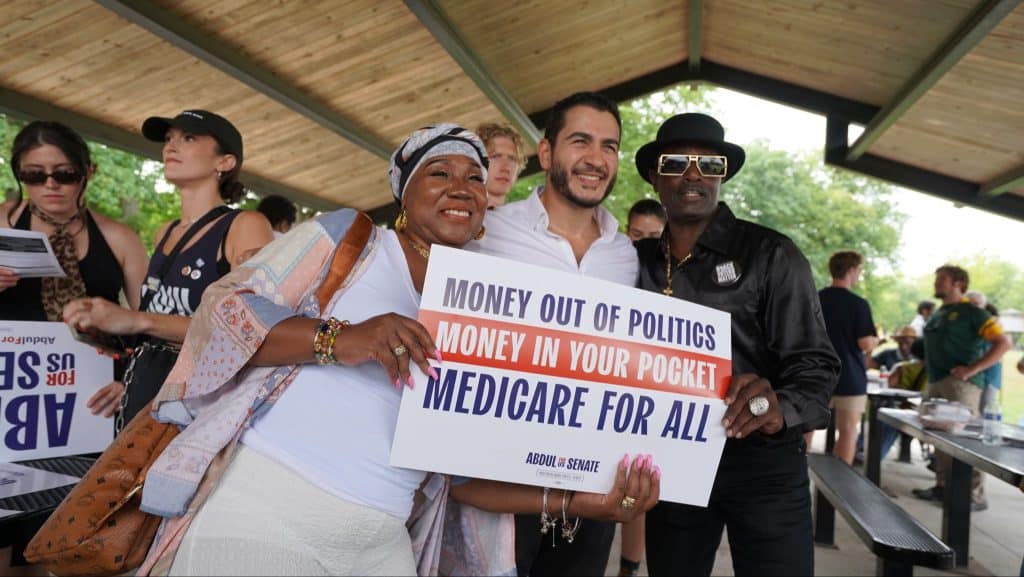
Early in the Michigan Senate Democratic primary, Erin Mallen sent $10 to State Senator Mallory McMorrow. Mallen, a mom who runs an Etsy shop near Traverse City, a liberal bastion in northern Michigan, liked McMorrow – she is young and a break from the Senate’s establishment who occupied a middle lane between Haley Stevens and Abdul El-Sayed, Mallen said.
Lagging in the polls, McMorrow dropped out in June, leaving Mallen to choose between the progressive Abdul El-Sayed and establishment Haley Stevens. Mallen liked El-Sayed more, but was hesitant. “I just don’t know that someone named ‘Abdul’ can win in Michigan,” she told Mondoweiss.
Her hesitation is emblematic of an overarching theme in the race: Can an Arab-American win in a statewide general election in an upper Midwest swing state? Mallen was turned off by Stevens’ willingness to take dark money or corporate contributions from groups like AIPAC and DTE Energy, which have spent about $70 million attacking El Sayed. In the end, she voted for El-Sayed.
“I always liked Abdul more, and he is probably the better choice – Stevens has too much baggage and doesn’t seem to stand for a break from anything, which is what people want,” Mallen said.
Recent polls indicate El-Sayed is pulling ahead, which suggests once-undecided Michiganders like Mallen are breaking for him. He was up by as much as 18 points in polling released last week. If accurate, he would pull off a stunning upset in Tuesday’s primary. The winner takes on the Trump-backed Republican Mike Rogers in the general.
El-Sayed would arguably be the most progressive U.S. Senate member. His campaign is focused on populist economics and affordability, getting money out of politics, and Medicare for All. He is an outspoken critic of U.S. military support for not just Israel, but any foreign country. Still, he has bucked the “leftist” label, stating that he looks at the political divide as a matter of “top and bottom.”
The race is the latest proxy war between the Democratic Party’s political establishment and the insurgent left, the latter of which has already notched major wins this primary season, including the “socialist sweep” in New York. Anti-establishment leftists have won in Colorado, New Jersey, and elsewhere, and this wing of the party will almost certainly have much more power in Congress next year.
But Michigan is an upper Midwest swing state where the establishment has always ruled, and many political observers believe El-Sayed’s brand of politics cannot win here. That’s partly what, at first, gave Robert Hart, a special education teacher who lives in Oakland County, a wealthier suburban area north of Detroit, pause about supporting El-Sayed.
Hart considered McMorrow briefly but was left unimpressed when she held a question-and-answer session with his union, the Michigan Education Association. She “gave politician responses” to Hart’s questions, but, beyond the issue of whether “Abdul” can survive the inevitable onslaught of racism in a general election, his politics are clearly to the left of most holding office here.
But it did not take Hart long to settle on El-Sayed.
“Politicians like Bernie and Abdul are altruistic, they’re doing it for the good of the people, to make the world a better place, and he’s not taking any corporate PAC money like a lot of the Republicans and Democrats,” Hart said. “So I thought, why not give him a shot?”
Polling on the question of who is more electable is mixed. A pollster with links to the political establishment put El-Sayed behind by nine in a hypothetical match-up with Rogers. Most others have put El-Sayed ahead by a few points, while a Sunday poll by EPIC-MRA, one of the state’s strongest pollsters, put El-Sayed behind by three and Stevens up by two against Rogers.
In the primary race, Stevens has polled better among Black voters in Detroit, especially older voters, who are generally more conservative. El-Sayed’s strength lies in the rural western and northern parts of the state, and should he win the primary, support in these regions, including winning over Trump voters, would be crucial.
The campaign has touted its cross-over appeal with economically dissatisfied voters, and some of those come from Three Rivers, a small manufacturing town near Kalamazoo. El-Sayed joined the picket line with a small United Auto Workers local representing workers at an American Axle Manufacturing plant that went on strike over their low hourly wages.
It surprised the union that El-Sayed showed up to such a small strike, but a Senate candidate’s presence “gave us more strength and extra oomph,” said UAW member April Van Aken. They won a $7-per-hour raise after 10 days.
Van Aken and others have mobilized for El-Sayed, knocking on doors, and she said she’s surprised by the level of receptivity to him in this largely red area. Many are frustrated with inflation, the Iran War, and other issues, and El-Sayed’s pro-union positions resonate with those who may switch sides, Van Aken said.
They do hear concerns that El-Sayed is an immigrant, Van Aken said. Others point to Stevens’ allegations that El-Sayed is “sexist” because he has criticized Michelle Obama and Michigan Gov. Gretchen Whitmer. Van Aken said they explain that El-Sayed is not an immigrant, and the sexism allegations are a smear campaign.
The AIPAC and DTE Energy contributions to Stevens are a major red flag to many in the area, where Israel is unpopular, Van Aken said. That, combined with El-Sayed joining the picket line, helped convince one Stevens supporter to switch sides.
“I thought ‘Wow – I really wasn’t expecting that because he was hardcore Haley Stevens,’” Van Aken added.
In Ann Arbor, among the state’s most liberal cities, Rima Mohammad, a member of the local school board and co-founder of the progressive People’s Coalition, said there is a palpable excitement around the campaign. Mohammad recounted an old woman at a farmer’s market who was moved to tears as they talked about El-Sayed.
“It’s emotional and people feel hopeful and that he is truly genuine and is really going to represent them,” Mohammad said. There is also synergy with a local city council race in which a slate led by a Democratic Socialist of America mayoral candidate is seeking to oust about half of an establishment political machine that has long governed the city.
Mohammad, who is Palestinian-American, said the primary has been emotionally draining for Arab-American and Muslim communities because of the Islamophobic attacks on them by Stevens, her supporters, AIPAC, and the political establishment. Still, there’s also hope.
“El-Sayed winning would mean people like us can do this, and people who are Arab and Muslim can step up and win a US Senate race,” Mohammad said. “It would show that we belong in the state and in its politics.”
Tom Perkins
Tom Perkins is a Detroit-based freelance reporter who covers the domestic response to the genocide in Gaza.

In this 6 minute video Peter Beinart discusses the Michigan primary.
“What AIPAC is essentially saying is we don’t care whether America remains a liberal democracy….anyone who looks honestly at what Donald Trump has done and what the vast majority of Republicans in congress have supported him in doing would accept that Donald Trump tried to overturn the 2020 election, and virtually everything he’s done since returning to office suggests that he would try as much as possible to do something similar in the midterm elections in 2026 and then likely in the presidential election in 2028…and yet we take it for granted that the most powerful American Jewish organization, AIPAC, that they prefer candidates who support Israel but would help Donald Trump overturn a democratic election to candidates like Abdul el-Sayed…
The American Jewish Establishment Has Given Up on American Democracy
The American Jewish Establishment Has Given Up on American DemocracyAmerican Jewry’s Most Powerful Organizations Care More About Whether a Politician Supports Israel than Whether They Support Free Elections in the United States
Peter Beinart again in Jewish Currents on American elections:
The Shame of the American Jewish Establishment…In its quest to defend Israel, establishment Jewry has abandoned liberal democracy in the US….More than a decade later, Greenblatt still leads the ADL. But when the Supreme Court this April gutted the Voting Rights Act for which King and Epstein marched, the organization said nothing. The ADL webpage about Epstein’s activities in Selma—which Greenblatt’s essay once linked to—has been taken down, along with much of the organization’s other material about civil rights….The ADL is not the only American Jewish organization that has lost interest in whether Black Americans fully possess the right to vote. The American Jewish Committee has also turned away from its civil rights past. In 1965, the organization asked its staff to march in Selma. “Our responsibility to the Negro,” declared the AJC’s president the previous year, “is really no more or less than our responsibility to ourselves.” Yet when the Supreme Court this spring enabled Republicans to gerrymander away most Black congressional representation in the South, the AJC was silent too. (Both the ADL and AJC failed to respond to repeated requests for interviews as well as a request for comment).
The Shame of the American Jewish Establishment
In other words, Beinart is saying, the ADL, AIPAC and other Jewish groups used to be concerned with civil rights, justice and all that liberal stuff. Now it’s only one issue they care about: Israel.
He’s won.