


Occupy activists joined a protest in solidarity with Egyptian protesters on November 25
(Photo: OccupyWallSt.org)
One of the main objections raised to the Occupy movement allying itself with the cause of Palestine solidarity is that it would distract from the economic message and allow opponents to paint the movement as “pro-terror,” as Daniel Sieradski told Adam Horowitz earlier this month. But other activists involved with Occupy Wall Street (OWS) are indeed concerned about U.S. foreign policy–particularly in the Middle East. Given that the movement was inspired by the Tahrir Square protests–and advance a structural critique that links economic and foreign policy issues– this shouldn’t be surprising. So the question remains whether the Occupy movement can affect change in the American discourse on foreign policy–and whether Palestine will be included in the discourse the Occupy movement is pushing?
First, the evidence that OWS is concerned with foreign policy, which should put to rest any journalist’s or activist’s contention that the Occupy movement is solely concerned with the economy, and nothing else. This morning, Occupy Wall Street activists attempted to disrupt the 17th annual Aerospace & Defense Finance Conference:
These war profiteers export death in the name of defense. They have obscene influence over our democracy with politicians in their pockets and hundreds of lobbyists working congress. They sell arms to to the 1% so that war can be waged against the 99% in efficient and technologically advanced ways. #OWS will not stand silent as these dangerous parasites take our tax dollars and turn them into arms and profit.
And in response to an Egyptian activist appeal to protest against the renewed crackdown on Egyptians in Tahrir and elsewhere, OWS marched on the Egyptian consulate and promoted a call to protest Combined Systems International, which supplies the Egyptian military with tear gas. Watch a video of the rally here:
There are countless other examples of foreign policy issues being taken up by the Occupy movements–some of which, like the botched move to send “election monitors” to Egypt, were unhelpful. But can it affect the U.S. discourse on war and the Middle East, as it has begun to change the discourse on the economy?
The task may be more of an uphill battle than changing the discourse on economics.
One reason is that the foreign policy discourse in the media, when it comes to the Middle East, is largely dominated by those with an Israel-centric view of the region. For example, labor leaders like Stuart Appelbaum, who may get an airing on income inequality, will not be in favor of, and in some cases would work actively against, showing Palestine solidarity. And the connections between the U.S. economic crisis and U.S. foreign policy may not resonate with the broader public. Still, it is clear that Occupy activists intend to push ahead with a critique of U.S. foreign policy.
But will Palestine be included? In Boston, it certainly is. In New York? There’s been more push back, which matters because the New York protests garner the most attention. And there have been less subtle ways that OWS in New York has avoided the Israel question–like not including, in their solidarity with Egypt call, the fact that Combined Systems International also supplies the Israeli military, which has killed Palestinian civilians using the tear gas, and flies an Israeli flag outside company headquarters.
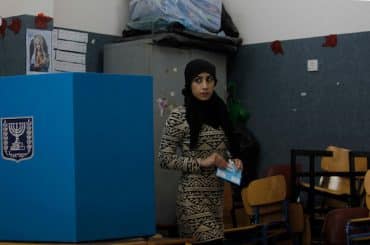
Palestine remains a dividing line on the left, as the Occupy movement shows. But Palestine solidarity activists seek to change that–will it work?
Anthony Alessandrini, an editor at Jadaliyya, had hopeful words for those seeking to organize with OWS activists around U.S. policy in the Middle East:
A generation that has been told that the greatest dream of the rest of the world is to be like “us” (so much so that this dream sometimes turns into its nightmarish, jealous, fairy-tale-villain opposite: “they hate us for our freedom”) has pointed to the place in the world that they have been told is the most backwards, the most “undemocratic,” the place in most dire need of being saved (by force, if necessary)—OWS looks to Cairo and says: we want to do what they have done. We want to make Tahrir in New York. We want to fight they way they fight. One more step (a huge step, a slow, agonizingly slow step) to: their fight is our fight.
OWS declares itself to be inspired by the Arab Spring. Many of those who have made OWS may not necessarily even know what they mean by this, and as recent events show, many of the participants have a lot to learn before a real solidarity can be built. But the good news is that they have not stopped wanting to learn, and if we can keep our patience, we—and I mean all of us—can maybe learn together, as Beckett might have put it, if not to succeed once and for all, at least to fail better each time.
Or so it seems right now. It’s a good moment for wild mood swings. The one thing that is certain is that OWS isn’t going anywhere; it’s going to take its sweet time, and those who have created it have made it clear that they are planning to stay, and to fight. And it’s certainly true that those who are struggling in Egypt, in Palestine (like the Palestinian Freedom Riders), and throughout the world aren’t going anywhere either. Time, as always, to get back to work.
As Alessandrini notes, OWS “has attempted to seize…the time (and, equally necessarily, the space) to have these sorts of important political conversations.” Palestine solidarity work in OWS will have to fight to occupy that important space.
“Palestine remains a dividing line on the left, as the Occupy movement shows. But Palestine solidarity activists seek to change that–will it work?”
Alex, I think this is inaccurate. If the goal is to make Palestine more of a consensus issue in the left, the solution is to have formulations that rest on the current opinions and priorities of the different streams in the movement.
My read is that some pro-Palestinians activists are perfectly fine with a dividing line, it’s that they want to reverse the power dynamic so that they can exclude those who strongly oppose them, instead of feeling victimized by those who would exclude them. (For example, when activists in the Labor Outreach Committee tried to exclude Stuart Applebaum from a meeting because they disagree with him on the I/P issue.)
It would be great if OWS was a place where the broad left could come together and ‘agree to disagree’ on certain issues respectfully, and keeping the focus on whatever points have broad support. That probably would include solidarity with Palestinians per se, but would exclude highly specific formulations.
the boston action at the consulate was not a “sanctioned” occupy boston action……
But Finkelstein speaks at occupy boston today…….
As for “official OWS” inclusion – who cares? Palestine is part of the discussion among people at the occupation(s) and more importantly Palestine is part of the discussion internationally, independent of what is being discussed here in the states.
Also, isn’t answering the question you pose about Palestine inclusion, specifically in New York worth answering? An even better question might be, why in Boston, but not in New York? I would also add that the way you start your piece is misleading – I think it should read ” one of the main objections among jewish occupiers….”
Palestine will be a dividing line on the left as long as gentiles let jews dominate all things I/P in the US – full stop.
Since OWS is largely about economic matters, OWS people (and MW readers) will enjoy the valuable New Yorker essay on Brazil’s amazing people-centered economy in which, unlike the USA, people matter perhaps more than bankers and businessmen — and all prosper. The USA’s unpleasant economic fixations (like its unpleasant fixations w.r.t. Israel) exist because of constant enforcement action, not because they make much sense. Neoliberalism has been put over on us and on much of the world, but it is not necessary, just “good” for big capital at everyone else’s considerable expense.
More on the same New Yorker article: arguing that Brazil should be a permanent member of the UNSC, Lula (Brazil’s former president) asks, “How come in 1948 the U.N. was wise enough to create the State of Israel, and in 2011 it is not wise enough to create a Palestinian state?”
This is my general take on these matters: it was a huge mistake to create Israel in the first place and the entire project is going to come to a very bad end indeed for everyone involved (and especially for the United States). Truman’s national security experts knew what they were talking about, as did Jewish anti-Zionists during the early decades of the 20th century. They had it figured out.