

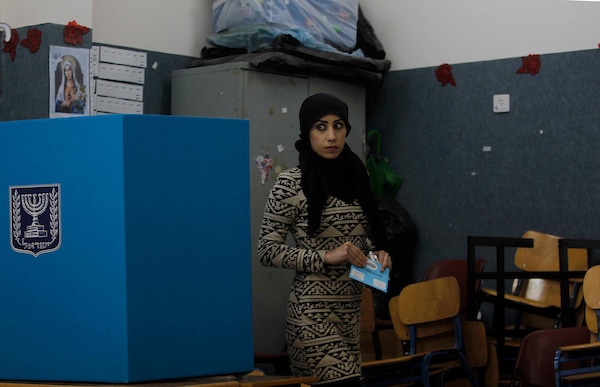
As the next Israeli elections draw nearer, with only three months to go, Palestinian citizens of Israel are facing the question of their role and place in Israeli politics. For years, Palestinians with Israeli citizenship have been split between those who support the use of their right to vote and to be represented in the Israeli government, and those who refuse to take part in Israeli elections, which they view as futile.
This year, the question comes in a particularly delicate context. After nearly three years of genocide, and in the midst of an unprecedented rise of far-right, anti-Palestinian sentiment in Israeli politics, many Palestinians in Israel feel the importance of asserting their presence. The possibility of doing so depends on convincing enough Palestinian voters of the utility in their vote, and mobilizing on election day. This requires producing a united Palestinian discourse, which can’t yet be taken for granted.
Palestinian political forces in Israel don’t see the coming elections with the same perspective. While most major parties focus on increasing Palestinian turnout to counter the Israeli far-right and assert the weight of Palestinian presence, some prioritize winning a seat in the coming government – even if it comes at the expense of united Palestinian representation. These differences arise amidst an increasing state crackdown on Palestinian activism in Israel, a worsening of conditions among Palestinians in terms of insecurity and demolitions of their property, and an exponential rise in religious and ethnic Israeli extremism and hostility towards Palestinians.
The dilemma facing Palestinians inside the Green Line
Since Israel’s inception, Palestinians have been regarded as a hostile presence by the Israeli establishment, referred to as a “demographic threat,” while entire political parties advocated for their forced removal from the country altogether. After the Nakba, Palestinians who survived expulsion became a minority inside the newly established state, placed under harsh military rule from 1948-1966. Throughout this period, Palestinians were granted the right to vote and be elected, but couldn’t form their own political parties until 1981. Since then, several Palestinian parties emerged and succeeded in winning seats in the Knesset, but failed to change the state’s policy towards Palestinian citizens of Israel and beyond.
Through their unique relationship to the Israeli state, ‘48 Palestinians (“48 Palestinians” refers to the Palestinian citizens of Israel—the indigenous population that remained within the 1949 armistice borders following the 1948 Nakba and the creation of the Israeli state) endure a number of intra-Palestinian issues imposed by occupation and increasing hostility from the Israeli far-right. These tensions are an intentional byproduct of Israeli statehood, further disenfranchising Palestinians by limiting their ability to affect change in the legal system.
To this day, Palestinian communities don’t have state-recognized urban plans. State expenditure for their communities is very limited compared to public expenditures in Jewish cities. Dozens of Palestinian villages are unrecognized by the state, enabling hundreds of demolitions of ‘Arab’ property every year. In recent years, Palestinian citizens of Israel have been facing another growing problem: the increase of armed, organized crime in their communities, amidst what many describe as Israeli police neglect.
In 2025, organized crime killed at least 250 people in Palestinian communities in Israel, according to Palestinian media reports. That number has exceeded 157 since the beginning of 2026. In January, Palestinians in the city of Um Al-Fahm marched in the thousands to protest against organized crime and police neglect of their communities. Under the pressure of the Palestinian street, representatives of the four leading Palestinian parties in Israel met in Um Al-Fahm — Hadash (Democratic Front for Peace and Equality), a coalition of Arab and Jewish non-Zionist left parties and figures, Ta’al (Arab Movement for Renewal), Balad (National Democratic Assembly), and Ra’am (United Arab List), an offshoot of the southern branch of the Islamic movement in Israel.
The four parties pledged to form a joint list in the coming elections. They first formed a joint list in 2015, which collapsed in 2021 upon Ra’am’s split.
Ra’am is led by Mansour Abbas, a Palestinian politician with a background of activism in the Islamic movement. Abbas grew close to members of Likud following his party’s split from the joint list, with hopes of joining the government coalition. He now says he has no contact with the Likud, but maintains a pragmatic stance, seeking allies within Zionist politics, based on the belief that “positive change for ‘48 Palestinians can be best achieved from within a government coalition.”
In recent months, Ra’am has held lengthy talks with the other three parties to reach an agreement. However, in June, talks reached a breaking point, with Abbas’s Ra’am reportedly withdrawing from the joint list, in hopes of participating in the upcoming Israeli cabinet.
In mid-June, Haaretz quoted Samer Swaid, director of the ‘Arab center for alternative planning’, an Arab think tank in Israel, saying that, according to their polls, around 50-54% of Arab voters are expected to turn out in October. Swaid highlighted that this figure can rise to 60-63% if Arab parties form a joint list, making the Palestinian vote a significant factor in the coming elections.
ِAccording to Razi Nabulsi, a Palestinian from Galilee and researcher at the Institute for Palestine Studies, the main challenge ahead of Palestinian citizens of Israel is that today’s Israeli political scene no longer has a place for a Palestinian voice, even if moderate.
“Zionist politics in the past dreamed of a Palestinian voice like Mansour Abbas, who would accept joining a Zionist-led coalition,” Nabulsi told Mondoweiss. “Today, Mansour Abbas is looking for somebody in the Zionist establishment to take him on, but they consider allying with him a stain, despite his positions.”
“The question is, how far can Palestinian votes produce any change on their issues?” Nabulsi noted. “Many Palestinians don’t vote out of realization that their vote doesn’t have any effect, especially under an explicitly racist Zionist consensus,” he said.
In Palestinian parties, the efficacy of votes is understood with a different logic. Aida Touma-Suleiman, a Knesset member for the Democratic Front for Peace and Equality, told Mondoweiss that “the main objective of Arab parties in the next elections is to stop the Zionist fascist right wing from coming back to power.” According to Touma-Suleiman, the votes of Palestinians in Israel “can take away seats in the Knesset, and diminish the chances of the fascist right wing, responsible for the genocide in Gaza, of coming back to office.”
Touma-Suleiman admits that “neither faction in the Zionist political spectrum will fulfill our demands and our hopes of equality, or end the occupation.” However, she stresses that “if they were all exactly the same, then there wouldn’t be a reason for us to do politics in Israel, but in reality some are more pragmatic, and somehow susceptible to international pressure or legal considerations.” Touma Suleiman highlighted what she views as the importance of Palestinians voicing their presence through votes and taking part in ousting the coalition that led the genocide.
What vision beyond elections?
Razi Nabulsi argues that “Arab parties have been trying to make this kind of stand in elections for years, but what is their capacity to produce new ideas?” According to Nabulsi, “even if these parties have a capacity to gather enough votes to oust the current coalition, without a strategic vision beyond elections, for the future of Palestinian presence in the country, these votes remain largely symbolic.”
Aida Touma-Suleiman points out that “Arab parties in Israel have a strategic vision, laid out in our political platform which we elaborated together.” Touma-Suleiman refers to the political platform of the joint list in 2015, which included obtaining the recognition of Palestinians in Israel as a national minority, with autonomy over their cultural and educational life, full equality (especially in urbanization, building, and demolition policies), countering racism and discrimination in all institutions, and supporting the resolution of the Palestinian cause based on international law.
Touma-Suleiman proclaims “this is our strategic vision, but we need to have representation and prevent genocidal fascists from getting to power again, in order to be able to defend it.”
For Razi Nabulsi, this platform is “difficult to concretize in the midst of an increasingly racist Israeli political scene, and with the tools of the Israeli state.” Nabulsi also believes that “such a vision doesn’t include new ways of action for Palestinians, adapted to the current conditions.”
The building of strategies to change reality from within the system “is something done in a real liberal democracy, which Israel is not,” according to Sami Shehadeh, a former* member of Knesset for Balad – the Democratic National Assembly party. Shehadeh told Mondoweiss that “Palestinian political actors are not delusional, and we understand that we are not in a democratic system that would allow us to advance change through its institutions, which is why our mission is different.”
Shehadeh considers that “since Israel is dominated by a mindset of racism and genocide, our historical mission is to present the alternative, as loud and clear as possible, and mark the contrast between our two visions as clearly as can be.” For him, Palestinians in Israel are not acknowledged enough, and are generally ignored.
This, according to Shehadeh “makes it difficult for citizens of western democracies to understand how much Israel is not a normal democratic system, and our role is to present a contrasting vision, an alternative vision with the legitimacy of votes, and highlight this reality.”
Different labels, same reality
Last month, Israel’s national security minister Itamar Ben-Gvir, known for his hard-line policy against the West Bank and Gaza’s Palestinians, bragged that his security forces demolished more than 5,700 Palestinian properties in Israel in 2025. Ben-Gvir also boasted that 20,000 more would be demolished in 2026.
At least 45 Palestinian villages in the Naqab desert in southern Israel remain unrecognized, with Israeli plans to replace them with Jewish farming towns. At the same time, Palestinian neighborhoods in main cities continue to be safe havens for armed, organized criminal groups. According to an Israeli report last February, reported by ‘48 Palestinian media, some 20% of Palestinian families in Israel live under the poverty line.
In November 2024, Israel’s own national program for health quality indicators reported that, compared to Jews, Palestinians in Israel had lower life expectancies, and higher infant mortality rates, due to a discriminatory policy in health care expenditure between Arab and Jewish communities.
This reality highlights the similarities between the reality of ‘48 Palestinians and Palestinians in the rest of historic Palestine, marked by the same Zionist structures ruling their lives. Or, as Aida Touma-Suleiman puts it: “Our cause as Palestinians in Israel is existential, and it is part of the larger cause of the Palestinian people.”
* An earlier version of this article incorrectly stated that Sami Abu Shehadeh is a current member of Knesset. The article was updated on July 22, 2026.
Qassam Muaddi
Qassam Muaddi is the Palestine Staff Writer for Mondoweiss. Follow him on Twitter/X at @QassaMMuaddi.
Part 1
First of all , compliments to MW. I’ve repeatedly complained that MW refuses to report from Israel and now, at last , a report on Israeli politics, with a focus on the extremely important Arab vote. However there are some omissions and errors.
Some comments;
1.The United Arab List led by Dr. Mansour Abbas was part of the Bennet-Lapid government coalition. From wiki:
On 2 June 2021, party leader Mansour Abbas signed an agreement to form a coalition government, the first time an independent Arab party became a member of the Israeli government, and the first time in more than 50 years that any Arab party formed part of the Israeli government; a photograph of Abbas, sitting with Yair Lapid and Naftali Bennett, signing the coalition agreement was widely circulated.[26][23] The agreement included guarantees that more than 53 billion shekels (US$16 billion) would be spent to improve infrastructure and reduce crime in Arab towns, provisions protecting homes built without permits in Arab villages, and recognition for Bedouin towns in the Negev desert.[14][27]
On 28 October 2021, the cabinet approved a plan to spend US$9.4 billion to improve employment opportunities and health services for Israeli Arabs and improve housing, technology, and infrastructure in Arab areas;[28][29] it included a further US$1 billion to address high crime rates in Arab areas.[28][30] In the scale of funding range of issues in the Arab community addressed, the plan had little precedent in Israeli history, and Abbas and Ra’am were widely credited with pushing forward what Abbas called a “historic step” forward for Arab Israelis.[25][29][31] The plan was signed into law when the budget passed on 4 November.[32]
At the United Arab List’s urging the coalition government recognized several Bedouin villages and connected thousands of previously-illegal homes to the electrical grid.[25][33][34]
2. Oct.7 :The Arab citizens were also traumatized . On that day Arab civilians were also murdered and kidnapped. Arab civilians were also casualties of Hezbullah and Iranian rockets. In the aftermath of Oct.7 many Arab civilians volunteered where needed , side by side with their Jewish neighbors.
part 2
3. No mention of Arab ministers and deputy ministers, committee chairpersons in the Knesset, Supreme Court Justices. Also their significant presence in medical professions . (My family doctor and my orthopedist and my eye doctor -are all Arabs.) I’m not trying to idealize. There’s been progress but they still certainly suffer from racism and inequality. Here in the Negev I’m involved with this group: https://www.dukium.org/ Donations are welcome.
4.Indeed the importance of the turnout of Arab voters in the upcoming elections can hardly be exaggerated . It’s crucial! In the last elections Arab turnout was 53.2%. Turnout country-wide was 70.6%. If the Arab turnout would reach that number, the achievement would be sensational . 20-25 Arab members of Knesset would be a tectonic shift.
5.”couldn’t form their own political parties until 1981″ – not true.
“The possibility of doing so (engaging politically) depends on…. producing a united Palestinian discourse.”
__________________________________________________
Mondoweiss is positioned to facilitate.