


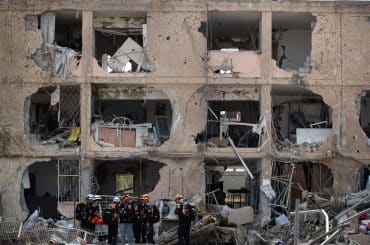
Graphic from ThinkProgress last August

Some rays of light amid the Iran warmongering. Yesterday the New York Times ran an important piece on the Iran war saber-rattling saying that it recalled the buildup to the disastrous Iraq war. Reporter Scott Shane several times made the Israel connection:
With Israel and Iran exchanging accusations of assassination plots, some analysts see a danger of blundering into a war that would inevitably involve the United States.
Echoes of the period leading up to the Iraq war in 2003 are unmistakable, igniting a familiar debate over whether journalists are overstating Iran’s progress toward a bomb. Yet there is one significant difference: by contrast with 2003, when the Bush administration portrayed Iraq as an imminent threat, Obama administration officials and intelligence professionals seem eager to calm the feverish language..
With the notable exception of Representative Ron Paul of Texas, Republican presidential candidates have kept up a competition in threatening Iran and portraying themselves as protectors of Israel. A bipartisan group of senators on Tuesday released a letter to President Obama saying that new talks could prove a “dangerous distraction,” allowing Iran to buy time to move closer to developing a weapon..
the news media, including The New York Times, which ultimately apologized to readers for some of its coverage of claims of Iraqi weapons of mass destruction, are again under scrutiny by critics wary of exaggerated threats. Both the ombudsman of The Washington Post and the public editor of The New York Times in his online blog have scolded their newspapers since December for overstating the current evidence against Iran in particular headlines and stories.
Jim Fallows, an important voice during the Vietnam debacle, approves this piece at the Atlantic:
it’s very good to see the NYT running, on page one and above the fold, an analysis of the reckless agitation for a preemptive military strike on Iran, and of the risks this talk holds for all involved. Lots of people wrote these analyses, after the fact, about the panicky rush-toward-war mentality that preceded the invasion of Iraq in 2003. It is certainly better to start talking about the problem now, when “hey, wait a minute” thoughts can make a difference.
Peter Beinart at the Daily Beast says that an attack on Iran makes no sense, but the hawks are winning the debate:
And who are the hawks who have so far marginalized the defense and intelligence establishments in both Israel and the U.S.? They’re a collection of think-tankers and politicians, most absolutely sincere, in my experience. But from Rick Santorum to John McCain to Elliott Abrams to John Bolton, their defining characteristic is that they were equally apocalyptic about the threat from Iraq, and equally nonchalant about the difficulties of successfully attacking it. The story of the Iraq debate was, in large measure, the story of their triumph over the career military and intelligence officials—folks like Eric Shinseki and Joseph Wilson—whose successors are now warning against attacking Iran.
How can it be, less than a decade after the U.S. invaded Iraq, that the Iran debate is breaking down along largely the same lines, and the people who were manifestly, painfully wrong about that war are driving the debate this time as well? Culturally, it’s a fascinating question—and too depressing for words.
Yes culturally it’s a fascinating question. And I don’t think Beinart is completely forthcoming; he went down the waterslide himself, he supported the Iraq war and back then he credited the influence of Paul Berman, Robert Kagan, David Frum, Tamara Cofman Wittes and Kenneth Pollack. The cultural question he addresses is the Israel lobby: the aggrandized role inside the Jewish community (and the American establishment) of neoconservative extremists. Who gave the neocons power? Liberals did. And culture played a significant role.
Note that Eli Clifton (who reports that Tucker Carlson says Iran should be annihilated) broke open the Israel lobby piece of this story months ago at Think Progress:
a Tuesday press release [PDF] from the American Israel Public Affairs Committee (AIPAC) brings to mind eery parallels between the escalation of sanctions against Iran and the slow lead up to the invasion of Iraq in 2003.
Now (and again thanks to Ilene Cohen) here is Yossi Verter, in Haaretz, saying that even people in Israel are sick of the saber-rattling. And Shimon Peres is trying to box out the hawks with Obama.
President Shimon Peres is expected to tell U.S. President Barack Obama early next month that he does not believe Israel should attack Iran in the near future.
…According to these officials, Peres is close to Prime Minister Benjamin Netanyahu’s position on Iran, while Defense Minister Ehud Barak is perceived, at least by the Americans, as pushing for an attack.
Peres told officials that there is no point in what he called the “unceasing self-intimidation” being voiced by senior Israeli spokesmen. This is what he intends to tell Obama.
This piece further undermines the reports by Jeffrey Goldberg in the Atlantic in 2010 and Ronen Bergman in the New York Times Magazine that cast an Israeli attack as inevitable and logical, based on Israeli military and government sources. Who were they talking to, and why were they parroting their views? Self-intimidation indeed.

“This piece further undermines the reports by Jeffrey Goldberg in the Atlantic in 2010 and Ronen Bergman in the New York Times Magazine that cast an Israeli attack as inevitable and logical, based on Israeli military and government sources. Who were they talking to, and why were they parroting their views? Self-intimidation indeed. ”
Wait, you mean Goldberg et al are not hacks writing for Israeli interests?
You mean there is actually a much more nuanced debate inside Israel on this issue(which is often repeated but is it really?)
Shock.
The problem is perhaps even larger.
It is basically futile for Iran to try to satisfy “us”. They should prove the negative. This would require to open for inspection all “suspect sites”, including the sites which held military secrets that Iran must have to survive. Two regimes that fully complied were subsequently destroyed.
The only way to resolve the issue of proliferation is if both sides exhibit some degree of good will, but it is forbidden in our political discourse to show any “good will” to an “evil regime”. So the best we can hope for is that we will keep sanctions forever. Consequences at the moment are bizarre. Contrary to info “uncovered” by Jeffrey Goldberg, Saudi Arabia did not prevent the rise in the price of oil after new sanctions on Iran. China gets cheaper oil from Iran, Russia sells less to China and more to hapless Europe, for a better price. In other words, we organized a financial bonus for China and Russia and a symmetric penalty for Europeans — and ourselves. No other tangible benefits can be shown.
Some moronic strategists were on record that even if the Western sanctions on Iran will not ruin it, they will be expensive. But those “losses” are boon to China, India and Russia (Russia gets valuable price increases for its oil and gas), so it is not exactly a loss for Iran — actually, it shapes a Eurasian block than enhances the security of the regime of Iran.
Yes, I noted that “Culturally it’s a fascinating question–and too depressing for words” line. Many ways to read that. I read it as depressing that no one is willing to push back against the Israel lobby, which I think is Beinart’s take too, though he would find it more than I a problem internal to modern American Judaism.
February 22, 2012
Khamenei Reconfirms Fatwa Against Nuclear Weapons
In a speech to nuclear scientists Ajatollah Ali Kahamenei today reconfirmed his Fatwa against nuclear weapons:
On numerous occasions, the Iranian people and government officials have announced that they do not seek to develop nuclear weapons and that nuclear weapons have no place among the needs of the nation and the military system of the country. We believe that using nuclear weapons is haraam and prohibited and that it is everybody’s duty to make efforts to protect humanity against this great disaster. We believe that besides nuclear weapons, other types of weapons of mass destruction such as chemical and biological weapons also pose a serious threat to humanity. The Iranian nation which is itself a victim of chemical weapons feels more than any other nation the danger that is caused by the production and stockpiling of such weapons and is prepared to make use of all its facilities to counter such threats.
Reading the whole speech and understanding the logic of Kahmenei’s judgement may be worth your time.
Posted by b on February 22, 2012 at 10:57 AM
http://www.moonofalabama.org/2012/02/khamenei-reconfirms-fatwa-against-nuclear-weapons.html#comments
Get ready, Israel will attack Iran, and, the US will rush to support Israel with whatever it takes in treasure and grunts. The issue is solely in Bibi N’s hands. Can you imagine, during a campaign for POTUS, that any American POTUS (or congress), will stand up against going to the aid of Israel, once the Persians react with force to the attack on them? In my thinking, it’s already a done deal, the way the power politics will play out, no matter the price of gas at them pump. There is nothing in the current campaign for next POTUS that suggests otherwise.
What will happen will be, additionally, a result of the US and Israel each retaining hole cards. I suggest you look at the Yom Kippur War, and how it came about via semi-ignorant complicity of the players: http://www.counterpunch.org/2012/02/22/what-really-happened-in-the-yom-kippur-war/