Muhammad Nu’man, a tile layer from Beit Sira, west of Ramallah, heard the loud, haunting sound of sirens while driving on the highway from Modi’in to the Negev earlier this month.
The traffic suddenly slowed to a halt, and then, as the sounds grew louder, the chilling reality of the situation settled in: an Iranian missile was imminent.
Nu’man, 36, watched as drivers all around him abandoned their vehicles and hurried toward a nearby roadside shelter. But all he could do was remain behind the wheel, gripping it tightly as he mumbled a quiet prayer. He was banned from entering the shelter.
“I could not move at all…I just waited for my fate,” he recounted. “All I kept thinking about was whether I would make it back to my daughters…or would this car be my grave?”
About a month ago, Nu’man had smuggled himself through the separation wall all the way south to the Negev, where he works in construction, operating off the books for an employer who agreed to take him on condition that his presence would never be officially acknowledged.
He had no permit to work in Israel, no legal presence, and hence no access to any of its 11,775 public shelters, only 37 of which are located in Arab towns.
During the month-and-a-half of the U.S.-Israeli war on Iran, missile strikes on Israeli cities were a near-daily reality, and bomb shelters a fact of life. But not for everyone.
Nu’man and thousands of other Palestinian workers from the West Bank who have smuggled themselves across the Green Line have no such option. Accessing a shelter without proper documentation could lead to exposure, arrest, and deportation.
At a time when conditions in Israeli prisons have been described as “torture camps,” the fact that thousands of Palestinian workers risk arrest just to make a living shows the level of desperation to which they have been driven. This was most recently illustrated when a viral video earlier in the month showed dozens of Palestinian workers being arrested by Israeli police after they emerged from the container of a garbage truck that had smuggled them past the Green Line.
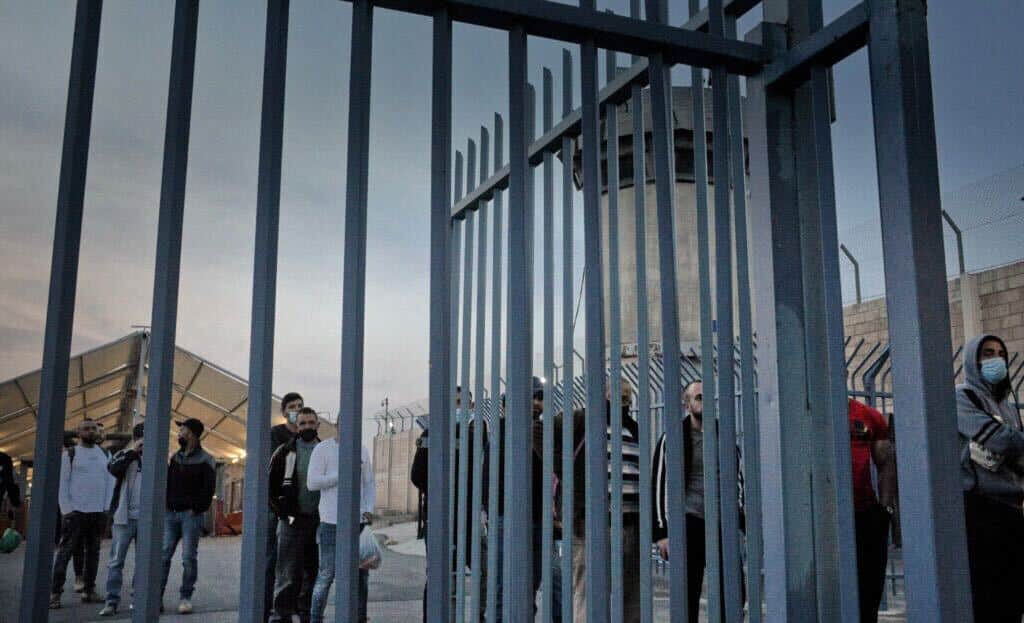
‘We are forbidden from entering the shelters’
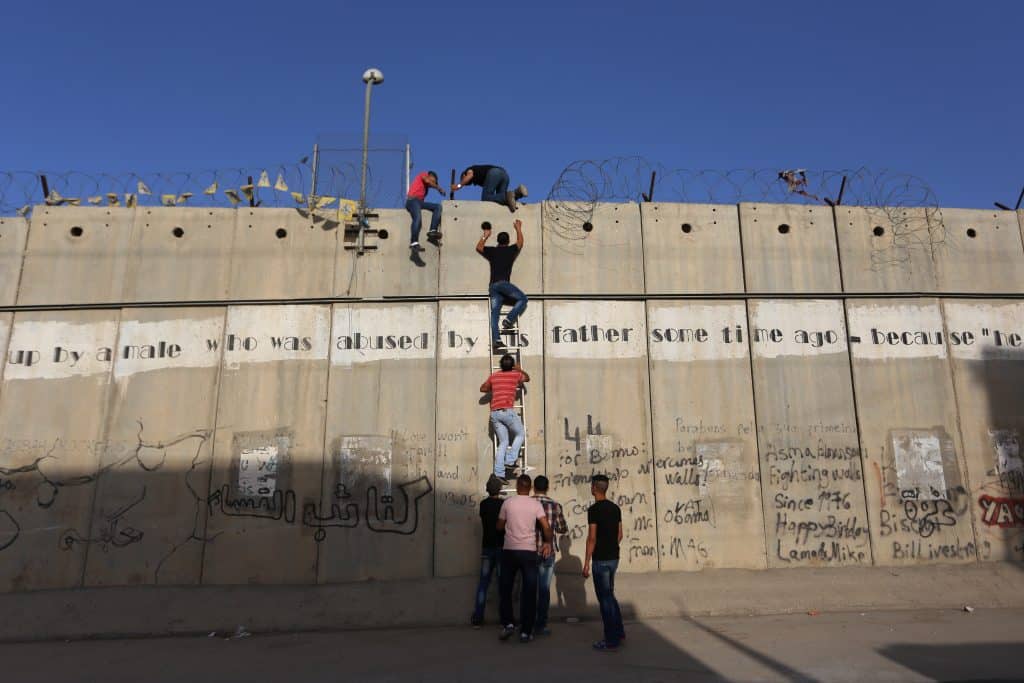
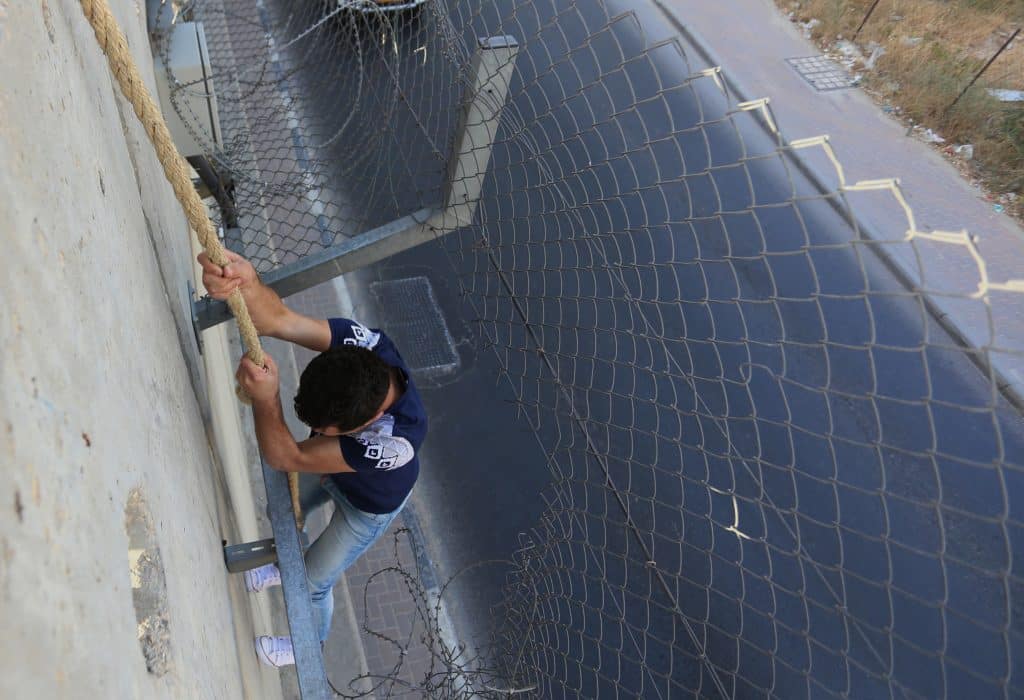
Nu’man usually crosses into Israel by climbing the separation wall in al-Ram. Workers gather before dawn and line up, with those arriving first moving ahead. They climb a ladder on one side, pull themselves over the top using a rope, then descend with another rope before dropping from a height of about eight meters.
“The driver waiting on the other side is unknown to them, as each step is handled by different people,” he said.
Some workers have been shot and killed by Israeli forces during the attempt.
In Beer Sheva, often referred to as the capital of the Negev, Nu’man stayed at the accommodation provided by his employer. He slept, ate, and worked at the same site and did not leave. His experience is shared by thousands of Palestinians from the occupied West Bank who work inside Israel.
Before October 2023, about 140,000 Palestinian laborers held permits to work in Israel, accounting for 29% of the construction workforce. An additional 40,000 were employed illegally in settlements and industrial zones.
In the aftermath of the Israeli genocide in Gaza, Israel barred most Palestinian workers from entering. Today, only about 7,000 are permitted to enter each month. Many turned to smuggling themselves across walls and in hidden vehicles.
Mu’tasim al-Faqih, 33, from the village of Qatanna near Ramallah, has worked in interior finishing in Tel Aviv since he was 22. Before the war, his Israeli employer treated him warmly enough to give him a gift worth 10,000 shekels ($3,200) when his son was born. But after the war in Gaza, that relationship changed. Al-Faqih’s hourly rate dropped from 800 NIS ($255) to 500 NIS ($160).
“There is no alternative,” he said. “Workers are many, jobs are few, and the employer weighs the risk of the police against the need.”
Al-Faqih has worked for the same family long enough that his employer trusts him and personally drives him across the Ni’lin checkpoint. But after the war, secondary crossings were shut down, leaving only official checkpoints and raising the stakes for both.
Al-Faqih was caught once, detained for 24 hours, then released. He went back to work the next day because his monthly obligations left him no choice.
Employers who hire undocumented Palestinian workers routinely deny them access to on-site safe rooms, fearing that the presence of illegal laborers on their premises would draw police scrutiny, fines, or closure.
During the earlier 12-Day War on Iran, al-Faqih was working in a new building that had functioning shelters. He slept inside one until the danger passed. This time, he’s renovating an older site with no safe rooms. He, his brother, and a cousin moved into a small apartment in the same structure occupied by Jewish tenants, but they do not use the building’s shelter.
“We are forbidden from entering because the other residents might ask about our nationality and report us,” he said.
At night, from the upper floors of a 13-story building, the three men listen to a radio and wait. They joke about this being their last days, but all cling to the hope of one day returning home.
Al-Faqih supports his elderly father, who lost his job after October 2023, as well as his recently married brother, who is still paying off a new home, and another brother who earns unstable wages from agriculture in the West Bank.
“I have huge responsibilities. I cannot walk away from what I owe,” he added.

‘All we can do is run to the stairwell’
Muhammad al-Qadi, a human rights expert, said the policy violates international law, noting that “Israel is obligated to protect the right to life and physical safety… regardless of nationality or legal status,” and that denying shelter or arresting people seeking protection is discriminatory and arbitrary.
Across Israeli construction sites, factories, and renovation projects, Palestinian workers describe the same pattern. Mujahid Nimr, 36, lives in Ramallah with his wife and two daughters, Sida, 6, and Mila, 18 months. He worked in a meat processing plant near Ashkelon before the permits were cancelled.
With construction the only sector still absorbing Palestinian labor, Nimr took it up despite having no experience. He now enters Israel through smuggling routes to work on building sites in Rishon LeZion, south of Tel Aviv.
Each morning, an Israeli taxi driver who does not speak Arabic collects Nimr and three other workers. Each of them pays 500 NIS ($162) per trip. They pass through the Ni’lin checkpoint under an arrangement between the driver and soldiers, with the vehicle waved through without inspection in exchange for payments the driver makes for each crossing. Because of this arrangement, Nimr can only return to Ramallah once every three weeks.
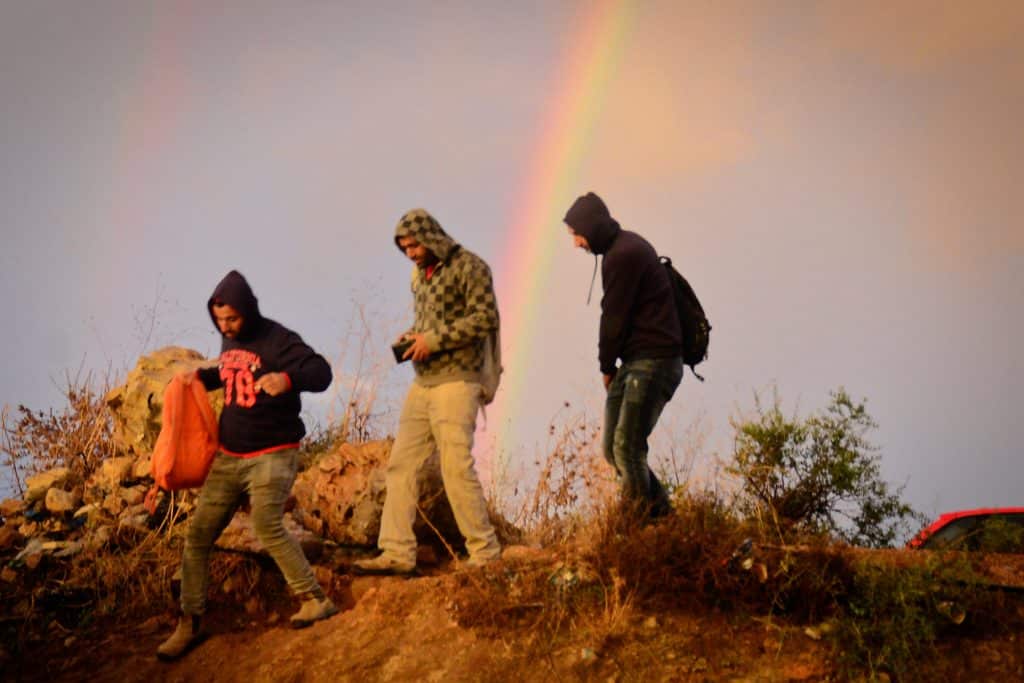
During the latest escalation, his employer did not offer protection.
“He says that whoever wants to go back to the West Bank can go, whoever wants to stay can work,” Nimr recalled. “He told us there are no shelters to protect us, and that all we can do is run to the stairwell when the sirens go off.”
He described days when the explosions came close enough to damage surrounding buildings. Workers were banned from standing outside. When they heard the sound, they ran downstairs and pressed themselves against the stairwell walls until it passed.
Although he returned to Ramallah two days before Eid to be with his family, he said he had to return after the holiday.
“There were days when the explosions were close enough to damage surrounding buildings,” he said. The stairwell, he knows, will be waiting.
This story is produced in collaboration with Egab.