

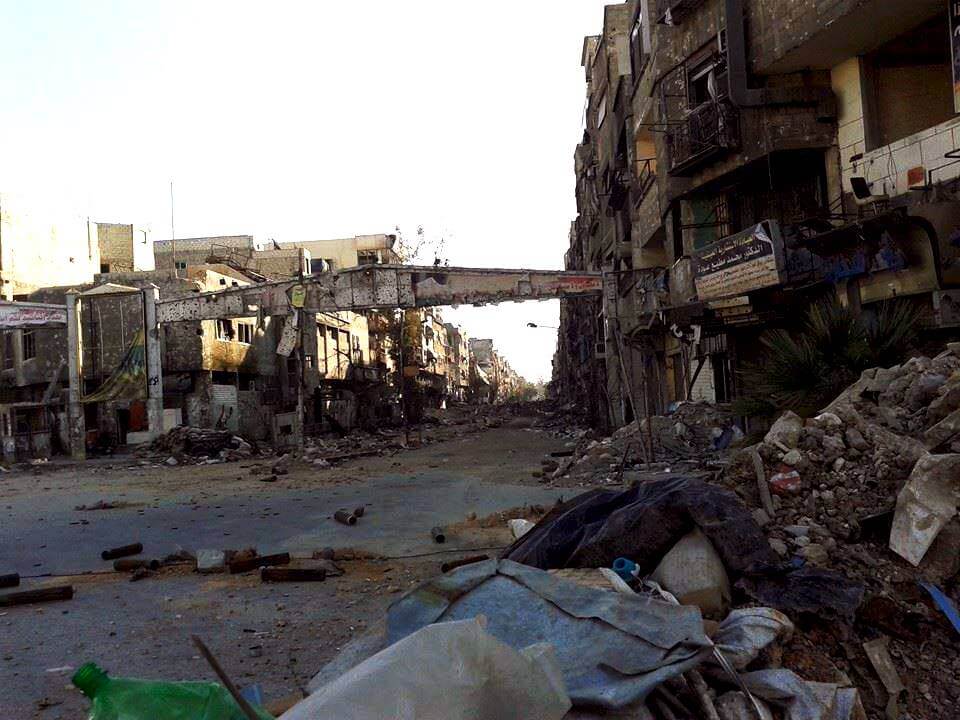
A week ago the world rejoiced when food trucks finally arrived to Yarmouk refugee camp in Syria to alleviate mass starvation, after nearly 200 days of siege and over 50 dead. Parcels of lentils, oil, sugar, rice and noodles were distributed. People gathered in the streets to cook a coffee-table-sized pot of soup. But an hour later two blasts hit the camp, and the siege and its bombing campaign were back.
“The day before the food arrived there was an explosive dropped from a helicopter, and the day the food arrived, two shells from the Syrian army hit the camp,” said Ramy al-Asheq, a Palestinian journalist and poet from Yarmouk camp now living in Jordan.
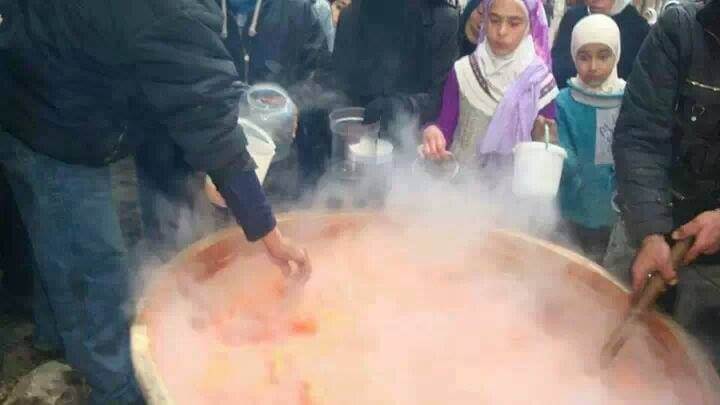
Even after the food arrived, it did little to curtail the starvation throughout the camp that has emaciated its lingering 40,000 residents. The death toll now has exceeded 63, jumping ten more after the food trucks entered. Abdallah, 24, a Palestinian raised in Syria living inside of Yarmouk, said only 50 food parcels came:
“Finally, after all the pressure and the popular media and international attention, the Syrian government has only allowed 50 food parcels—with the knowledge that the number per household exceeds twelve persons per family inside the camp. The living conditions are in the worst stages. The introduction of some food parcels did not change the fact that the tragedy in the camp already caused more than 55 deaths due to hunger and the majority of children are suffering from malabsorption and malnutrition.”

The first death
Before the aid convoy entered Yarmouk on January 18th, the scene inside of the camp was brutal. There’s a group of young volunteers that check houses for new dead, daily. Although the siege began almost seven months ago, the first death was on August 18, 2013 when an infant, Jana Ahamed Hasam, died.
“Jana could not be breastfed because her mother had been unable to enter the camp since it was cut off by the blockade,” said the Palestinian Association for Human Rights in Syria in a report on the starvation published earlier this month. By Christmas, 23 were dead. Among the fatalities were those caused by a lack of medical supplies for those who’d sustained injuries from a succession of bombs that have hit Yarmouk almost daily since last fall.
“Total closure means nobody and nothing goes in or out. So there is now a total lack of food, medicine and diesel, and all other materials,” said Nayef, a Palestinian from Syria who fled to Spain last year. “For the past nine months there is a shortage of electricity and the situation is more and more collapsing …there are around 500 wounded persons and they need special care, direct medical help and evacuation.”
Nayef is in daily contact with people inside of Yarmouk, receiving updates from one of the few organizations still active on the ground. He went on to describe a horrific scene of desperation:
“People now are eating grass from the ground and people have begun to eat cats and dogs as meat for a protein meal. Most of the children in Yarmouk are suffering from blood problems and weakness, and other health issues related to malnutrition. For seven months no vaccines have entered the camp.”
The camp is kept closed to the outside world by a checkpoint on the north end. Before the siege, Palestinians like al-Asheq could sneak in and out, bringing along whatever they could carry. But al-Asheq too fled in 2012 after it became impossible to continuously pierce the barricaded peripheral quarters– although he said militias were still able to find ways to enter until February 2013. At that time he left Syria for Jordan, but al-Asheq was not allowed in the country. Instead he was sequestered in a camp on the border. After a few days, al-Asheq snuck out of “Cyber City” camp and traveled to Amman where he now sofa hops at the apartment of friends. There is a warrant out for his arrest from Jordanian authorities, he said, and he has been told that if he is caught, he would be hot-returned to Syria.
Why starve Yarmouk?
Syria’s war has spiraled into a seemingly endless stream of death, where mass casualties of non-combatants have become the norm. The United Nations will no longer count the dead. The U.S., though at one time eager for a militarized intervention, has conceded, “there is no military solution to the violence that has displaced millions and taken more than 130,000 lives,” in the words of Secretary John Kerry. Still one of the more difficult questions with Yarmouk’s siege is why al-Assad’s forces are keen on killing tens of thousands of refugees by cutting off access to food and water.
Although Yarmouk is a refugee camp, it’s more like a neighborhood of Damascus, but with poor infrastructure. It spans two square kilometers and before Syria was engulfed in conflict, housed close to 200,000 people. In 2011 the UN reported around 160,000 lived in Yarmouk, but by the time the siege sealed it off only around 40,000 remained. The residents are a conglomerate of Palestinian refugees and somewhere between 5,000 and 10,000 Syrians.
Yarmouk’s only checkpoint is guarded by two Palestinian splinter groups founded and headquartered inside the camp, and Syrian regime security forces. They can be found at the north end of Yarmouk, toting machine guns. In mid-January an eight-year old from Yarmouk thought the checkpoint had opened and ran towards it. When he reached a distance of 500 meters, the checkpoint guards shot and killed him.
Even before the war broke out, the Palestinian parties now guarding the checkpoint, the Popular Front for the Liberation of Palestine-General Command (PFLF-GC; no relation to the secular socialist party, “the PFLP,” an active member of the PLO) and Fatah Intifada, were already aligned with al-Assad, and had made enemies with their neighbors inside of Yarmouk. In June 2011 after a protest where Palestinians refugees breached the border with Israel, the PFLP-GC gained a reputation inside of the camp as thugs for putting protesters in danger. At the demonstration, Israeli soldiers opened fire. Twenty-three were killed. Palestinians like al-Asheq view the PFLP-GC as responsible for leading the marchers into danger, while trailing from a safe distance.
Within days of the 2011 demonstration, young Palestinian activists stormed the PFLP-GC offices in Yarmouk. The party then opened fire and 11 were killed. Abdallah described it as a “pure massacre.” Because the weapons used by the Palestinian armed group were sanctioned by al-Assad, by the time Syria had fallen into warfare, Yarmouk was already divided. The PFLP-GC had sided with the regime, yet most of its residents sought to keep out of the conflict.
Then in late 2012 a wave of opposition sympathizers and fighters sought refuge in the camp and regime forces retaliated with tanks. At that time, the PFLP-GC aided the regime in door-to-door raids; the war had become local. But now, the PFLP-GC members have cleared out except for the checkpoint and a few snipers, and the only residents left who live inside the camp are viewed as associated with the opposition, whether they are involved or not. And al-Assad forces have decided to purge this quarter where none of their allies are living.
Since the first aid convoy entered Yarmouk, the United Nations Refugee Works Agency (UNRWA) has encouraged citizen lobbying for continual breaches of the siege. An online campaign was launched with more than 10 million on Twitter involved. As a result a second food package entered Yarmouk on January 21st. “[A]fter waiting all day [we were] permitted to deliver only 26 food parcels, which means to date, we have delivered just a few hundred food parcels,” said UNRWA spokesperson Chris Gunness. Still, Gunness described the aid as, “a drop in the ocean. We demand that Yarmouk and other civilian areas throughout Syria are open to safe, regular and substantial humanitarian access.”
Even if more food aid arrives, it cannot roll back the damage that has already been done to the thousands who are starving.
“There are two more that died after we talked, and one died yesterday after the receipt of aid,” said al-Asheq. “Only those whose names are documented are listed in the count as of now. Maybe tomorrow we will find more bodies of the dead in their homes.” Still, however grim the future of Yarmouk seems, the young journalist and poet will continue to push to end the siege. And in the meantime, he is publishing a book of poems, which will launch in Cairo.
“I write poetry about the revolution,” said al-Asheq. He also is a noted songwriter, drafting lyrics for well known Syrian musicians including the national darling Assala Nasri. But because he is a wanted person, a refugee who escaped a refugee camp, al-Asheq is not free to attend the exhibit. “I will not travel, the book will travel, only,” he said.
No diesel, no electricity for 9 months and nobody enters or leaves; how are the messages and photos getting out?
Absolutely no doubt that the situation in the camp is very very serious, but also very hard to distinguish what is true and what is made up. Either way, it’s a very sad situation.
Allison, it sounds like you are in Jordan where you can interview Syrian-Palestinian refugees? It would make it easier to understand your article if that was clear.
This statement is a little ambiguous: Yarmouk was already divided. The PFLP-GC had sided with the regime, yet most of its residents sought to keep out of the conflict.
Divided implies into two, but we should know that it is at least three. The armed PFLP-GC militias, the Saudi/Qatar backed terrorists and, of course, most of the 160,000 innocent Palestinian refugees. The two armed groups (what are the numbers, a few thousand or so) are responsible for turning the camp into a war zone. Assad’s biggest failure of leadership is to allow that situation have emerged in the first place. He cannot be criticized for trying to isolate the terrorists once they have established themselves inside Yarmouk. Unless, of course, you think the Syrians should just surrender to the Saudi/Qatar terrorists that have invaded their country.
Thanks, Allison, for the one paragraph from a neutral party — UNRWA. Aside from that, not a word about Khaled Meshal, The Muslim Brotherhood, Hamas or Qatar. Yarmouk would be an island of peace if it weren’t for the perfidious PFLP-GC? The PLO, which has been trying to keep the refugee camps neutral, worked hard to broker a ceasefire for Yarmouk with the provision that no Palestinian parties, like Hamas or PFLP-GC, that were parties to the fighting could take part in the coalition managing the camp. The negotiations fell apart this fall because Hamas backed out.
If the U.S. had not insisted on financially supporting the rebels the death toll would be nothing like it is. The civil war would be nothing like it is.
Is Obama Trying to Resolve or Prolong the Conflict in Syria?
http://goingtotehran.com/is-obama-trying-to-resolve-or-prolong-the-conflict-in-syria
Will It Take 130,000 More Dead Syrians for the Obama Administration to Engage Iran in a Serious Effort to End the Syrian Conflict?
http://goingtotehran.com/will-it-take-130000-more-dead-syrians-for-the-obama-administration-to-engage-iran-in-a-serious-effort-to-end-the-syrian-conflict
“I write poetry about the revolution,” said al-Asheq.
There is NO revolution; this is NOT a revolution! This is a CIVIL WAR and civil wars are brutal on all sides. But worst of all is when civil wars are instigated by foreign elements as in this case: Qatar, Saudi Arabia and Israel with plenty of U.S. stoking!
“Then in late 2012 a wave of opposition sympathizers and fighters sought refuge in the camp and regime forces retaliated with tanks.”
Seems to me the opposition made this camp a target.
But blame for this is on ALL sides, especially those who insisted on starting this war.
Let Israel that is responsible for those refugees being there in the first place and for covert operations in Syria resettle them back on Palestinian land IN ISRAEL!!!
When it comes to Syria; the truth has been savaged.